
By: Julius Konton
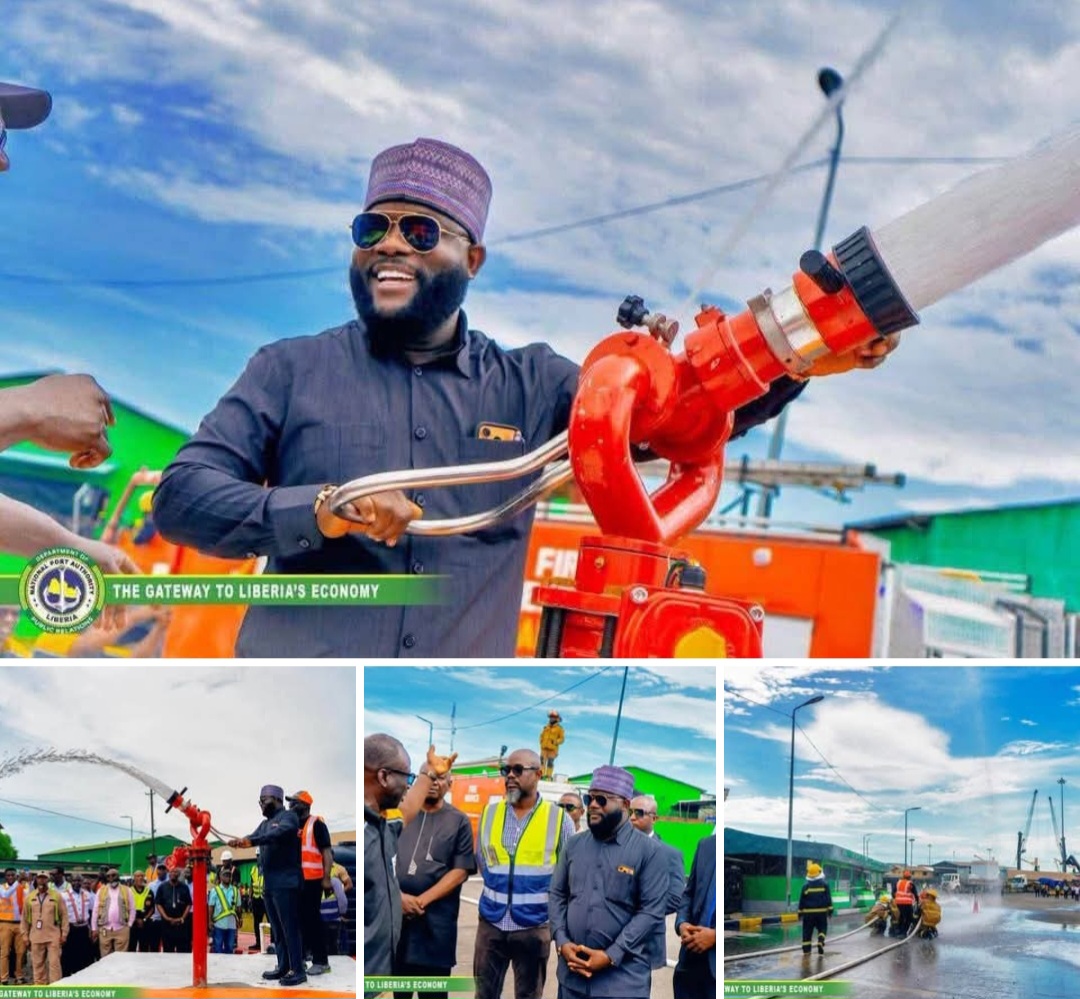
In a significant move to strengthen operational safety and emergency preparedness at Liberia’s busiest maritime gateway, the National Port Authority (NPA), in partnership with HSE Solution Incorporated, has commissioned the first-ever fire hydrant system at the Freeport of Monrovia.
The landmark initiative, which includes the installation of seven strategically positioned fire hydrants and a live emergency fire drill, marks a major advancement in the country’s port safety infrastructure and aligns with global maritime safety standards.
The Freeport of Monrovia handles more than 80 percent of Liberia’s international trade, serving as the backbone of the country’s import and export economy.
According to port statistics, Liberia’s maritime sector contributes significantly to government revenue and facilitates the movement of thousands of metric tons of cargo annually, including petroleum products, food commodities, construction materials, and industrial equipment.
Officials say the new hydrant network is expected to drastically reduce fire response times within the port, minimizing risks to human life, cargo, and strategic infrastructure.
Speaking during the dedication ceremony, NPA Managing Director Sekou Hussein Dukuly described the project as a major milestone in the institution’s ongoing modernization efforts.
“This is a critical achievement for the NPA and a major boost to our emergency response capacity.
The installation of these seven fire hydrants places us in a stronger position to respond rapidly to fire outbreaks and ensure the safety of workers, port users, and cargo operations,” Dukuly said.
The initiative forms part of the NPA’s ambitious RESET Strategic Plan (2025–2030), a reform framework focused on Rebuilding, Efficiency, Safety, Expansion, and Transformation of Liberia’s port infrastructure.
The strategy seeks to modernize port operations, improve security systems, and position Liberia as a competitive maritime hub in West Africa.
Historically, fire safety infrastructure at the Freeport of Monrovia has remained limited despite the port’s establishment in 1948 and its central role in Liberia’s economy.
Industry analysts have long warned that inadequate fire response systems at ports increase the risk of catastrophic losses, especially in handling combustible cargo and fuel shipments.
The International Maritime Organization (IMO) estimates that port-related fires account for nearly 20 percent of global maritime operational disruptions annually, costing the global shipping industry billions of dollars in damages and insurance claims.
For his part, HSE Solution Chief Executive Officer Erickson Brown emphasized that the live fire exercise was designed to test preparedness and strengthen coordination among emergency responders.
“The simulation exercise is meant to sharpen our emergency teams’ readiness and ensure swift action during fire incidents.
Protecting Liberia’s main trade gateway is essential for sustaining economic stability and investor confidence,” Brown stated.
The fire safety upgrade comes at a time when Liberia is intensifying efforts to improve infrastructure resilience and compliance with international port safety regulations, amid increasing cargo traffic and growing regional trade demands.
Experts say the installation of the hydrants could serve as a model for similar upgrades at other ports across Liberia, including the Ports of Buchanan, Greenville, and Harper.
With this development, the Freeport of Monrovia takes a critical step toward becoming a safer, more efficient, and globally competitive maritime hub in the Mano River region.
