
By: Julius Konton
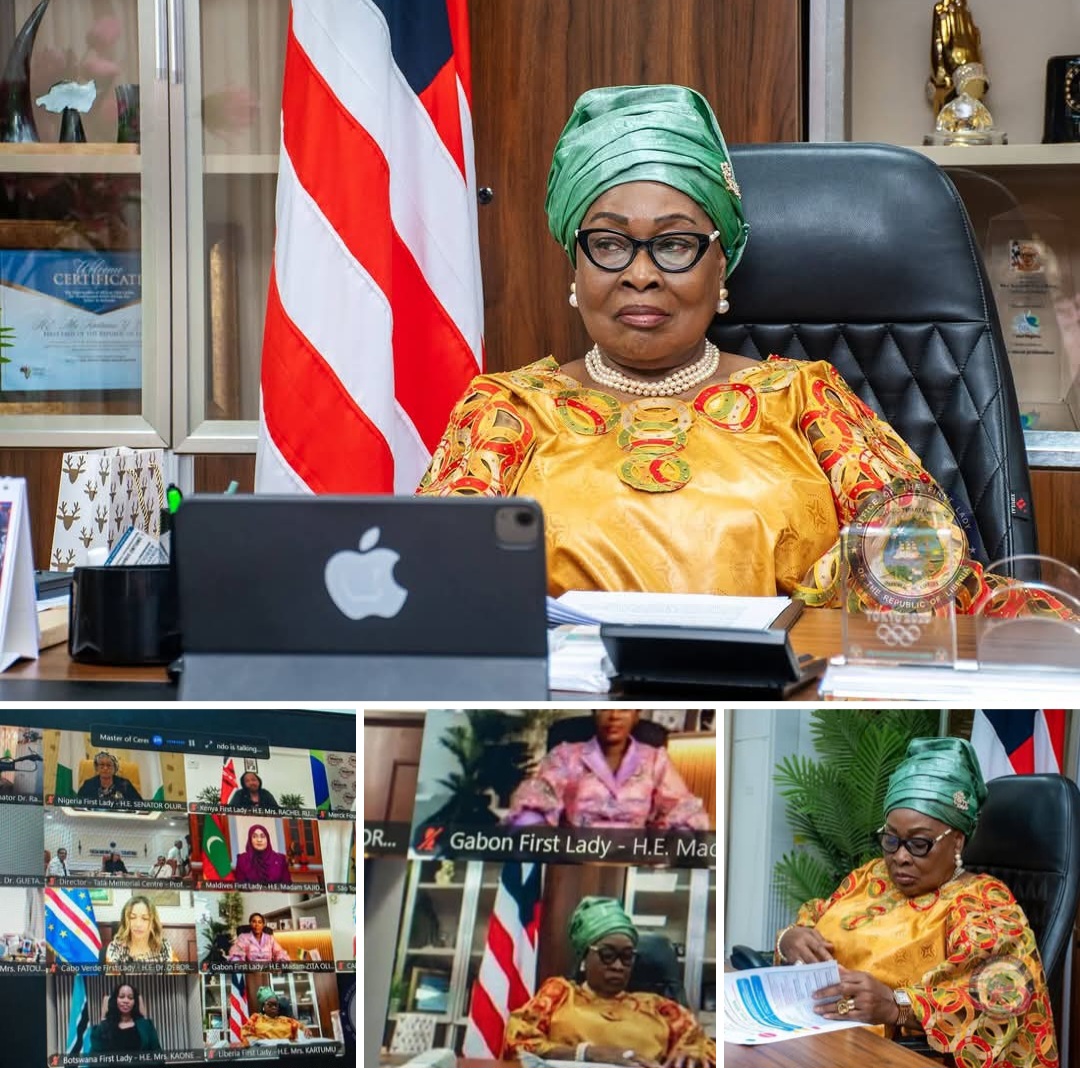
Liberia’s First Lady, Kartumu Boakai has delivered a compelling and deeply reflective address at the 13th Edition of the Merck Foundation Africa-Asia Luminary Summit, urging global leaders to prioritize compassion, peace, and healthcare over conflict and political divisions.
Speaking virtually at the annual summit of the First Ladies Initiative (MFFLI), Mrs. Boakai used her platform not only to advocate for stronger healthcare systems and women’s empowerment but also to issue a broader moral challenge to world leaders amid rising global instability.
Her speech came against the backdrop of growing geopolitical tensions and health emergencies that forced the summit’s relocation twice , first from Dubai due to regional conflict, and later from India over disease outbreak concerns.
“There are moments in history when the world gathers beyond speeches to search its conscience. This is one of those moments,” she declared.
In one of the most emotionally charged parts of her address, the First Lady recounted her personal experience in Dubai earlier this year during escalating hostilities in the Middle East.
“I was no longer thinking as a First Lady. I was thinking as a mother,” she said. “Every bomb falls on somebody’s child.”
Her remarks reflect broader global realities.
According to statistics , more than 120 million people worldwide were forcibly displaced by conflict by the end of 2025, the highest figure in recorded history.
Simultaneously, the World Health Organization estimates that nearly 4.5 billion people over half the world’s population still lack access to essential healthcare services.
Mrs. Boakai argued that these crises reveal a dangerous imbalance in global priorities.
“While nations invest trillions in war, mothers still carry babies across villages and deserts searching for medicine, dignity, and hope,” she said.
Liberia’s Growing Healthcare Transformation
Turning to Liberia’s partnership with the Merck Foundation, Mrs. Boakai highlighted what she described as “historic progress” in strengthening the country’s fragile healthcare system.
Liberia, a nation of approximately 5.5 million people, continues to rebuild its healthcare infrastructure after years of civil war (1989–2003) and the devastating Ebola epidemic of 2014–2016, which killed over 4,800 Liberians and exposed severe weaknesses in the national health system.
Through its collaboration with Merck Foundation, Liberia has so far secured 58 scholarships for young health professionals in highly specialized and underserved fields, including:
Fertility and Embryology
Oncology
Diabetes Care
Women’s Health
Pediatrics
Infectious Diseases
Dermatology
Endocrinology
“These are not just numbers,” Mrs. Boakai emphasized. “These are firsts.
History is literally walking through our hospitals.”
The country, which has historically suffered from one of the world’s lowest doctor-to-patient ratios estimated at fewer than 0.4 doctors per 10,000 people has increasingly relied on international partnerships to build local expertise.
Breaking the Silence on Infertility
As Ambassador of Merck Foundation’s “More Than a Mother” campaign, Mrs. Boakai placed particular emphasis on reproductive health and infertility stigma, a major social challenge across Africa.
Out of the 58 scholarships, 28 have been dedicated specifically to fertility, embryology, and reproductive care, a move she described as transformative in a region where infertility often leads to discrimination, abandonment, and emotional trauma for women.
“A woman’s worth must never be measured by her womb, but by her humanity,” she declared.
According to health experts, infertility affects nearly 17.5% of the global adult population, with cultural stigma disproportionately affecting women in African societies.
Investing in Liberia’s Girls
Mrs. Boakai also spotlighted Liberia’s participation in the Merck Foundation’s Educating Linda Program, which currently supports 40 high-performing but underprivileged girls through annual scholarships, mentorship, leadership development, and academic support.
Education statistics remain troubling across Liberia.
UNESCO estimates that nearly 32% of girls in sub-Saharan Africa drop out before completing lower secondary education, often due to poverty, early marriage, and teenage pregnancy.
“When you educate a girl, you alter the destiny of a nation,” the First Lady said.
A Call for African First Ladies to Lead Beyond Ceremony
In one of the most politically resonant moments of her speech, Mrs. Boakai challenged Africa’s First Ladies to move beyond ceremonial roles and become moral influencers within state leadership.
“As First Ladies, we sit beside Presidents and Heads of State. Perhaps this is the season for us to speak wisdom into leadership itself.”
Her message struck at the heart of the summit’s broader agenda using soft power, advocacy, and strategic partnerships to confront social injustice, health inequalities, and gender disparities.
The Merck Foundation, celebrating its 9th anniversary and 14 years of development programs across Africa and Asia, has provided more than 2,280 scholarships in 52 countries, according to the organization.
Mrs. Boakai concluded with a call for a “covenant of conscience,” urging leaders to invest more in healing than destruction.
“The future of humanity will not be decided by those who build the biggest armies,” she said. “It will be decided by those who build the strongest systems of compassion.”
Her remarks have since drawn strong attention across diplomatic and development circles, reinforcing Liberia’s growing voice in global health diplomacy and women-centered advocacy.
As the summit ended, one message stood above all: while the world prepares for war, Africa’s women, led by voices like Liberia’s First Lady, are preparing for healing.
