
By: Julius Konton
Liberia’s Minister of Finance and Development Planning, Augustine Kpehe Ngafuan, has paid glowing tribute to the United Nations Country Team (UNCT) for its steadfast support to Liberia during one of the most uncertain periods in the country’s recent history, while calling for a new era of stronger partnerships, greater accountability, and measurable development outcomes.
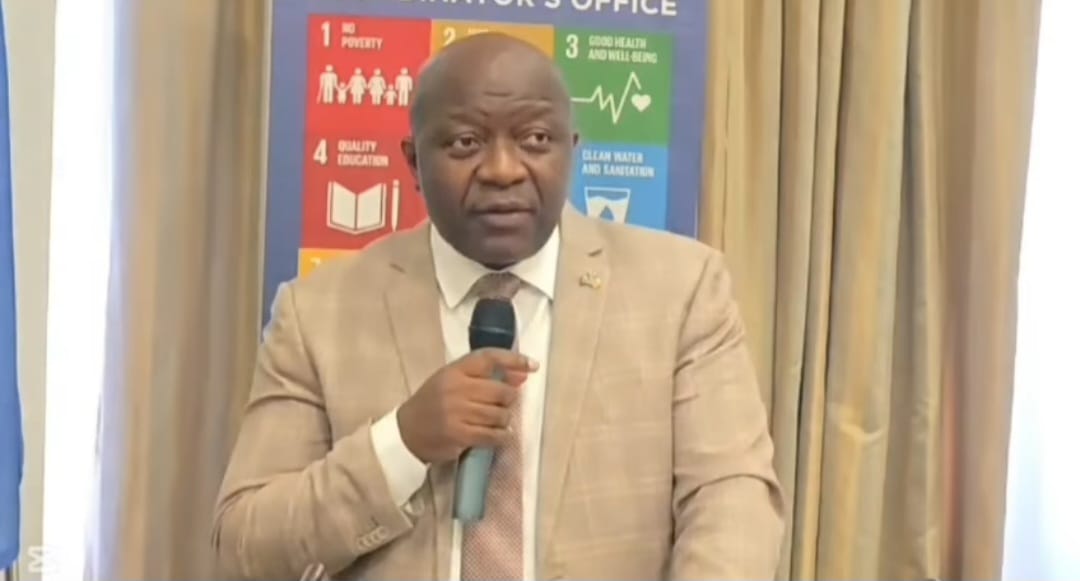
Delivering the keynote address at the opening of the 10th Annual United Nations Country Team Retreat 2026, held under the theme, “Catalyzing Impact & Collective Action in a New Development Reality Through the UN Cooperation Framework 2026–2030,” the Finance Minister praised the UN for convening what he described as a timely gathering focused on addressing the defining development challenges confronting Liberia, Africa and the wider international community.
Ngafuan commended the United Nations for its unwavering solidarity following the sudden reduction of assistance from the United States Agency for International Development (USAID), which occurred only weeks after the Liberian Government launched its ARREST Agenda for Inclusive Development (AAID), the country’s five-year national development blueprint covering 2025–2029.
He said the unexpected shift in international assistance created significant uncertainty for Liberia at a critical moment.
“The support, solidarity and continued commitment of the United Nations family were instrumental in helping Liberia weather that difficult period.
For this enduring partnership, Liberia remains deeply grateful,” the Minister declared.
He further acknowledged the UN’s technical and financial assistance toward Liberia’s Voluntary National Review (VNR), which was recently presented during the United Nations High-Level Political Forum on Sustainable Development in New York.
The review evaluates the country’s progress toward achieving the 2030 Sustainable Development Goals (SDGs).
Reflecting on the changing international development landscape, Ngafuan observed that traditional aid models are increasingly giving way to new approaches centered on trade, investment, innovation and private-sector partnerships.
While describing these changes as opportunities, he cautioned that they should never undermine the core global commitment to “Leaving No One Behind,” the central promise of the Sustainable Development Goals.
“We must reject narrow individualism within the international family,” he said.
He emphasized that at a time when geopolitical tensions are reshaping development priorities and vulnerable countries face growing uncertainty, the international community has a moral obligation to continue protecting the poor, empowering women and youth, supporting marginalized communities, and ensuring that development remains firmly people-centered.
“The Sustainable Development Goals are more than development targets, they represent a moral commitment to human dignity, equity and shared prosperity,” he stressed.
Presenting an overview of Liberia’s recent economic performance, the Finance Minister said the country continues to demonstrate remarkable resilience despite persistent global economic headwinds.
According to him, prudent fiscal management, strengthened domestic revenue mobilization and ongoing public financial management reforms have contributed to sustained macroeconomic recovery.
He disclosed that:
Real GDP growth increased from approximately 4 percent in 2024 to about 5.5 percent in 2026, moving Liberia closer to its 2029 target of 6 percent annual growth.
Nominal Gross Domestic Product expanded from roughly US$4.8 billion to US$5.64 billion, bringing the country closer to its medium-term target of US$6.5 billion.
GDP per capita increased from US$861 to US$964, reflecting gradual improvements in income levels and economic opportunities for Liberians.
Domestic revenue collection has recorded significant growth through strengthened tax administration, fiscal reforms and improved public financial management.
International financial institutions, including the International Monetary Fund (IMF) and the World Bank, have also projected continued growth for Liberia while encouraging sustained fiscal discipline and structural reforms.
“These achievements demonstrate that Liberia is doing its part.
We are strengthening institutions, improving governance, expanding domestic resource mobilization and creating an enabling environment for investment and private-sector growth,” Ngafuan stated.
The Finance Minister challenged longstanding international perceptions of Africa, insisting that the continent should no longer be viewed primarily through the lens of humanitarian need.
Instead, he described Africa as one of the world’s greatest investment frontiers.
“Our continent is rich in natural resources, blessed with one of the world’s youngest populations, and filled with innovation and opportunity.
Those who invest in Africa today are investing in one of the greatest engines of future global growth,” he said.
He emphasized that partnering with Africa should be regarded not as charity but as a strategic investment in shared global prosperity.
A major highlight of Ngafuan’s address was his call for stronger coordination between Liberia and its international development partners under the implementation of the ARREST Agenda.
He urged donors and development agencies to clearly disclose the total value of financial commitments they intend to provide throughout the implementation period of the national development plan.
The Minister also requested that partners specify:
The ARREST Agenda pillar being supported;
The counties and sectors targeted;
Specific projects and programs to be financed;
Expected implementation timelines; and
Anticipated development outcomes.
According to him, such transparency would enable government to coordinate investments more effectively, eliminate duplication, identify financing gaps and maximize the impact of every development dollar invested in Liberia.
Ngafuan further called on all development partners implementing projects under the ARREST Agenda to provide periodic progress reports detailing achievements, implementation challenges, lessons learned and measurable development outcomes.
He said the reports would strengthen Liberia’s mutual accountability framework, improve evidence-based policymaking and assure citizens that development commitments are producing tangible improvements in their daily lives.
“Development should never be measured by the amount of money committed, but by the number of lives transformed,” he emphasized.
Concluding his address, the Finance Minister challenged both government institutions and development partners to move beyond dialogue and embrace implementation driven by trust, transparency, accountability and measurable impact.
He warned that history would not judge governments and development institutions by the number of meetings held or strategies endorsed, but by whether they reduced poverty, expanded opportunities and improved the quality of life for ordinary citizens.
“This is our moment to demonstrate that even amid unprecedented global uncertainty, genuine partnership can still transform nations.
Let us move beyond coordination to true collaboration, beyond commitment to implementation, and beyond ambition to lasting impact.
The people of Liberia deserve nothing less,” Ngafuan concluded.
The United Nations Country Team Annual Retreat serves as the UN’s principal strategic planning forum in Liberia, bringing together UN agencies, government officials and development partners to align priorities under the United Nations Sustainable Development Cooperation Framework 2026–2030.
The framework is designed to support Liberia’s ARREST Agenda for Inclusive Development (2025–2029) while advancing the United Nations 2030 Sustainable Development Goals, focusing on inclusive economic growth, human capital development, climate resilience, governance reforms and social protection.
Liberia, a nation of approximately 5.7 million people, continues to work with international partners to strengthen macroeconomic stability, attract investment, expand domestic resource mobilization and accelerate progress toward sustainable and inclusive development.
