
By: Julius Konton
Morocco and Guinea have agreed to deepen their strategic partnership, signing 25 cooperation agreements covering key sectors of their economies as the two West African and North African partners seek to accelerate trade, investment and sustainable development.
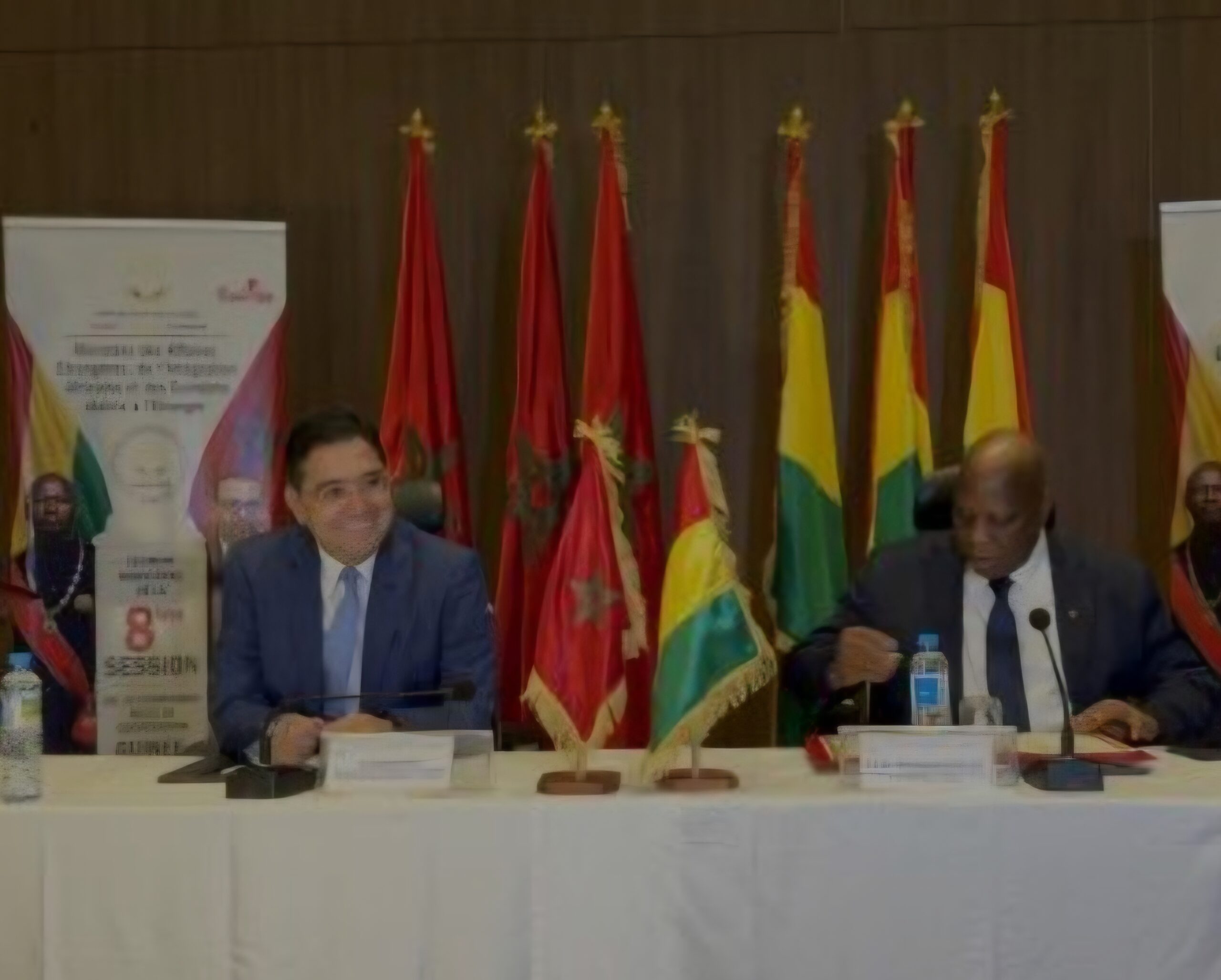
The agreements were concluded in Conakry during the eighth session of the Morocco-Guinea Joint Cooperation Commission, co-chaired by Morocco’s Minister of Foreign Affairs, African Cooperation and Moroccan Expatriates, Nasser Bourita, and Guinea’s Minister of Foreign Affairs, African Integration and Guineans Living Abroad, Dr. Morissanda Kouyaté.
The meeting represents a renewed effort by both governments to translate longstanding diplomatic ties into expanded economic cooperation, particularly at a time when Guinea is preparing for a major transformation of its mining, infrastructure and industrial sectors.
The two ministers said the relationship should evolve into an exemplary model of South-South cooperation, anchored in mutual economic interests, shared prosperity and sustainable development.
25 agreements broaden cooperation
The new agreements significantly expand the legal and institutional framework governing bilateral relations.
According to Morocco’s Foreign Ministry, the agreements cover economy and finance, air transport, customs, agriculture, energy, tourism, justice, healthcare, meteorology and climatology, ports, housing and urban planning, sports, culture, handicrafts, higher education, scientific research and innovation, academic scholarships and vocational training.
The breadth of the agreements reflects an attempt by Rabat and Conakry to move beyond traditional diplomatic cooperation toward practical partnerships capable of generating investment, employment, skills development and infrastructure.
Bourita said Morocco is prepared to share its development experience with Guinea in line with the vision of King Mohammed VI, including supporting priority projects identified by the Guinean government.
A major focus of the discussions was Guinea’s “Simandou 2040” development program, which seeks to use the country’s mineral wealth and related infrastructure investments as a catalyst for broader economic transformation.
The Simandou iron-ore deposits in southeastern Guinea are among the world’s most significant untapped or developing high-grade iron-ore resources.
The project has consequently attracted major international investment and is expected to reshape Guinea’s transportation, mining, industrial and export infrastructure.
Morocco has expressed readiness to contribute expertise and cooperation in sectors linked to Guinea’s development priorities, including strategic infrastructure, security, fisheries, healthcare, industrial and agricultural processing, food security, water management, energy and skills development.
The partnership could therefore extend beyond the extraction of natural resources to areas such as agro-processing, logistics, human-capital development and industrialization.
Morocco and Guinea have maintained longstanding political and diplomatic relations rooted in decades of African solidarity and cooperation.
Rabat has increasingly emphasized economic engagement with African countries as part of its broader South-South cooperation strategy, while Guinea has sought international partnerships to diversify its economy and strengthen infrastructure.
The two governments highlighted the “centuries-old” bonds of friendship and solidarity between their peoples, as well as the relationship between King Mohammed VI and Guinea’s President Mamadi Doumbouya.
The latest agreements build on that political relationship by creating mechanisms for greater institutional cooperation and private-sector engagement.
Agriculture, energy and food security
Agriculture and food security are expected to remain particularly important areas of cooperation.
Guinea possesses substantial agricultural potential but continues to face infrastructure, processing and logistics constraints that limit the value generated from its agricultural production.
Morocco, meanwhile, has developed significant expertise in agricultural modernization, irrigation, water management, fertilizer production, agribusiness and agricultural value chains.
Cooperation in these areas could help Guinea increase domestic food production while developing processing industries capable of supplying both domestic and regional markets.
Energy and water management are similarly strategic. Expanding reliable electricity supplies and improving access to water are critical to industrial development, particularly as Guinea seeks to build infrastructure around its mining sector and population centers.
The inclusion of ports, customs and air transport in the agreements is also significant.
Guinea’s mineral exports require efficient transportation networks connecting inland production areas to ports on the Atlantic coast.
Improvements in port infrastructure, customs procedures and transport connectivity could reduce logistical bottlenecks and strengthen Guinea’s position as a regional trading hub.
For Morocco, deeper economic links with Guinea could further strengthen its commercial presence in West Africa and create opportunities for Moroccan companies operating in infrastructure, finance, construction, telecommunications, agriculture, banking, logistics and other sectors.
The agreements also place considerable emphasis on higher education, scientific research, innovation, vocational training and scholarships.
Both governments recognize that infrastructure and natural resources alone cannot guarantee long-term economic transformation.
Training engineers, technicians, health professionals, agricultural specialists and other skilled workers will be crucial if Guinea is to capture a larger share of the economic value generated by its mineral and infrastructure investments.
Moroccan institutions have for years hosted students from across Africa, while Morocco has increasingly positioned education and professional training as important components of its African cooperation policy.
The Morocco-Guinea partnership comes as African countries increasingly seek to expand intra-African trade and reduce dependence on the export of unprocessed commodities.
The African Continental Free Trade Area (AfCFTA) aims to create a single African market covering more than 1.4 billion people, with the long-term objective of increasing intra-African trade and encouraging investment and industrialization.
Within that broader framework, cooperation between Morocco and Guinea could provide opportunities for companies from both countries to participate in regional value chains.
Guinea’s mineral resources, agricultural potential and Atlantic access, combined with Morocco’s industrial, financial, agricultural and infrastructure capabilities, provide a potentially complementary economic partnership.
The two ministers emphasized that signing the agreements is only the beginning.
They committed to ensuring effective follow-up and implementation of the new legal framework, an issue that is often critical in translating bilateral agreements into measurable economic results.
For Guinea, the immediate challenge will be turning international partnerships into infrastructure, jobs, industrial capacity and improved public services.
For Morocco, the partnership offers an opportunity to deepen its role as a bridge between North and West Africa while expanding economic cooperation under its South-South development strategy.
The eighth session of the Joint Cooperation Commission therefore marks an important step in the evolution of Morocco-Guinea relations from longstanding political friendship toward a broader partnership focused on investment, industrialization, infrastructure, human capital and sustainable development.
With 25 agreements now providing a strengthened framework for cooperation, Rabat and Conakry will face the more consequential task of ensuring that the commitments translate into projects and economic opportunities capable of delivering tangible benefits to citizens in both countries.
