
By : Julius Konton
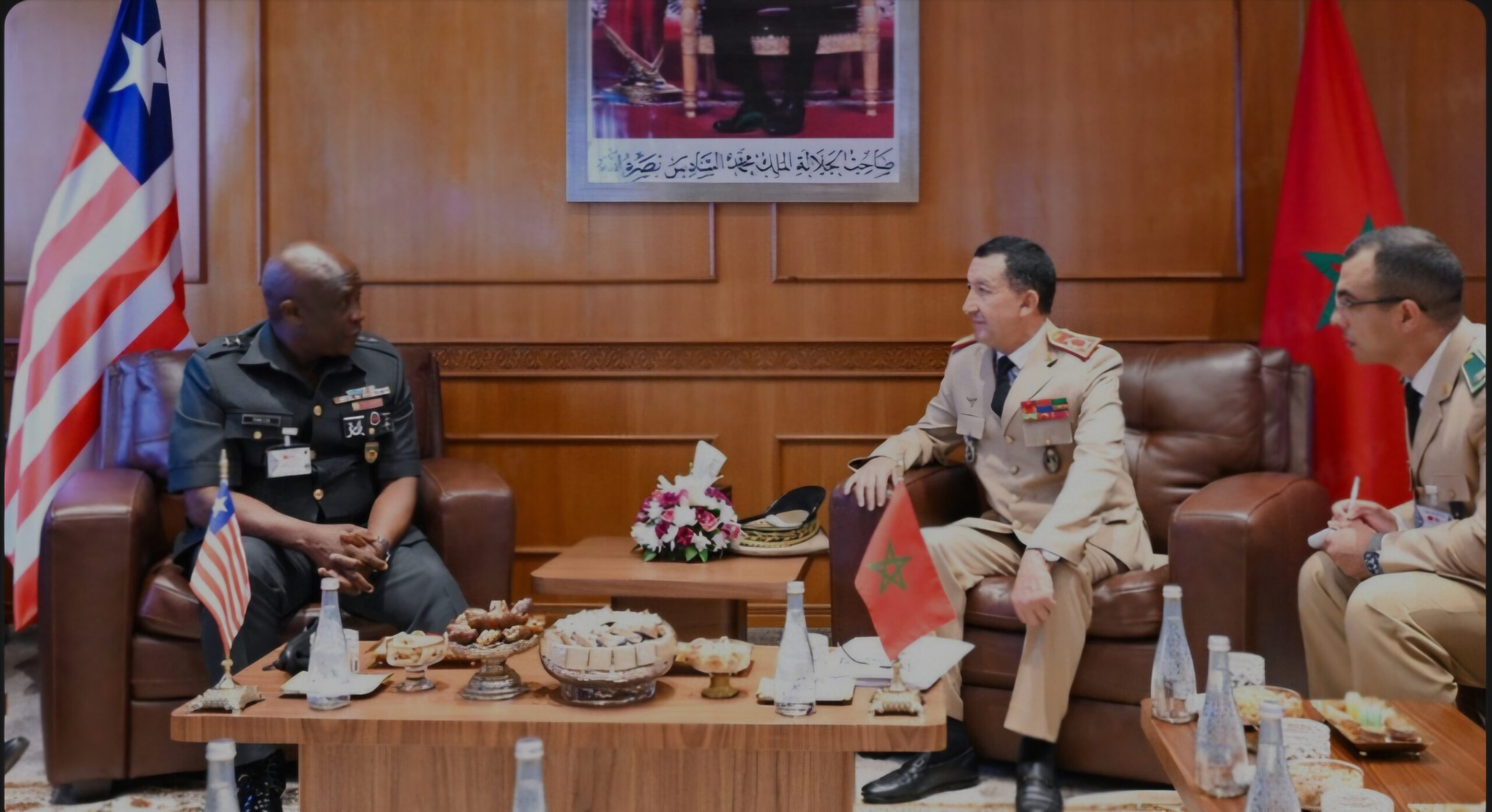
Morocco and Liberia are moving to deepen military cooperation, with senior defense officials discussing expanded collaboration in military training, joint exercises and exchanges of personnel during high-level talks in Rabat.
The discussions were held at the headquarters of the General Staff of the Royal Moroccan Armed Forces, where Morocco’s Inspector General of the Armed Forces and Commander of the Southern Zone, General Mohammed Berrid, met Liberia’s Chief of Staff of the Armed Forces, Major General Davidson Fayiah Forleh.
According to Morocco’s state news agency MAP, the talks focused on implementing and expanding military cooperation between the two countries under a defense agreement signed on October 21, 2025.
The meeting represents another step in efforts by Rabat and Monrovia to translate their growing diplomatic relationship into practical defense and military cooperation, particularly in professional training, operational preparedness and institutional exchanges.
Liberia’s Ambassador to Morocco attended the meeting, underscoring the diplomatic importance attached to the evolving security partnership.
Major General Forleh is in Morocco for an official visit.
His visit provides an opportunity for Liberia’s military leadership to engage directly with Morocco’s senior defense establishment on areas that could strengthen the capabilities and professionalism of the Armed Forces of Liberia.
The 2025 military cooperation agreement provides the framework for the latest discussions. While details of specific programs were not publicly disclosed, the two sides identified training, military exercises and exchange visits as key areas for further cooperation.
Such arrangements can provide opportunities for military personnel to participate in specialized courses, leadership development, tactical exercises, professional exchanges and institutional capacity-building.
The talks were held under the instructions of King Mohammed VI, Morocco’s Supreme Commander and Chief of the General Staff of the Royal Armed Forces, highlighting the strategic importance Morocco attaches to its defense engagement with Liberia.
Morocco has increasingly positioned itself as an important military and security partner within Africa, combining bilateral defense relationships with participation in multinational security and training initiatives.
The Royal Moroccan Armed Forces have developed extensive experience in multinational military exercises, including African Lion, a major annual multinational exercise involving African, U.S. and other international military personnel.
African Lion has grown into one of the continent’s largest multinational military exercises, involving thousands of troops and focusing on areas including interoperability, humanitarian assistance, command-and-control, peacekeeping and crisis response.
For Liberia, deeper military cooperation with Morocco could complement its broader efforts to strengthen professional military capacity following years of institutional rebuilding after the country’s civil wars.
The Armed Forces of Liberia have undergone significant transformation since the end of Liberia’s civil wars in 2003.
The country’s military was restructured in the postwar period, with international partners playing a major role in rebuilding the institution.
The United States, through its security cooperation programs, has been particularly influential in the professionalization and restructuring of the Liberian military.
The AFL was formally reconstituted in 2006, following a comprehensive reform process that included recruitment, training, vetting and the establishment of a new professional military structure.
Today, Liberia maintains a relatively small armed force compared with many countries in the region, reflecting the country’s post-conflict security priorities and emphasis on a professional, civilian-controlled military.
Liberian troops have also gained international experience through participation in United Nations peacekeeping operations, providing personnel with exposure to multinational command structures and complex security environments.
The proposed expansion of training cooperation could be particularly significant for Liberia as the AFL continues developing specialized capabilities.
Military exchanges can strengthen areas such as leadership, logistics, engineering, communications, medical support, intelligence, peacekeeping operations and disaster response.
Joint exercises, meanwhile, allow armed forces from different countries to test their ability to operate together, coordinate command structures and respond to simulated security or humanitarian emergencies.
For Liberia, whose security institutions continue to emphasize professional development and regional cooperation, access to Morocco’s military training expertise could provide an additional avenue for capacity-building.
The discussions also come at a time of major changes in Africa’s security environment.
West Africa and the broader Sahel region continue to face threats from violent extremist groups, organized crime, trafficking networks, maritime insecurity and political instability.
Countries along the Gulf of Guinea have consequently placed increasing emphasis on intelligence-sharing, border security, maritime surveillance and stronger regional military cooperation.
Although Liberia has not experienced the level of militant violence seen in parts of the Sahel, the country’s location along the Atlantic coast makes maritime security, border management and regional intelligence cooperation important components of its national security strategy.
Liberia is also a member of the Economic Community of West African States (ECOWAS), which has historically played a central role in regional peace and security.
The Morocco-Liberia military relationship also forms part of a broader diplomatic and economic engagement between the two countries.
Morocco has expanded its political, commercial and development partnerships across Africa since returning to the African Union in 2017 after a 33-year absence.
Liberia, meanwhile, has sought to strengthen international partnerships as it pursues economic development, institutional reform and improvements in national security.
The military cooperation agreement signed in October 2025 therefore provides a platform for the two governments to expand their relationship beyond traditional diplomatic ties.
For Monrovia, the immediate priority will likely be ensuring that any new training and exercise programs translate into measurable improvements in military professionalism, operational readiness and institutional capacity.
For Rabat, deeper cooperation with Liberia offers another opportunity to strengthen Morocco’s longstanding engagement with West Africa and contribute to broader African security partnerships.
Tuesday’s meeting in Rabat suggests that the October 2025 agreement is now entering a more operational phase, with both countries looking to turn diplomatic commitments into practical military cooperation.
As Major General Forleh’s visit continues through September 13, further discussions are expected to determine how training programs, exercises and military exchanges between the two countries could be structured and implemented.
