
By: Julius Konton
Liberia has launched a pioneering school-based intervention aimed at combating substance abuse among young people, marking what education and development advocates describe as a significant shift toward prevention-focused policies in schools.
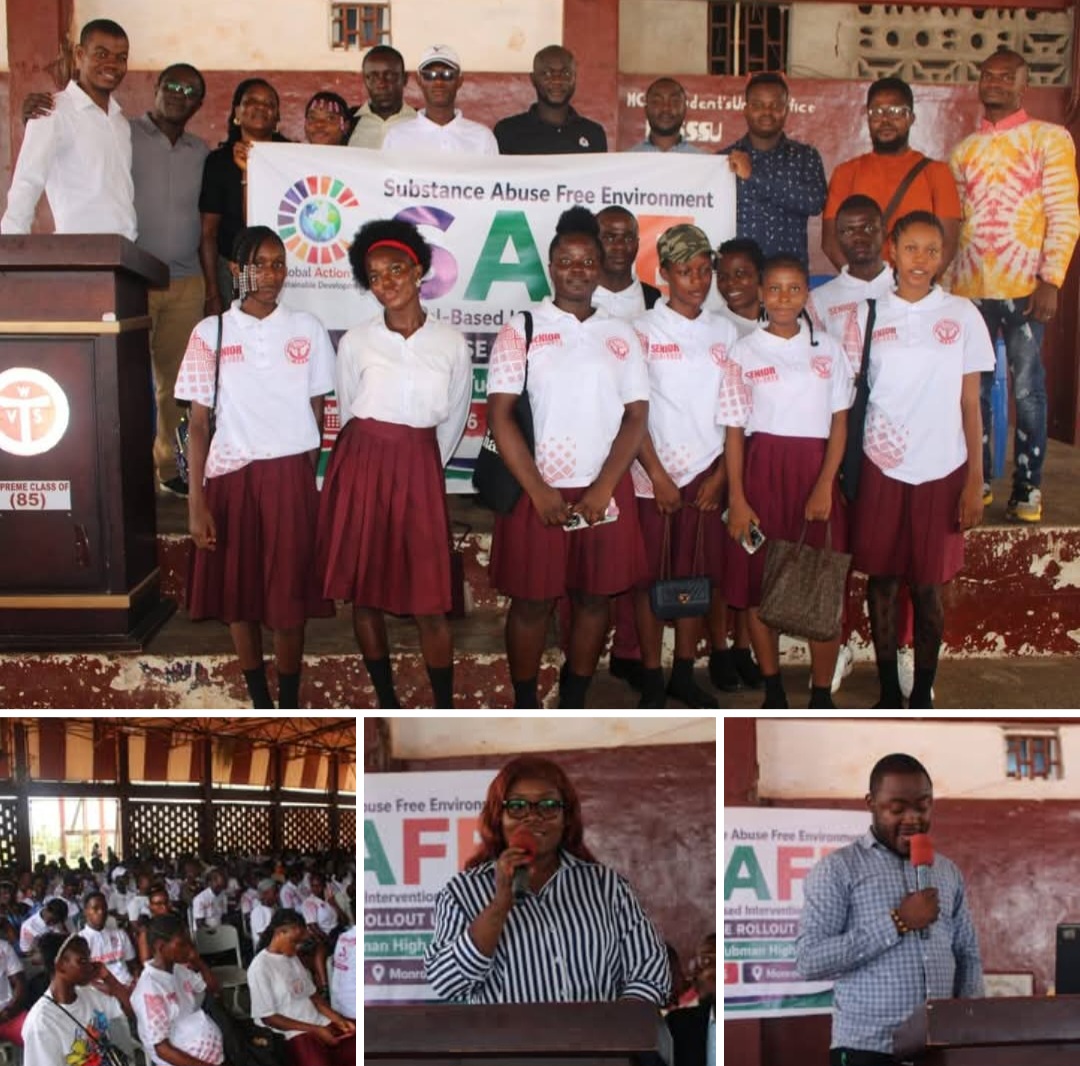
The initiative, known as the Substance Abuse Free Environment (SAFE) School-Based Intervention Program, was officially rolled out at William V.S. Tubman High School in Monrovia during a ceremony attended by representatives of the Ministry of Education, school administrators, student leaders, civil society organizations, educators, development partners, and members of the media.
The program, spearheaded by the Global Action for Sustainable Development (GASD), seeks to address substance abuse among school-aged youth through evidence-based prevention strategies, institutional reforms, and targeted student interventions.
Speaking during the launch on behalf of GASD Executive Director James Koryor, organizers described the initiative as more than a ceremonial undertaking, framing it instead as a national response to a growing social challenge threatening Liberia’s educational system and youth development prospects.
“Substance abuse among young people is not an isolated challenge affecting only schools or families.
It is a national concern that requires a united, coordinated, and sustained response,” representatives emphasized during remarks at the event.
A Growing Concern Across Africa and Beyond
Substance abuse among adolescents has emerged as a growing public health challenge across many parts of the world.
According to estimates from the United Nations Office on Drugs and Crime and the World Health Organization, millions of young people globally are exposed to alcohol, narcotics, prescription misuse, and synthetic drugs, often resulting in increased school dropout rates, mental health risks, violence, and reduced productivity.
Across sub-Saharan Africa, education and health experts have increasingly warned of rising youth vulnerability to illicit substances due to unemployment, poverty, peer pressure, weak institutional support systems, trauma, and social instability.
Liberia, which continues rebuilding social institutions after years of civil conflict and the socio-economic disruptions caused by epidemics and economic shocks, faces mounting pressure to strengthen youth protection mechanisms.
Although Liberia lacks extensive nationwide school-level statistics on adolescent substance abuse, educators and community organizations have repeatedly reported increasing concerns about drug exposure among students, particularly in urban communities.
A First-of-Its-Kind School Prevention Strategy
Organizers described the SAFE initiative as Liberia’s first comprehensive school intervention model aligned with international prevention standards under the Universal Prevention Curriculum, an internationally recognized framework for substance use prevention education.
Unlike conventional awareness campaigns, the SAFE model emphasizes research, data collection, and customized interventions tailored to the realities of individual schools.
“The program recognizes that no two school environments face identical risks,” organizers explained, stressing that prevention cannot succeed through a one-size-fits-all approach.
Under the pilot framework, interventions will target three categories of student populations:
Universal prevention services and awareness for all students;
Selected interventions targeted support for vulnerable groups at elevated risk;
Indicated interventions specialized assistance for students already displaying early warning signs.
The program is structured around three key pillars:
Strengthening school policies and accountability systems;
Improving school climate and student safety;
Delivering evidence-based prevention education and life-skills training.
Students participating in the initiative will receive training in emotional resilience, decision-making, interpersonal communication, peer-pressure resistance, and healthy coping strategies designed to reduce vulnerability to substance use.
Education specialists note that prevention programs emphasizing social and emotional learning can significantly improve behavioral outcomes while reducing future social costs associated with addiction, violence, and academic underperformance.
Students at the Center of the Response
Addressing students directly during the launch, organizers emphasized that young people are not merely beneficiaries but active stakeholders in shaping safer learning environments.
“You are not only beneficiaries of this initiative, but partners in this movement,” representatives said, encouraging students to become ambassadors for drug-free lifestyles and peer leadership.
School administrators and educators were similarly urged to deepen mentorship and psychosocial support for students, recognizing schools not only as academic institutions but as spaces where character, discipline, confidence, and civic responsibility are formed.
Toward a National Expansion
The pilot phase at Tubman High School is expected to serve as a model for broader implementation nationwide.
GASD announced plans to begin strategic consultations with the Ministry of Education, the Monrovia Consolidated School System, and the Liberian National Students Union to establish a comprehensive partnership framework for expanding the SAFE initiative to schools across Liberia.
Advocates say such preventative investments may ultimately prove less costly than addressing long-term consequences of addiction, crime, school dropout, and deteriorating public health outcomes.
For Liberia, a country where nearly two-thirds of the population is under the age of 25 , the stakes are especially high.
Supporters of the initiative argue that protecting young people from substance abuse is not simply an education issue but an economic and national development imperative.
As the ceremony concluded, stakeholders renewed calls for sustained collaboration, arguing that lasting progress will depend on government institutions, schools, families, civil society, and students working together to create safer, healthier, and more resilient communities.
“Together, we can build a future where every young person can grow, learn, and succeed in a safe, substance-free environment,” organizers declared..
