
By: Julius Konton
Liberian President Joseph Nyuma Boakai Sr. has challenged Liberians living abroad to move beyond conferences and expressions of patriotism toward measurable contributions to national development, calling for a new partnership centered on investment, skills transfer, institution-building and accountability.
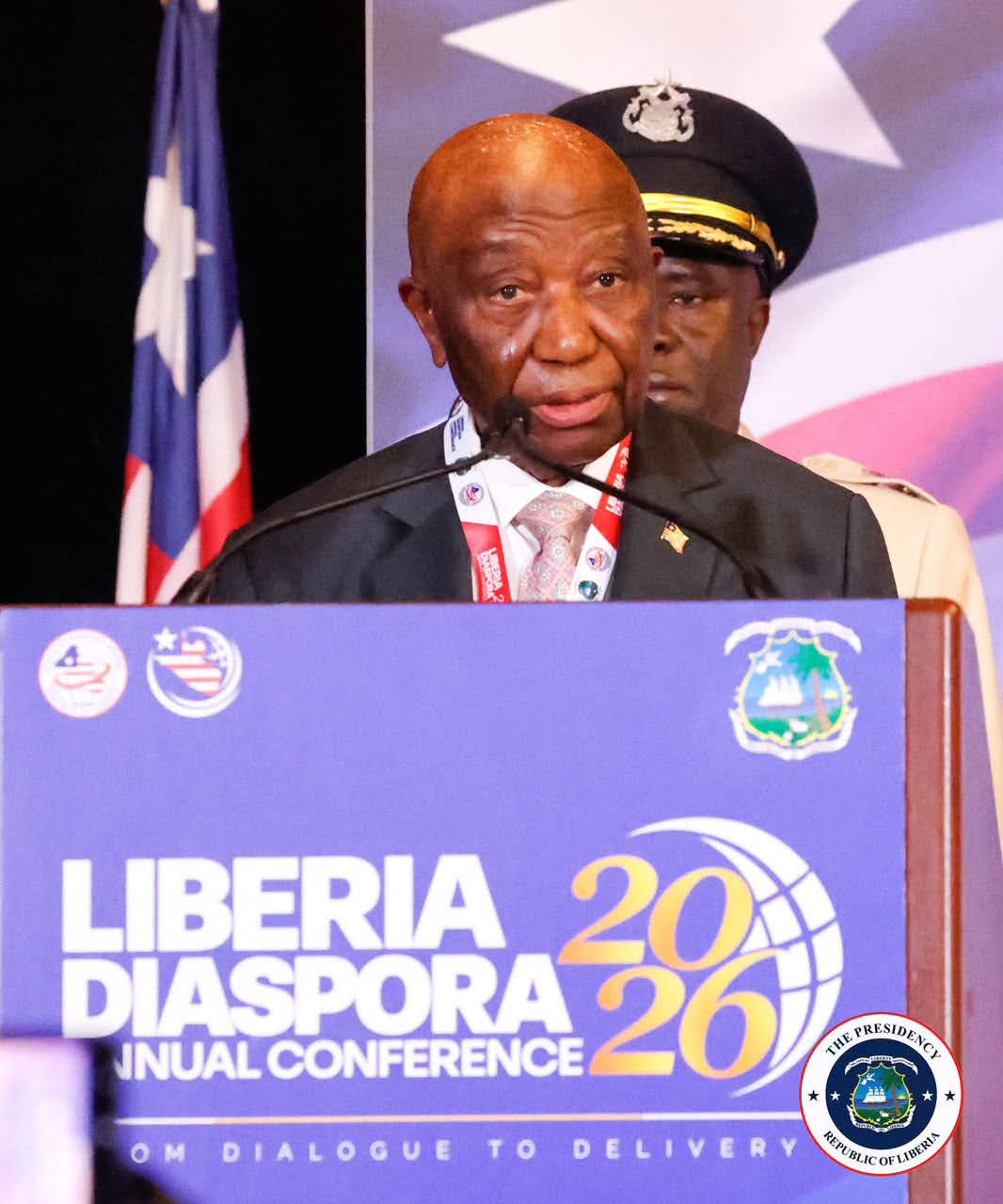
Addressing the 2nd Annual Diaspora Conference in Alexandria, Virginia, under the theme “From Dialogue to Delivery: Mobilizing the Global Liberian Diaspora for National Transformation,” President Boakai said his administration wants Liberia’s estimated global community of citizens and people of Liberian heritage to become a more organized and productive component of the country’s development strategy.
The President described the diaspora as Liberia’s “16th County” and “Fifth Estate,” arguing that Liberians abroad possess knowledge, professional expertise, financial resources, business networks and international connections that can contribute substantially to Liberia’s transformation.
The conference represents a continuation of discussions launched during the inaugural gathering, which focused on reconciliation, national healing, economic growth and prosperity.
“From Dialogue to Delivery,” the President said, should mean moving “from resolutions to responsibilities; from intentions to implementation; and from annual conferences to year-round partnership.”
Diaspora’s economic weight
The call comes as remittances remain a major component of Liberia’s economy.
World Bank data show that personal remittances received by Liberia amounted to 21.3 percent of GDP in 2024, one of the highest ratios in the region. The figure underscores the importance of Liberians abroad to household welfare and the wider economy.
Liberia’s economy itself was estimated at approximately US$5.25 billion in 2025, with GDP growth of 5 percent and a population of about 5.73 million. GDP per capita was approximately US$915 that year, according to World Bank data.
President Boakai argued, however, that the next phase of diaspora engagement should go beyond supporting families through remittances.
“For decades, Liberians abroad have supported families, paid school fees and medical bills, built homes, financed businesses, and responded to national emergencies,” he said, while calling for greater emphasis on productive investment, skills transfer and institution-building.
The President urged Liberian doctors to establish partnerships with hospitals and medical schools, educators to work with schools and universities, engineers to contribute to infrastructure programs, technology professionals to support digital transformation and entrepreneurs to establish partnerships with businesses in Liberia.
US$1 billion revenue milestone
Boakai’s appeal comes at a significant moment for Liberia’s public finances.
Earlier this month, the Executive Mansion announced that Liberia had collected more than US$1 billion in domestic revenue in a single year, describing it as the first time in the country’s 179-year history that the threshold had been crossed without borrowing or foreign aid.
The President said the milestone should not be judged simply by the size of the revenue figure but by its impact on ordinary Liberians.
He said government revenue must translate into better roads, schools, healthcare, jobs, economic opportunities and improved livelihoods, while stressing the need to match revenue collection with accountability and public investment.
The revenue milestone is particularly significant in an economy where development needs remain substantial. World Bank data put Liberia’s 2025 GDP at about US$5.25 billion, meaning the reported US$1 billion domestic-revenue milestone represents a substantial fiscal achievement relative to the size of the economy.
President Boakai linked the diaspora initiative to his administration’s ARREST Agenda for Inclusive Development, Liberia’s 2025–2029 national development plan.
The agenda focuses on Agriculture, Roads, Rule of Law, Education, Sanitation and Tourism, with broader objectives involving economic transformation, human capital development, governance and inclusive growth.
The government has presented the ARREST Agenda as Liberia’s fourth post-conflict national development plan and has developed complementary development agendas for all 15 counties.
The development challenges are considerable. Liberia’s national development framework identifies persistent weaknesses in education infrastructure and human capital. Government planning documents, for example, reported that in 2021 about 1.4 million students were enrolled in 6,249 schools, while approximately 36 percent of teachers were untrained and the student-to-qualified-teacher ratio was about 69 to 1.
These gaps, Boakai suggested, present opportunities for Liberian professionals abroad to contribute expertise, mentorship, technology and investment.
At the conference, President Boakai proposed five practical areas for action.
First, organize the global Liberian community.
He called for stronger coordination among diaspora organizations, professionals, businesses, women, youth and Liberian diplomatic missions.
Second, connect skills to national needs. Liberian professionals abroad, he said, should have practical mechanisms to teach, mentor, advise and provide specialized services even when permanent relocation is impossible.
Third, convert capital into productive investment.
Boakai called for credible investment opportunities, professional due diligence, transparent rules and investment mechanisms capable of creating enterprises, infrastructure and jobs.
Fourth, invest in the next generation. He urged stronger links between young Liberians abroad and their counterparts at home through internships, mentorship, innovation, cultural exchanges and service opportunities.
Fifth, measure delivery. Every major conference recommendation, he said, should have a responsible institution, partners, a timeline and measurable outcomes.
He proposed an implementation scorecard that would allow future conferences to determine what was promised, what was delivered, what was delayed and the reasons for delays.
From remittances to investment
The President’s emphasis on productive investment reflects a broader development challenge facing Liberia.
While remittances provide substantial support to households, transforming diaspora resources into businesses, infrastructure and productive enterprises could create longer-term economic effects.
Liberia’s economic structure remains heavily dependent on natural resources and external economic relationships.
The ARREST Agenda therefore calls for greater value addition, diversification and private-sector development, including in agriculture, tourism, digital technology and infrastructure.
The government has also identified agriculture as a major area for transformation. Its National Agriculture Development Plan seeks to strengthen production, aggregation, processing, marketing and consumption across food crops, tree crops, fruits and livestock.
For the diaspora, those priorities could provide potential areas for investment, technical partnerships and knowledge transfer.
Maryland-Liberia partnership cited as model
Boakai also pointed to the Maryland–Liberia partnership as an example of how diaspora networks can help establish bridges between Liberia and institutions abroad.
He said such partnerships should ultimately be judged by tangible outcomes including completed projects, businesses created, jobs generated and improvements in people’s lives rather than by agreements and signatures alone.
The President also welcomed efforts to better understand the size, location, professional skills and institutional capacity of Liberians abroad.
He highlighted a Rapid Survey conducted through Liberia’s diplomatic missions and called for the development of a regularly updated diaspora information system capable of connecting professionals with national needs, investors with opportunities and institutions with potential partners.
Diaspora diplomacy and Liberia’s UN role
Boakai further linked the diaspora strategy to Liberia’s expanding international role.
Liberia began a new two-year term as a non-permanent member of the United Nations Security Council in January 2026, after receiving 181 votes in the June 2025 General Assembly election.
The country is serving on the 15-member council through the end of 2027.
Liberia is also scheduled to hold the Security Council presidency in December 2026, according to the United Nations Security Council’s official schedule.
Against that backdrop, Boakai said Liberians abroad could help expand the country’s international reach by using universities, businesses, professional associations and community networks to create opportunities in investment, education, technology, tourism and development cooperation.
“Diaspora diplomacy,” he said, is “not a substitute for the work of Government” but can serve as a “force multiplier” for the Republic.
Beyond economics, Boakai appealed for greater unity among Liberians abroad and at home, warning against allowing political disagreements to undermine national development.
He called for a culture in which Liberians could disagree over politics, policies and personalities without becoming abusive or abandoning opportunities for cooperation.
The President’s appeal comes against the historical backdrop of Liberia’s long experience with political division, civil conflict and post-war reconstruction.
Liberia endured two civil wars between 1989 and 2003, followed by a prolonged international and national effort to rebuild institutions, infrastructure and social cohesion.
Boakai said the country’s future would require Liberians to combine accountability with responsibility and criticism with constructive participation.
“Patriotism into participation”
Concluding his address, President Boakai called on Liberians abroad to participate in national development regardless of whether they can return permanently.
He said those able to return permanently should be welcomed, while those able to return temporarily or contribute from abroad should also be regarded as important participants in Liberia’s national effort.
“Let us turn patriotism into participation; participation into projects; and projects into measurable improvements in the lives of our people,” Boakai declared.
He urged Liberians around the world to put their resources behind their convictions and contribute to the country’s development through action.
His closing message was a reaffirmation of the administration’s national slogan:
“Think Liberia, Love Liberia, and together Build Liberia.”
The challenge now moves beyond the conference hall: translating the commitments announced in Alexandria into investments, professional exchanges, institutional partnerships, youth opportunities and measurable development outcomes across Liberia.
