
Liberia Links Mining Expansion to Reliable Power, Rail and Infrastructure Development
By: Julius Konton
Liberia has stepped up its campaign to attract international capital, presenting a broad portfolio of opportunities in mining, energy, rail infrastructure and related sectors to investors and business leaders at a high-level investment roundtable in New York.
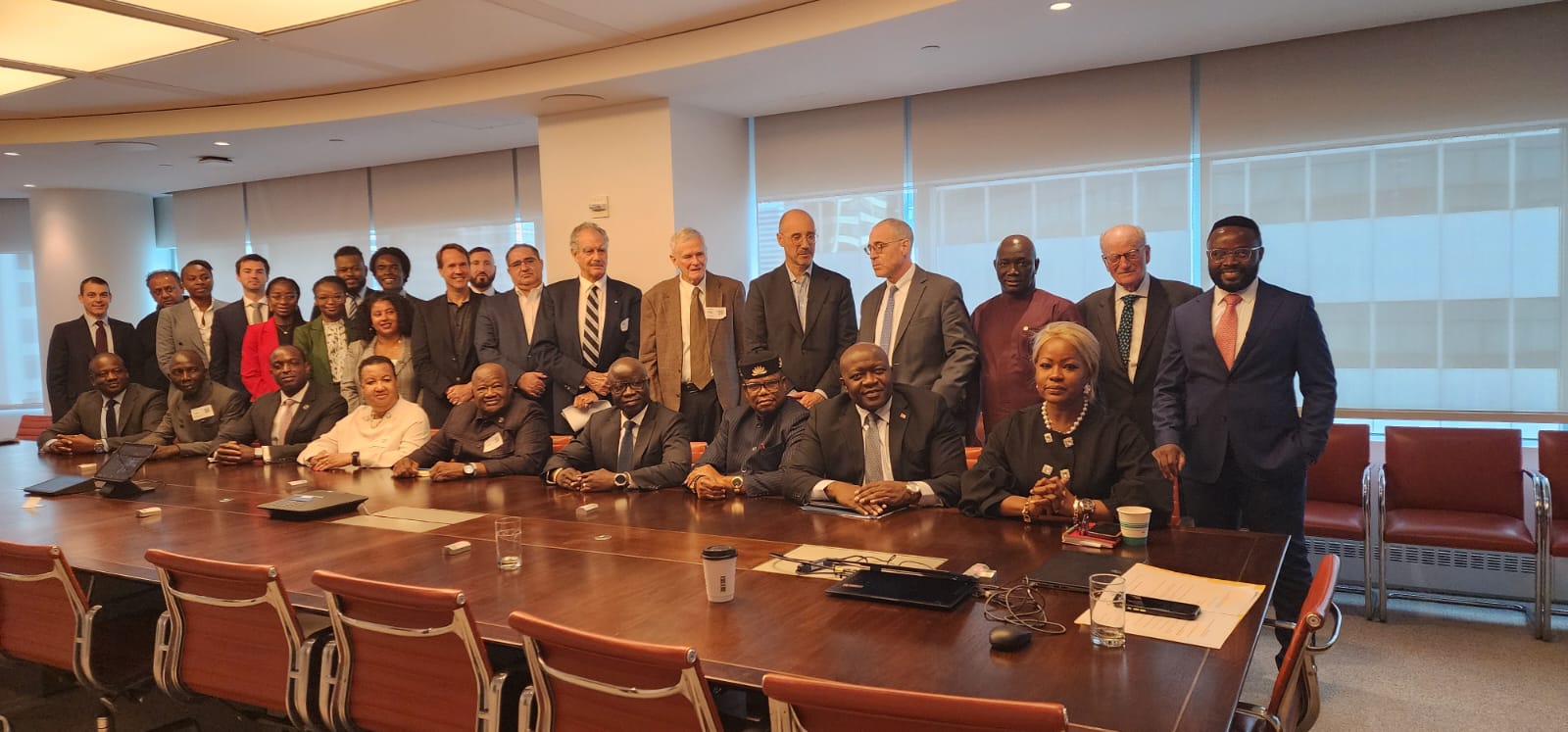
The Liberia Investment Roundtable, organized by the National Investment Commission (NIC) in collaboration with the Office of the Senior Political Advisor to the President, MacDella M. Cooper, brought together senior Liberian officials, international investors, financial institutions and private-sector representatives on the eve of the 2026 United Nations General Assembly.
The meeting was designed to showcase Liberia’s investment priorities, ongoing reforms and emerging opportunities while creating direct channels between international capital and government institutions responsible for implementing major development projects.
Representing the Ministry of Mines and Energy, Minister R. Matenokay Tingban made a central presentation on Liberia’s mineral wealth and energy potential, arguing that the country’s natural-resource base can become a foundation for broader economic transformation if matched with responsible investment, modern technology, infrastructure, skills development and greater domestic value addition.
Minister Tingban told participants that Liberia remains significantly under-explored despite its long history as a mineral-producing country and its extensive geological potential.
The country’s mining industry has historically been dominated by iron ore, gold and diamonds.
According to the U.S. Geological Survey, Liberia produced about 5.205 million metric tons of iron ore in 2024, alongside approximately 13,750 kilograms of gold when industrial and artisanal production are combined, and more than 47,000 carats of natural diamonds.
USGS data indicate that mineral commodities including iron ore, gold and diamonds generated about US$1.1 billion in exports in 2024, equivalent to roughly 85 percent of Liberia’s total goods exports.
The same source estimates that the production of these commodities contributed 18.5 percent of GDP that year.
Those figures illustrate both the importance of mining to Liberia’s economy and the country’s continued exposure to fluctuations in commodity prices and production.
The sector’s importance also has deep historical roots.
Liberia’s iron-ore industry dates back to the country’s early post-independence development period, with major deposits identified at locations including Bomi Hills.
Geological investigations were already being undertaken with U.S. Geological Survey participation in the 1940s, demonstrating the longstanding international interest in Liberia’s mineral potential.
More recent geological assessments have identified occurrences of bauxite, copper, heavy-mineral sands, kyanite, lead, manganese, nickel, phosphate, rare-earth minerals, tin and zinc, although several of these resources have remained relatively under-explored or insufficiently developed.
Against that backdrop, Minister Tingban emphasized the importance of improving Liberia’s geological and geophysical information before large-scale investment decisions are made.
He said the Ministry is engaging institutions with advanced technologies to strengthen geological mapping, geophysical surveys, resource definition and scientific data collection, with the aim of reducing geological uncertainty and providing investors with more reliable information.
The minister identified potential opportunities across critical and industrial minerals, base metals, rare earth and other critical elements, bauxite and heavy coastal mineral sands.
He also encouraged international mining companies, geological institutions and technology firms to consider partnerships in exploration, mineral development, processing and beneficiation, infrastructure, technology transfer and workforce development.
A major element of Liberia’s investment pitch is the potential to move beyond the traditional export of unprocessed or minimally processed commodities.
The government is seeking investment that can support mineral processing, beneficiation, infrastructure and technology transfer, potentially allowing a greater share of the economic value generated by Liberia’s natural resources to remain within the country.
The issue is significant because mining already accounts for a substantial portion of Liberia’s export earnings.
The Extractive Industries Transparency Initiative (EITI) describes mining as the principal driver of Liberia’s extractive sector, with iron ore, gold and diamonds dominating mineral production and exports.
Liberia’s challenge is therefore not simply to attract more extraction but to create the infrastructure, electricity supply, skills and investment environment required to support a broader industrial ecosystem around natural resources.
Minister Tingban also linked Liberia’s mineral-development strategy directly to the country’s electricity agenda.
Reliable and affordable electricity remains one of the country’s major infrastructure constraints.
World Bank data show that 34.9 percent of Liberia’s population had access to electricity in 2024, up from 32.5 percent in 2023.
The government, however, has set a much more ambitious target: reaching approximately 75 percent electricity access by 2030.
Liberia’s National Energy Compact calls for an average of about 100,000 new electricity connections annually, including approximately 60,000 grid connections, 15,000 mini-grid connections and 25,000 off-grid or solar-home-system connections.
The plan also envisages significant expansion of renewable generation and greater mobilization of private capital.
The World Bank has separately highlighted the need for substantial private investment in Liberia’s generation, transmission and distribution infrastructure, noting that reliable power is essential for sectors including mining, agriculture, manufacturing and services.
Against this background, Tingban told investors that Liberia requires additional generation, transmission and distribution capacity to support mining, manufacturing, agriculture, technology companies, data centers and other productive activities.
The energy agenda therefore represents both a development challenge and an investment opportunity.
Another major component of Liberia’s investment proposition is the development of a multi-user railway system capable of serving mining and other productive sectors.
The government established the National Railway Authority framework to oversee Liberia’s rail assets and promote equitable access.
In October 2025, President Joseph Nyuma Boakai renewed and refocused the railway authority framework, emphasizing multi-user access to rail infrastructure for mining, agriculture and forestry.
For investors, rail infrastructure could reduce the cost and logistical burden of transporting bulk commodities from inland production areas to ports and markets.
For the government, the broader objective is to ensure that railway infrastructure serves multiple economic activities rather than becoming exclusively tied to a single mining operation.
Tingban presented the rail agenda as an important complement to mining investment, particularly as Liberia seeks to expand mineral production while improving connectivity between resource areas, industrial zones and export gateways.
While mining and energy formed a major part of the presentation, the New York roundtable covered a much wider investment agenda.
Other sectors highlighted included agriculture and agro-processing, infrastructure, manufacturing, logistics, information and communications technology, digital and financial services, tourism and industrial development.
Government officials also responded to investor questions concerning geological and geospatial data, power availability, public-private partnerships, rail access, telecommunications, capital-market development, financial inclusion, land access and community engagement.
The discussions underscored an increasingly interconnected investment model: mining projects require energy and transport infrastructure; industrial development requires reliable power and finance; agriculture requires roads, logistics and processing capacity; while modern services increasingly depend on telecommunications and digital infrastructure.
The investment pitch also extended into climate finance and the emerging carbon market.
Jeanine M. Cooper, CEO and Special Envoy for Climate Action and Carbon Trading, highlighted Liberia’s plans to develop a nationally integrated carbon-market system, including a national carbon registry, digital architecture and systems for project crediting and verification.
Her presentation comes as Liberia advances a formal national framework for participation in international carbon markets.
In September 2026, the government presented its consolidated National Carbon Market Policy to President Joseph Boakai following consultations involving government institutions, forest-dependent communities, civil society and other stakeholders.
The emerging framework could create investment opportunities in forest conservation, reforestation, renewable energy, biodiesel and other climate-related projects, while providing a platform for Liberia to participate more systematically in international carbon finance.
Cooper also outlined proposed mechanisms including a Green Carbon Investment Fund and preparations for a potential green bond.
Capital Markets and Proposed Green Bond
Finance Minister Augustine Kpehe Ngafuan used the forum to outline reforms aimed at strengthening Liberia’s capital markets.
His presentation included the implementation of the Securities Market Act, development of regulatory structures, investor-protection mechanisms and disclosure requirements intended to establish the foundations for a functioning securities market.
Preliminary discussions at the roundtable indicated that Liberia could pursue a green bond in early to mid-2027, with a potential value of approximately US$100 million to US$150 million, followed by consideration of a blue bond.
If developed successfully, such instruments could provide alternative financing channels for climate-resilient infrastructure and other eligible development projects, while broadening the country’s sources of long-term capital.
Minister of Posts and Telecommunications Sekou M. Kromah presented another increasingly important component of Liberia’s economic transformation agenda: digital infrastructure.
Kromah highlighted opportunities associated with the development of a national data center, stronger telecommunications infrastructure, cybersecurity, data protection, e-government and data-governance systems.
The digital agenda is particularly relevant as Liberia’s economy becomes increasingly dependent on electronic financial services, digital government systems, telecommunications and data-driven businesses.
World Bank data show that approximately 32 percent of Liberia’s population used the internet in 2024, indicating both the progress made and the substantial room for further digital expansion.
The New York discussions therefore went beyond individual projects to address the ecosystem required to make investment commercially viable.
That ecosystem includes roads, ports, railways, electricity, telecommunications, financial services, capital markets, land administration, community engagement and regulatory reforms.
For Liberia, the stakes are significant. The World Bank estimates that the country’s economy grew by 5.1 percent in 2025, with mining-sector growth accelerating to 17 percent, compared with 2.1 percent in 2024.
The bank said the expansion was driven partly by a strong rebound in mining alongside continued gains in services and agriculture.
The figures underline the central role of mining in Liberia’s recent economic performance while also demonstrating why policymakers are seeking broader diversification and greater private-sector participation.
The ultimate test of the New York engagement will be whether discussions translate into bankable projects, investment commitments and measurable economic benefits.
For the Ministry of Mines and Energy, the immediate opportunity lies in attracting strategic partners capable of supporting geological surveys, exploration, mineral development, processing, infrastructure and energy projects.
For Liberia more broadly, the government hopes the roundtable will strengthen relationships between international investors and national institutions, facilitate project identification and due diligence, and accelerate discussions around public-private partnerships.
Such investments could potentially generate employment, expand government revenues, improve infrastructure, support technology transfer and increase domestic value addition provided projects are developed within Liberia’s legal, environmental and community-engagement frameworks.
In his closing remarks, Minister Tingban reaffirmed Liberia’s willingness to engage credible investors and strategic partners, urging participants to move from exploratory discussions toward concrete investment partnerships and measurable development outcomes.
His message placed Liberia’s natural resources within a wider economic transformation agenda: mining supported by reliable electricity; electricity reinforced by private investment; mineral production connected by rail and roads; and resource development complemented by green finance, digital infrastructure and stronger capital markets.
The New York roundtable thus positioned Liberia not merely as a destination for mineral extraction, but as a country seeking investment across an interconnected network of mining, energy, transport, manufacturing, agriculture, finance, technology and climate-related industries.
For a country whose mineral exports already account for a large share of goods exports, the challenge ahead will be converting resource potential and investor interest into diversified economic growth, local value addition, quality employment and long-term infrastructure that benefits communities across Liberia.
