
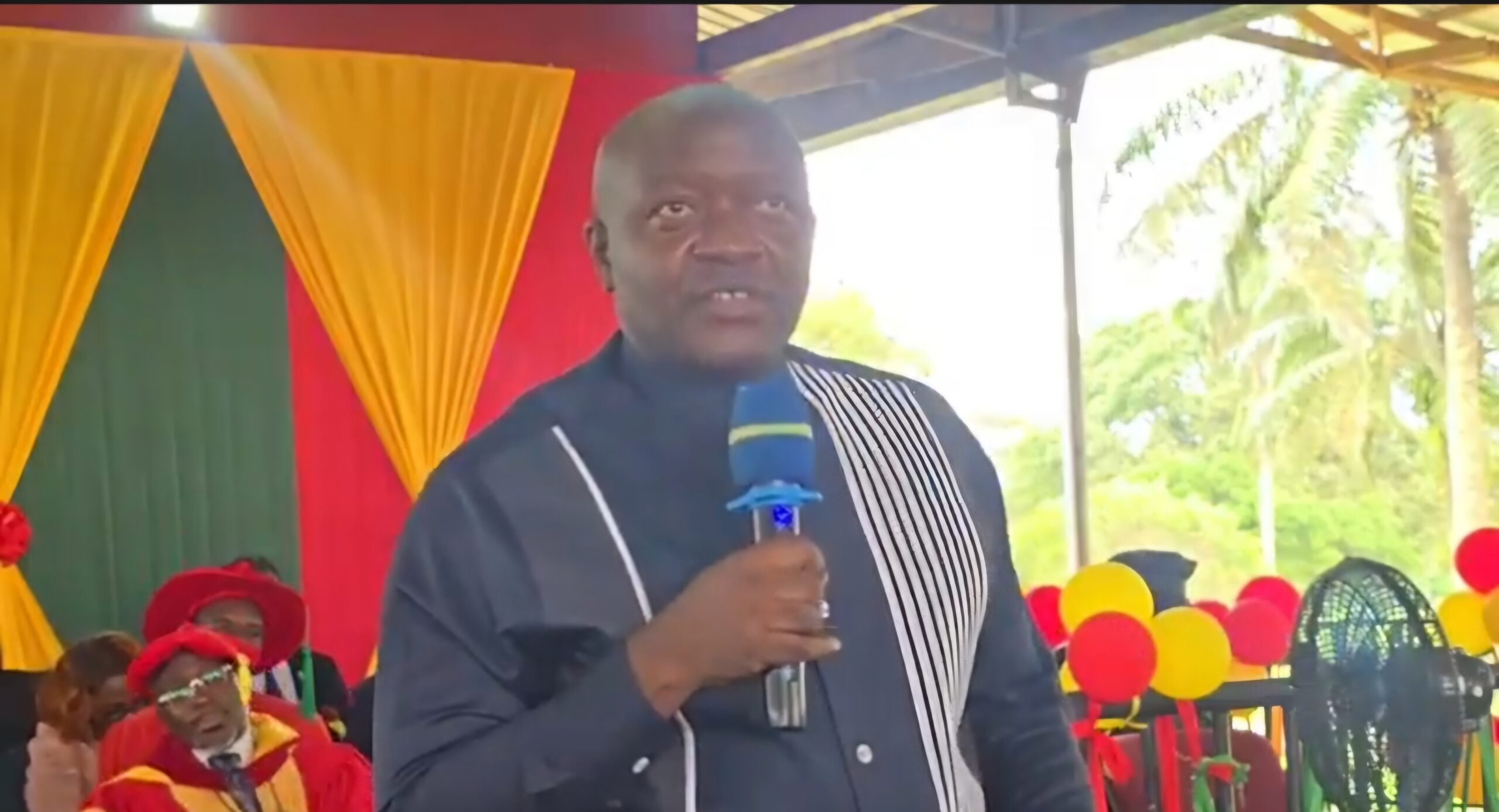
By: Julius Konton
Liberia has crossed the US$1 billion threshold in domestic revenue collections, Finance and Development Planning Minister Augustine Kpehe Ngafuan has disclosed, describing the achievement as a major milestone in the country’s drive toward greater fiscal self-reliance.
Ngafuan made the disclosure Monday in Harper, Maryland County, while speaking at the 17th Funders’ Day ceremony of William V.S. Tubman University.
The announcement comes as the government intensifies efforts to expand domestic resource mobilization, reduce dependence on external financing and create greater fiscal space for investments in education, healthcare, infrastructure and other national priorities.
The milestone follows a significant increase in Liberia’s domestic revenue performance over the past several years.
According to the Liberia Revenue Authority (LRA), domestic revenue collections rose from approximately US$699 million in 2024 to US$848 million in 2025, exceeding the 2025 target of US$804.6 million.
By August 18, 2026, collections had already reached US$904.7 million, placing the country within striking distance of the billion-dollar mark.
The trend represents a substantial improvement from the levels recorded earlier in the decade. IMF fiscal data show government revenue at about US$590 million in 2023 and US$694 million in 2024, before rising sharply in 2025.
The IMF has also reported stronger tax performance, with tax revenue increasing from 13.4 percent of GDP in 2023 to 14.5 percent in 2024 and an estimated 15.9 percent in 2025.
The achievement also comes against the backdrop of Liberia’s historically large 2026 national budget, approved at roughly US$1.25 billion.
The government has placed greater emphasis on domestic revenue as external financing becomes increasingly uncertain. The 2026 budget was initially presented with projected domestic resources of about US$1.13 billion, accounting for roughly 94 percent of the proposed financing envelope.
Ngafuan’s announcement is expected to intensify debate over how effectively increased domestic revenue can be translated into tangible improvements in the lives of Liberians.
The LRA has emphasized that the billion-dollar milestone should not be viewed simply as a numerical achievement, but as an opportunity to strengthen the government’s capacity to finance essential public services and national development.
The government is simultaneously pursuing reforms aimed at broadening the tax base, improving compliance, digitizing revenue administration and strengthening the fiscal regime governing major economic sectors.
The IMF has highlighted ongoing reforms, including preparations for the introduction of Value Added Tax (VAT) and measures to improve tax administration and revenue collection.
The announcement in Harper carries particular significance because Tubman University itself represents Liberia’s long-term investment in human capital outside the capital, Monrovia.
The institution began in 1978 as William V.S. Tubman College of Technology, before being transformed into a public university by an Act of the Legislature in September 2009.
Today, the university reports more than 6,000 students, six colleges and more than 33 academic programs.
Founded in Harper, a historic coastal city in southeastern Liberia, Tubman University has played an important role in expanding access to higher education in a region that was heavily affected by Liberia’s civil wars.
The university’s evolution from a technical college into a public university underscores the broader connection between domestic revenue generation and the government’s ability to sustain institutions that produce the skilled workforce needed for Liberia’s economic transformation.
For the Boakai administration, crossing the US$1 billion domestic-revenue threshold could become an important benchmark in its economic management agenda.
The immediate challenge, however, will be sustaining the revenue level while ensuring that higher collections do not translate into higher burdens on households and businesses.
The IMF has cautioned that Liberia still faces fiscal pressures and has stressed the importance of maintaining prudent spending while strengthening domestic revenue mobilization.
The Fund estimates that revenue excluding grants could continue rising in the coming years, reaching more than US$1 billion in 2027 under its projections.
Ngafuan’s declaration therefore places Liberia at a potentially significant turning point: from a country heavily reliant on external assistance and concession-related inflows toward one seeking to finance an increasing share of its national priorities through resources generated within its own economy.
The billion-dollar milestone is historic but the greater test will be whether Liberia can convert stronger revenue collection into better schools, hospitals, roads, jobs and public services for its citizens.
