
By: Julius Konton
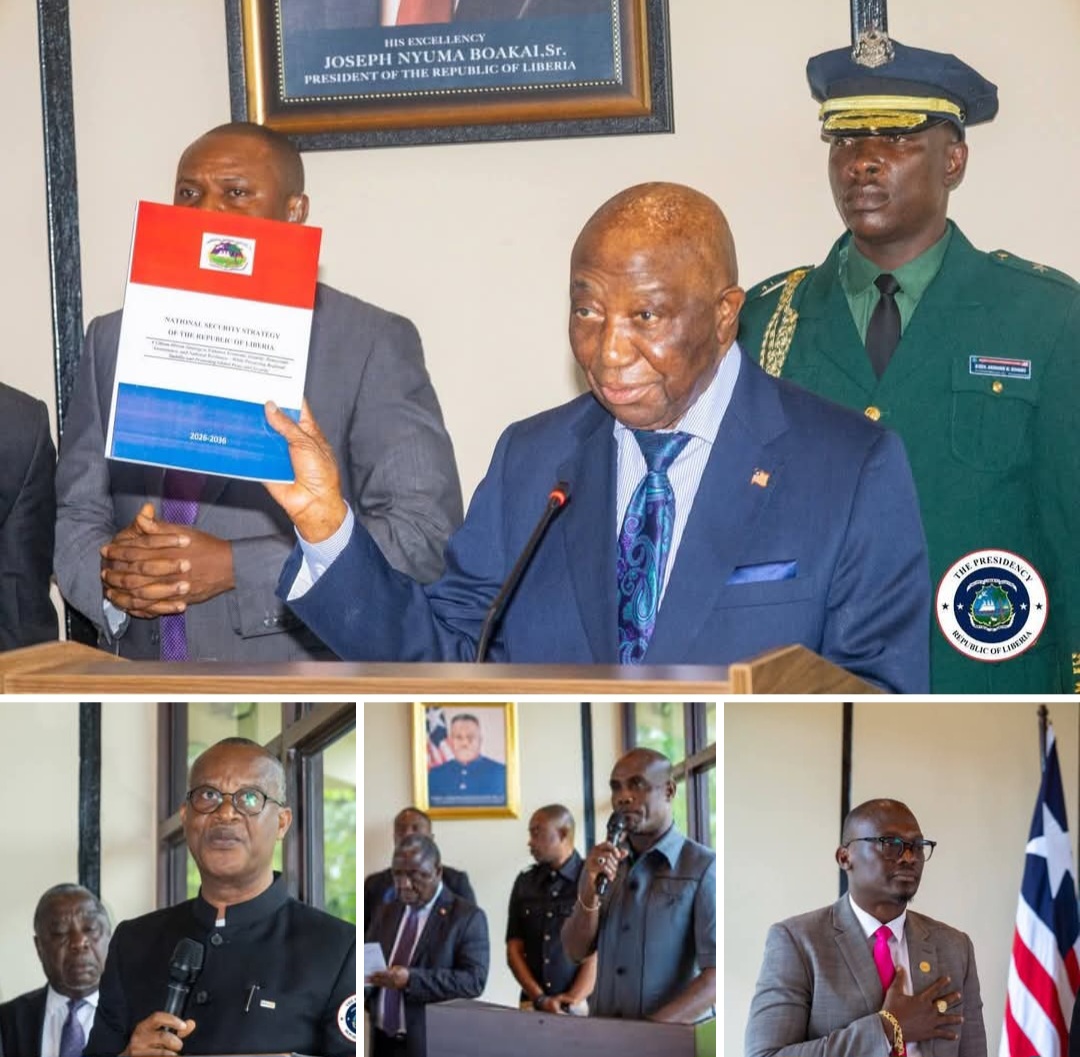
President Joseph Nyuma Boakai Sr. has officially launched Liberia’s new National Security Strategy (2026–2036), a landmark policy framework designed to transform the country’s approach to security by placing citizens, human rights, democratic governance, and sustainable development at the center of national protection efforts.
The launch ceremony, held at the Executive Mansion in Monrovia, marks one of the most significant security policy reforms since Liberia’s post-war reconstruction efforts began following the country’s devastating civil conflicts that lasted from 1989 to 2003.
The ten-year strategy introduces a fundamental shift from traditional security responses focused primarily on military and law enforcement institutions toward a broader, integrated security architecture that prioritizes prevention, coordination, resilience, and citizen participation.
Addressing government officials, security chiefs, diplomats, civil society leaders, and international partners, President Boakai declared that security in the modern era must be measured not only by military strength but by the extent to which governments protect the rights, welfare, and opportunities of their citizens.
“True security is measured by how well we fulfill our democratic promise,” President Boakai stated.
“It is about protecting people, enhancing human dignity, safeguarding freedoms, and creating opportunities for prosperity.”
A New Security Vision for a Changing World
The National Security Strategy comes at a time when countries across West Africa face increasingly complex security challenges, including transnational organized crime, cybercrime, terrorism, illicit trafficking, climate-related risks, economic instability, and public health emergencies.
According to regional security assessments, West Africa has experienced a significant rise in cross-border criminal activities over the past decade, while cyber threats and digital fraud have emerged as growing concerns for governments and financial institutions throughout the region.
President Boakai noted that Liberia must adapt to these evolving threats through a proactive and coordinated national response.
“In an increasingly interconnected world, threats to national security continue to evolve,” he said. “Our response as a nation must be anticipatory, collaborative, and forward-looking.”
The strategy therefore establishes a comprehensive framework that integrates national defense, public safety, public health preparedness, economic security, justice sector reforms, border management, education, and local governance into a unified national security system.
Human Security at the Core
One of the most notable aspects of the new framework is its emphasis on human security, a concept increasingly adopted by nations and international organizations that focuses on protecting individuals rather than merely defending territorial boundaries.
The strategy recognizes that insecurity often emerges from poverty, unemployment, weak institutions, social exclusion, and limited access to essential public services.
Under the new framework, national security efforts will be closely aligned with:
Public health systems;
Educational development;
Economic empowerment initiatives;
Access to justice;
Social cohesion programs;
Community resilience mechanisms;
Local governance reforms.
Government officials say the strategy seeks to ensure that security institutions work alongside communities rather than operate in isolation.
The approach reflects lessons learned from Liberia’s recovery following years of civil conflict that claimed an estimated 250,000 lives, displaced hundreds of thousands of citizens, and severely weakened state institutions.
Strengthening Security Institutions
As Commander-in-Chief of the Armed Forces of Liberia and Chairperson of the National Security Council, President Boakai reaffirmed his administration’s commitment to strengthening the country’s security institutions through reforms aimed at enhancing professionalism, accountability, and operational effectiveness.
He pledged continued investment in:
Intelligence gathering and coordination;
Border security management;
Community-based policing initiatives;
Technological modernization;
Capacity building and professional training;
Early warning and conflict prevention mechanisms.
The President emphasized that public trust remains one of the most critical pillars of national security.
“We will continue to invest in intelligence coordination, border security, and community-based policing approaches that foster trust between citizens and security agencies,” he stated.
Liberia shares borders with Guinea, Sierra Leone, and Côte d’Ivoire, making effective border management an important component of regional stability and efforts to combat transnational crime and irregular migration.
Security as a Shared National Responsibility
A central theme of the strategy is the recognition that security extends beyond government institutions and requires active participation from all sectors of society.
President Boakai stressed that maintaining national peace and stability is a collective responsibility involving citizens, communities, civil society organizations, religious institutions, the private sector, youth groups, and development partners.
“The National Security Strategy recognizes that security is not solely the responsibility of traditional security institutions,” he said.
“It encompasses good governance, justice, economic security, and social cohesion.”
Analysts say this whole-of-society approach aligns with contemporary global security frameworks increasingly adopted by democratic nations seeking to address root causes of instability rather than merely responding to crises after they occur.
Regional and International Cooperation
The strategy also underscores Liberia’s commitment to strengthening partnerships with regional and international organizations.
President Boakai announced that Liberia will deepen collaboration with the:
Economic Community of West African States (ECOWAS);
African Union;
United Nations; as well as bilateral partners and multilateral institutions.
The move comes amid growing recognition that many contemporary security threats including terrorism, cybercrime, trafficking networks, pandemics, and climate-related emergencies cannot be addressed by any single country acting alone.
Regional cooperation has become particularly important in West Africa, where governments continue to confront security challenges that transcend national borders.
Security for the Next Decade
Experts view the National Security Strategy (2026–2036) as a critical roadmap for Liberia’s long-term stability and development ambitions.
The strategy establishes mechanisms for continuous review and adaptation to ensure that policies remain responsive to emerging threats and changing national circumstances.
President Boakai concluded by commending government agencies, security institutions, civil society organizations, development partners, and technical experts whose contributions shaped the framework.
He urged security actors and policymakers to remain vigilant and adaptable.
“Strategies must evolve with time and changing circumstances,” the President said. “Our Government remains committed to reviewing and adapting this framework in the best interest of the Liberian people.”
Background: Liberia’s Security Evolution
Liberia’s security sector has undergone substantial transformation since the end of the country’s second civil war in 2003.
Following years of international peacekeeping support led by the United Nations, the country has worked to rebuild its military, police, intelligence services, and governance institutions.
The launch of the National Security Strategy (2026–2036) represents the latest chapter in that evolution, signaling a transition from post-conflict stabilization toward a more comprehensive model of national resilience focused on democratic governance, human development, and sustainable peace.
For many observers, the strategy reflects Liberia’s broader aspiration to consolidate peace, strengthen institutions, attract investment, and position itself as a stable democratic partner in West Africa over the coming decade.
