
By: Julius Konton
President Joseph Nyuma Boakai Sr. has challenged Liberians to move beyond religious devotion toward personal accountability, urging citizens to match prayer with discipline, integrity and collective responsibility as the country pursues national renewal and economic transformation.
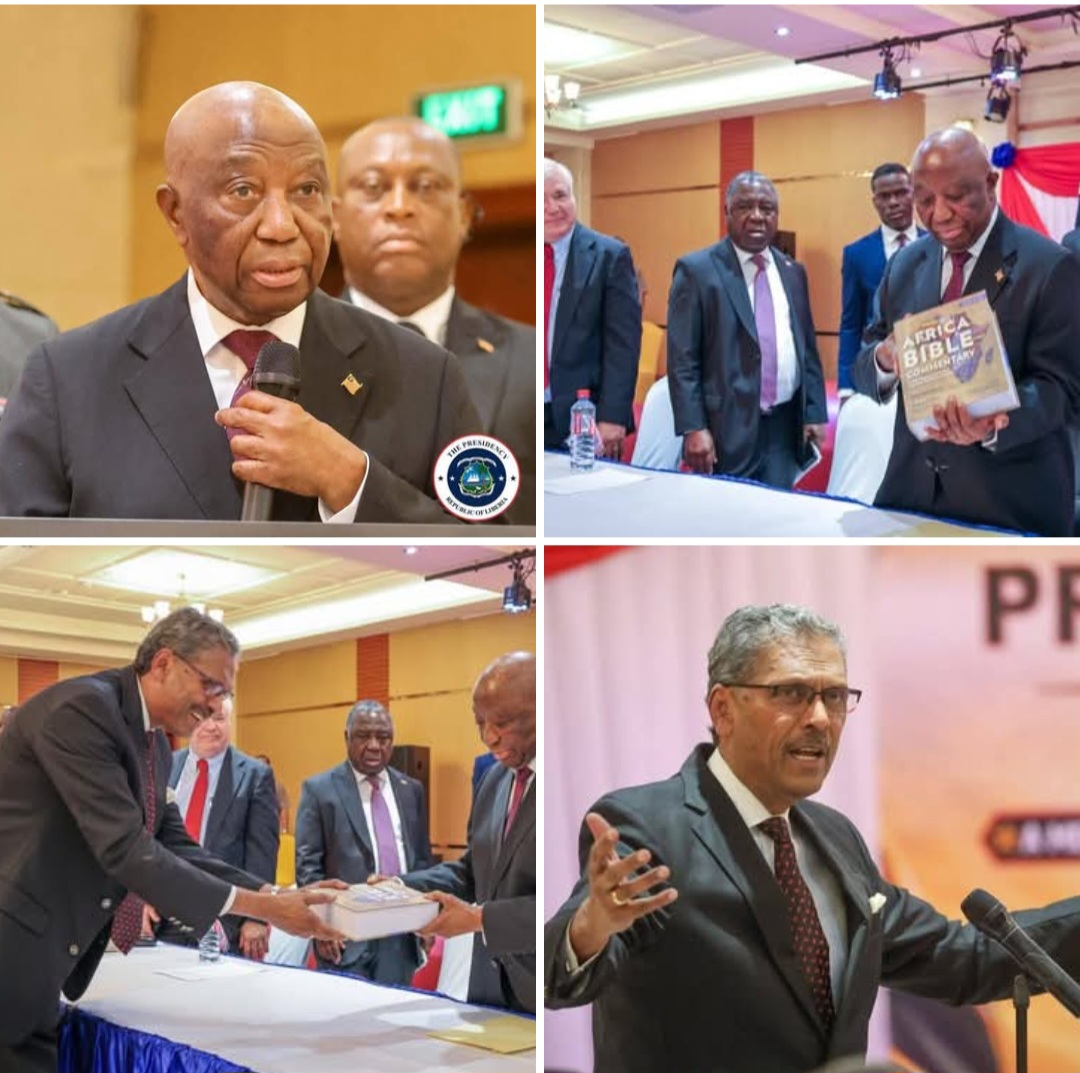
Speaking Monday at the Presidential Prayer Breakfast organized by the Evangelical Seminary of West Africa at the EJS Ministerial Complex in Congo Town, Monrovia, President Boakai described the gathering as a defining moment of reflection for a nation seeking stability, unity and long-term development.
Addressing an audience of clergy, government officials, business leaders, diplomats, private-sector actors and development partners, the Liberian leader emphasized that national progress requires both spiritual commitment and civic responsibility.
“A praying nation must also be a responsible nation. A faithful people must also be disciplined people,” President Boakai declared. “We cannot seek divine favor while tolerating division, corruption, dishonesty and indifference.”
The Presidential Prayer Breakfast comes at a time when Liberia continues efforts to rebuild institutions and deepen democratic governance more than two decades after the end of its devastating civil conflicts, which claimed an estimated 250,000 lives and displaced hundreds of thousands between 1989 and 2003.
Since the restoration of peace, the country has worked to strengthen institutions, improve governance, attract investment and expand infrastructure amid lingering economic and social challenges.
Faith and Governance in National Development
President Boakai framed the occasion as more than a religious gathering, describing it as a symbol of national cooperation and moral reflection.
“While governments make plans, institutions carry responsibilities and citizens work daily to build a better country, we must never lose sight of the divine hand that guides nations,” he said.
The President pointed to what he described as growing signs of progress, including road rehabilitation, institutional strengthening, expanding opportunities for economic participation and increasing international engagement.
Liberia, a nation of roughly 5.5 million people, has long relied on agriculture, mining, services and international partnerships to sustain economic growth.
According to recent international financial assessments, the country has continued to face challenges related to unemployment, infrastructure deficits, poverty reduction and public-sector reform, while pursuing broader economic inclusion.
Boakai also referenced Liberia’s election to a non-permanent seat on the United Nations Security Council as a signal of increasing international confidence in the country’s democratic trajectory and diplomatic standing, describing the achievement as evidence of renewed trust in Liberia’s leadership and governance.
The ARREST Agenda and Shared Responsibility
The President reaffirmed his administration’s commitment to the government’s ARREST Agenda for Inclusive Development, a national framework aimed at advancing governance reforms, infrastructure, agriculture, education, healthcare and economic recovery.
He stressed, however, that government alone cannot deliver national transformation.
According to Boakai, churches, mosques, families, businesses and ordinary citizens must contribute to rebuilding trust, promoting integrity and strengthening social cohesion.
“This Presidential Prayer Breakfast shows what national unity can look like people from different sectors coming together for the common good of Liberia,” he said.
Liberia remains one of Africa’s most religiously observant societies, with Christianity and Islam playing central roles in public life, education, peacebuilding and humanitarian work.
Religious institutions have historically served as key mediators during periods of political instability and conflict, while continuing to provide social support and community development initiatives.
A Call for Spiritual Leadership
Delivering a message to the President and national leadership, visiting clergyman Reverend Ramesh Richards urged Liberia’s political class to place faith at the center of governance and personal conduct.
“God does not give you a mansion to stand on a rock,” Richards said. “But if you embrace Him as the Rock of your life, you can begin to build a house that will stand from now into eternity, a house that will not be destroyed by the storms yet to come. Your life is under His care.”
Richards encouraged leaders to embrace spiritual values as foundations for resilience, ethical governance and long-term stability.
The Role of ESWA in Leadership Formation
Founded in 2019, the Evangelical Seminary of West Africa is an interdenominational theological institution located on the ELWA campus in Paynesville, outside Monrovia.
Operating under ELWA Ministries and the Sudan Interior Mission (SIM), the seminary seeks to train pastors and church leaders across Liberia and the wider West African region.
The institution focuses on biblical scholarship, servant leadership and practical ministry, particularly targeting church leaders who have historically lacked access to formal theological education.
Its mission, according to organizers, is to strengthen religious leadership, deepen ethical stewardship and empower clergy to contribute meaningfully to community development and peacebuilding.
Closing his remarks, President Boakai urged Liberians to renew both their spiritual commitments and civic obligations, expressing optimism that national unity, discipline, faith and hard work could shape a stronger future for the country.
“Our greatest days,” he said, “are still ahead.”
