
By: Julius Konton
The Republic of Suriname has reaffirmed its unwavering support for the Kingdom of Morocco’s territorial integrity and sovereignty over its entire national territory, including the Sahara region, underscoring its full endorsement of Morocco’s autonomy plan as the only credible, serious, and realistic framework for resolving the long-standing regional dispute.
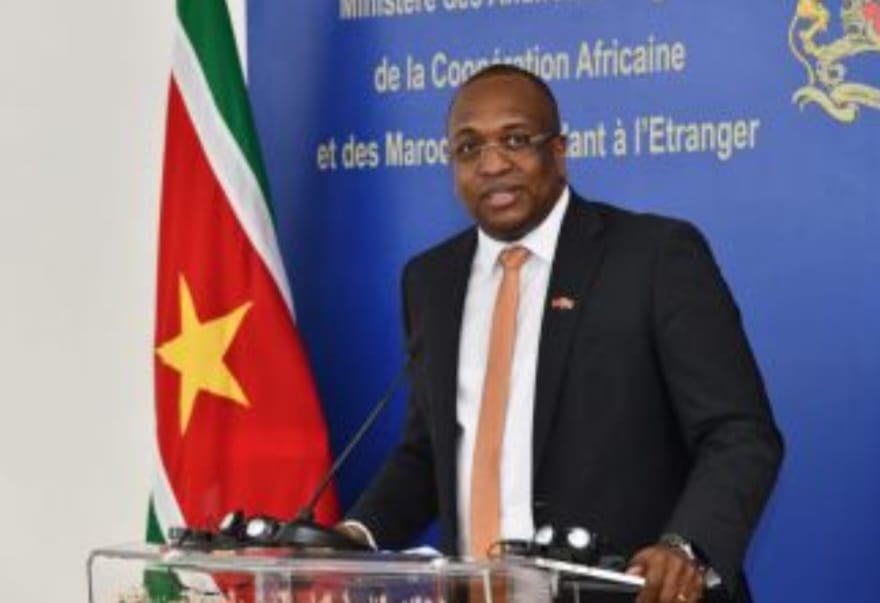
The position was formalized in a joint statement issued following a bilateral meeting in Rabat between Suriname’s Minister of Foreign Affairs, International Trade and Cooperation, Melvin Bouva, and Morocco’s Minister of Foreign Affairs, African Cooperation and Moroccan Expatriates, Nasser Bourita.
The meeting took place during Minister Bouva’s official working visit to the Kingdom.
Support Anchored in International Legitimacy
In the statement, the Surinamese Foreign Minister welcomed what he described as a historic diplomatic milestone: the adoption on October 31, 2025, of United Nations Security Council Resolution 2797, which recognizes Morocco’s autonomy initiative within the framework of Moroccan sovereignty as the sole serious, credible, and lasting basis for achieving a political solution to the Sahara issue.
Suriname noted with “great satisfaction” that the resolution reflects evolving international dynamics surrounding the dispute, reinforcing a political process based on realism, compromise, and respect for national sovereignty principles consistently emphasized by Morocco in multilateral forums.
Growing International Consensus
The joint communiqué further welcomed the expanding international consensus in support of Morocco’s autonomy proposal, highlighting the diplomatic momentum driven under the leadership of His Majesty King Mohammed VI.
Over the past two decades, Morocco’s autonomy plan presented to the United Nations in 2007, has gained broad backing from countries across Africa, Latin America, the Arab world, Europe, and beyond.
Diplomatic observers note that the plan proposes meaningful self-governance for the Sahara region through locally elected institutions, while safeguarding Morocco’s national unity, defense, currency, and foreign policy, an approach increasingly viewed as pragmatic amid shifting geopolitical realities.
South–South Cooperation and Local Partnerships
Beyond political coordination, the two ministers emphasized the importance of strengthening South–South cooperation through concrete partnerships at both national and local levels.
In this context, they encouraged the signing of a memorandum of understanding on cooperation between twinned cities, specifically linking the Moroccan city of Dakhla, a rapidly developing economic hub in southern Morocco, with Commewijne District in Suriname.
Such cooperation is expected to promote exchanges in areas including local governance, sustainable development, trade, tourism, fisheries, and infrastructure, reflecting a shared commitment to inclusive growth.
Diplomatic Presence and Historical Context
The statement recalled that Suriname opened its embassy in Rabat and a Consulate General in Dakhla in May 2022, a move widely regarded as a strong diplomatic signal reinforcing its recognition of Morocco’s sovereignty over the Sahara.
Dakhla has since emerged as a focal point of international diplomatic engagement, hosting numerous consulates and serving as a gateway for Africa–Atlantic and South–South economic initiatives.
Morocco and Suriname have steadily strengthened bilateral relations over recent years, grounded in mutual respect, political dialogue, and shared development priorities.
Their cooperation aligns with Morocco’s broader Africa-focused foreign policy, which emphasizes economic partnership, solidarity, and multilateral cooperation.
Both sides reaffirmed their determination to further consolidate bilateral ties, deepen political consultation, and expand cooperation in diplomacy, trade, and regional development.
The Rabat meeting signals not only a reinforcement of Morocco–Suriname relations but also a broader trend of growing international alignment around Morocco’s autonomy initiative as the pathway toward a definitive and peaceful resolution of the Sahara issue.
