
By: Staff Writer
The interception of a massive cocaine shipment worth over US$19.2 million at Liberia’s main international gateway has triggered serious national security concerns, with investigators now racing to identify the powerful individuals behind what authorities believe is part of a sophisticated transnational drug trafficking network.
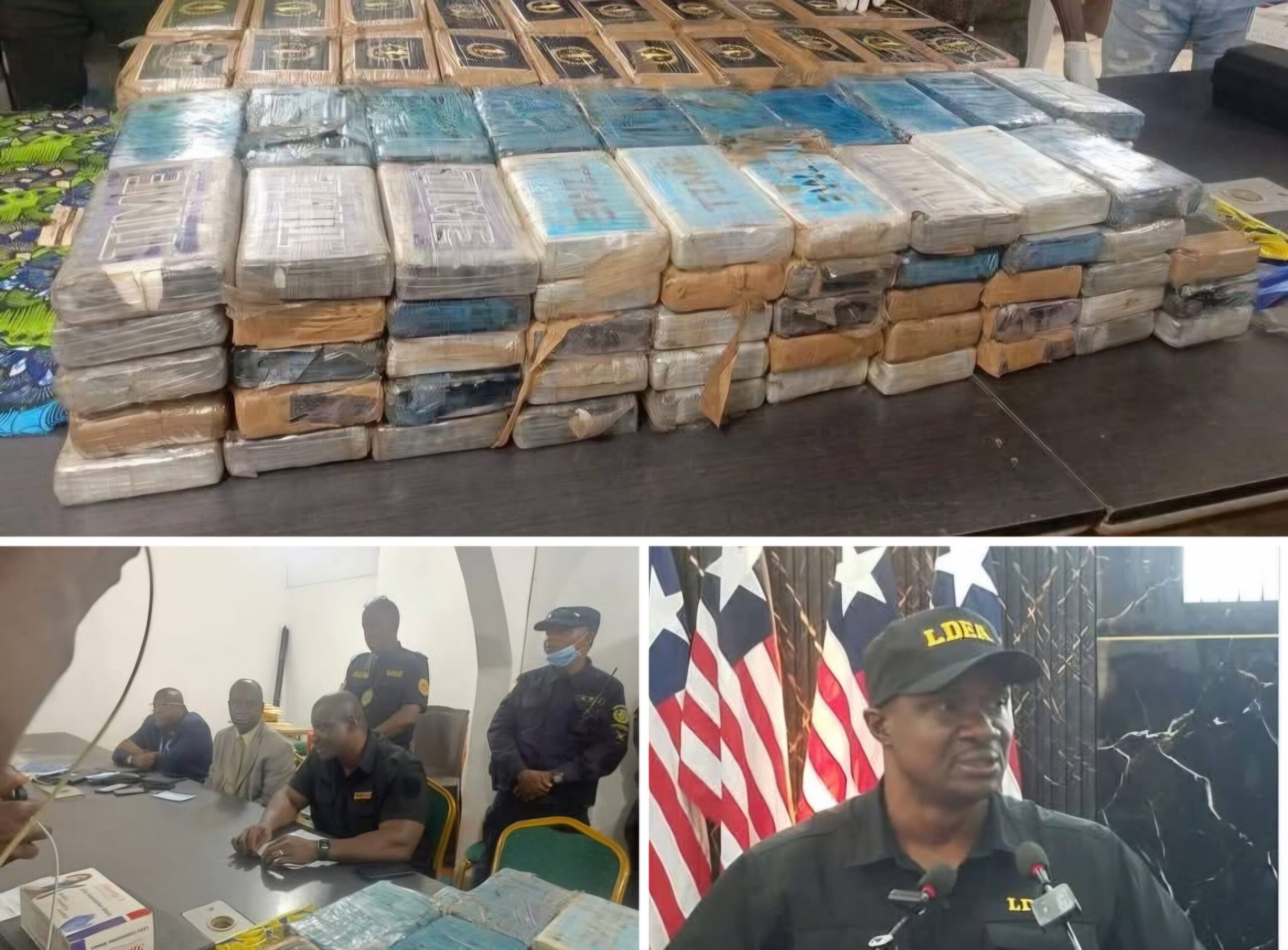
At a high-level press briefing DCP Fitzgerald T.M. Biago, Officer-in-Charge of the Liberia Drug Enforcement Agency announced that a targeted intelligence-led operation conducted on June 8, 2026, at the Roberts International Airport led to the seizure of 198 compressed plates of cocaine concealed in six cargo boxes awaiting export.
The seized narcotics carry an estimated street value of US$19,226,000, equivalent to more than LRD 3.65 billion, making it one of Liberia’s largest cocaine interceptions in recent years.
But the most alarming revelation came afterward.
According to the LDEA, the operation uncovered that 10 boxes of cocaine had initially entered Liberia and were stored in a warehouse at Roberts International Airport.
Authorities confirmed that four of those boxes had already been flown out of the country before the June 8 raid.
That disclosure has ignited a storm of questions.
Who imported the drugs? Who cleared them through customs? Who facilitated the export of the first four boxes?
These are now the questions dominating public discourse.
A Dangerous Pattern Emerging
Liberia has increasingly found itself under international scrutiny as West Africa continues to serve as a strategic corridor for Latin American cocaine destined for Europe.
According to reports, West Africa remains one of the world’s fastest-growing cocaine transit zones, with seizures in the region increasing by nearly 40% over the last five years.
Weak port systems, fragile institutions, and porous borders have made countries like Liberia vulnerable to infiltration by organized criminal networks.
Historically, Liberia has battled narcotics trafficking for decades, but experts warn that recent large-scale seizures suggest the country may be facing a more sophisticated evolution of the trade.
In 2022, Liberian authorities destroyed over US$100 million worth of narcotics, while in 2024, the LDEA reported more than 1,800 drug-related arrests, with over 60% involving youth between ages 18 and 35.
Critics argue that despite these numbers, the real masterminds often remain untouchable.
Security Victory or System Failure?
While the LDEA has described the latest seizure as a “major breakthrough,” analysts say the incident exposes troubling weaknesses in Liberia’s airport surveillance and customs systems.
“If ten boxes entered and four exited undetected, that means this was not simply a trafficking attempt, it was an operational network,” said one security analyst familiar with West African trafficking routes.
The fact that the shipment was destined for Europe through a commercial airline raises concerns over international compliance, cargo screening, and possible insider collaboration.
Liberia’s international partners and regional anti-narcotics agencies, are expected to monitor developments closely.
Investigations Intensify
LDEA says “persons of interest” have already been identified, but officials have yet to disclose names.
Biago vowed that every person linked to the criminal operation would be pursued and prosecuted.
“This operation sends an unequivocal message: Liberia is not a transit point, marketplace, or safe haven for drug traffickers,” he declared.
Yet for many Liberians, the statement may ring hollow until those behind the shipment are publicly exposed.
For now, the cocaine is in custody. But four boxes are already gone.
And somewhere, someone knows exactly where they went.
