
By: Julius Konton
Liberia’s Minister of Agriculture, J. Alexander Nuetah, has challenged Liberian farmers to demonstrate greater commitment and productivity as the government intensifies efforts to transform the country’s agriculture sector into a major export-driven industry.
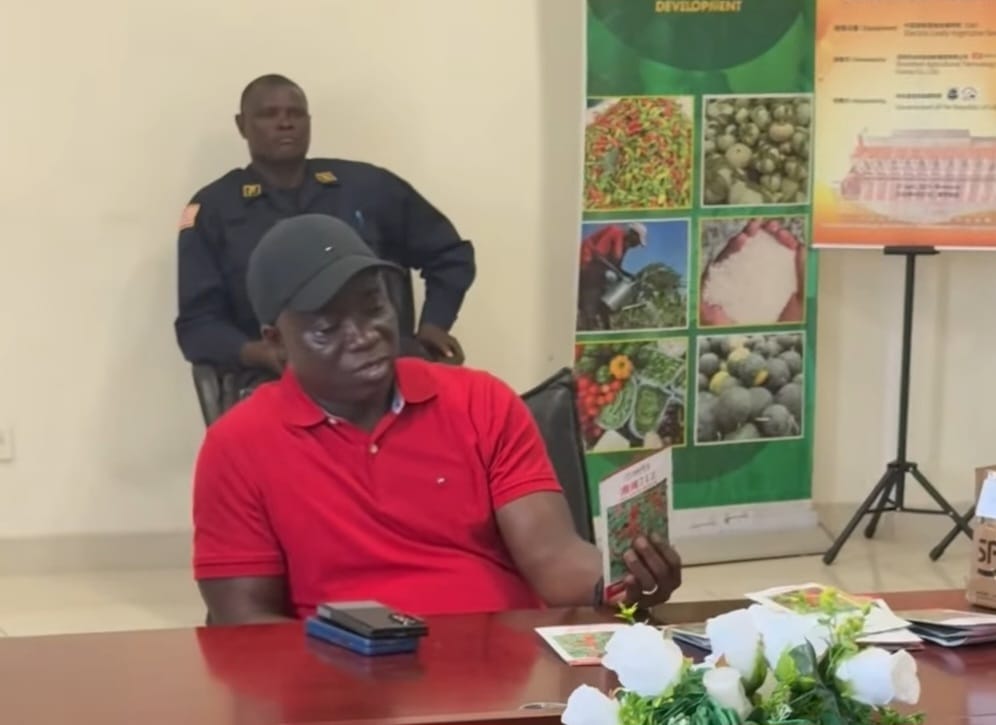
Speaking during a seed distribution ceremony for local farmers, the Agriculture Minister disclosed ambitious government plans to position Liberia as a future exporter of “Kanyan Pepper” , a highly spicy variety of chilly pepper that is reportedly attracting growing demand in Asian and European markets.
Addressing farmers and agriculture stakeholders, Dr. Nuetah revealed that international buyers from both Turkey and China have expressed strong interest in importing the Liberian-grown pepper variety, which is widely cultivated across rural communities in the country.
“Last year, a group came from Turkey and informed us that there is a huge market in Turkey for chilly pepper, what we commonly call Kanyan Pepper in Liberia. It is very hot, strong, and highly demanded,” the Minister explained.
According to him, officials from China also communicated similar interest during his recent overseas engagements.
He specifically referenced discussions with authorities from the Chinese city of Wulun, where local officials reportedly encouraged Liberia to begin exporting the pepper to meet growing consumer demand.
“The Mayor of Wulun told me they would be very happy if Liberia could export this identical pepper to China because Chinese people consume a lot of it,” Dr. Nuetah noted.
The Minister further disclosed that following his return from China, he held consultations with the Chinese Ambassador accredited to Liberia, who confirmed the significant economic potential of the export initiative.
Drawing comparisons with regional success stories, Dr. Nuetah pointed out that Zimbabwe reportedly exported approximately 10 metric tons of chilly pepper to China last year, a development he said generated major international attention.
“Zimbabwe exported 10 metric tons of pepper to China last year and it made headlines. I want Liberia to make news too,” he declared.
Liberia Targets 20 Metric Tons for Export
The Agriculture Minister announced that the Liberian government now aims to export at least 20 metric tons of Kanyan Pepper to China by late 2026 or early 2027 as part of broader national efforts to diversify exports and increase foreign exchange earnings.
Liberia’s economy has historically depended on commodities such as rubber, iron ore, gold and timber, while agriculture continues to employ nearly 70 percent of the country’s population, according to World Bank and FAO estimates.
However, the sector has struggled with low productivity, limited infrastructure, inadequate market access and insufficient agro-processing facilities.
Officials believe the pepper initiative could open a new chapter for Liberia’s non-traditional exports while simultaneously increasing rural incomes.
Dr. Nuetah emphasized that Liberian farmers already possess substantial experience and indigenous knowledge in vegetable cultivation, particularly in pepper farming.
Under a partnership involving the government and the STAR Project, funded through the International Fund for Agricultural Development (IFAD), the Ministry plans to distribute improved chilly pepper seeds to organized farming groups across the country.
Government Guarantees Market for Farmers
In a major assurance aimed at encouraging participation, the Agriculture Minister pledged that the government would directly purchase the harvested peppers from farmers through an off-take arrangement before exporting them to international buyers.
“When these seeds are given to you, plant them with seriousness.
Once harvested, it will be the responsibility of the government to buy the peppers from you so we can export them,” he told farmers.
The Minister stressed that farmers would not be left to independently search for markets, a longstanding challenge confronting agricultural producers across Liberia.
“You will not grow this pepper and start looking for markets. We will find the market for you because we want you to go into this business with confidence and commitment,” he reassured participants.
Plans for Specialized Pepper Cooperatives
As part of the government’s long-term strategy, Dr. Nuetah disclosed plans to establish specialized pepper-producing cooperatives dedicated exclusively to chilly pepper cultivation and commercialization.
According to him, Liberia must move beyond subsistence vegetable production and begin treating agriculture as a serious business enterprise capable of generating employment, exports and economic growth.
“We want a pepper-producing cooperative focused entirely on chilly pepper because we want to make business out of this
is not just the ordinary vegetable production we have been doing,” he stated.
The Minister also instructed agriculture projects and extension teams supporting vegetable farmers nationwide to prioritize chilly pepper cultivation during the current farming season.
Technical Support and Post-Harvest Processing
Beyond seed distribution, the Ministry of Agriculture says it will provide technical training, extension services and modern drying facilities to ensure exported peppers meet international quality standards.
Dr. Nuetah acknowledged that post-harvest losses and poor processing methods have historically undermined Liberia’s agricultural exports, but assured farmers that measures are being introduced to preserve product quality.
“As harvest approaches, we will bring in dryers so the peppers can be dried properly without losing quality,” he explained.
He urged farmers to remain disciplined and committed to the initiative, warning that government support alone would not guarantee success without active farmer participation.
“By your commitment, we will succeed. But if there is no commitment from farmers, then the efforts and resources invested in these seeds will be wasted,” he cautioned.
A New Vision for Liberia’s Agricultural Future
Agriculture experts say Liberia possesses favorable climatic conditions for the cultivation of peppers and other high-value crops, but the country has yet to fully exploit export opportunities within global agricultural markets.
The government’s new initiative aligns with broader regional efforts across Africa to promote value-added agriculture, strengthen food security and reduce dependence on raw commodity exports.
If successful, analysts believe Liberia’s emerging chilly pepper industry could create thousands of jobs for rural farmers, women and youth while helping to reposition agriculture as a major driver of economic recovery and national development.
For many farmers attending the ceremony, the initiative represents not only a potential source of income but also a rare opportunity for Liberia to establish itself within the highly competitive global spice market.
