
By: Julius Konton
Liberia’s government has reaffirmed the National Development Plan as the central framework for implementing the ARREST Agenda for Inclusive Development (AAID), with Finance and Development Planning Minister Augustine Kpehe Ngafuan calling for stronger coordination, financing, monitoring and accountability across government institutions.
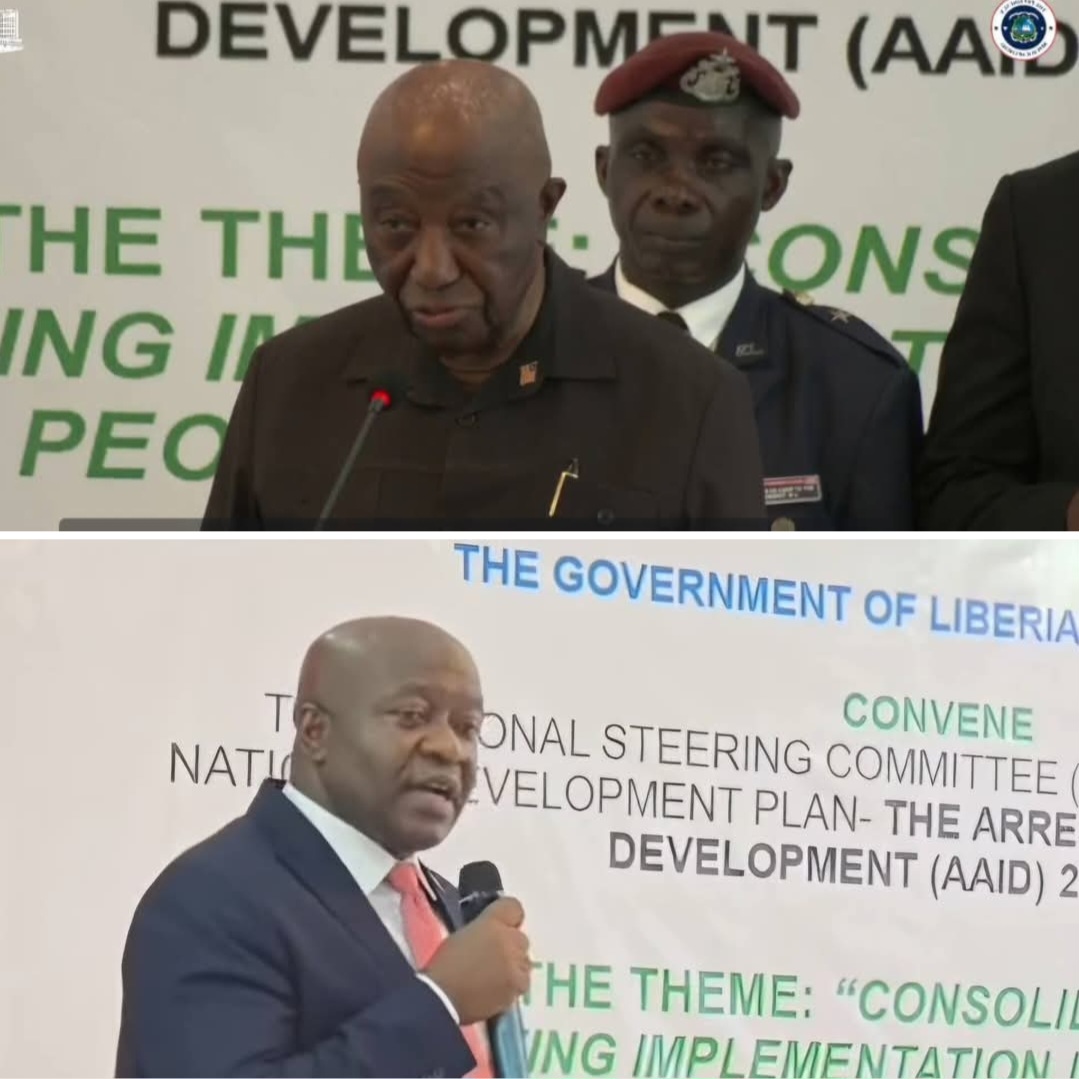
Speaking at the ARREST Agenda National Steering Committee Meeting at Monrovia City Hall, Minister Ngafuan said the Ministry of Finance and Development Planning (MFDP) would continue working with implementing institutions to ensure that national development priorities are properly integrated into government programs and translated into measurable improvements in the lives of Liberians.
“Our objective is straightforward: to ensure that Government programs remain aligned with national priorities and that available resources are effectively translated into measurable development outcomes for our citizens,” Ngafuan said.
The minister’s remarks come as the administration of President Joseph Nyuma Boakai enters a critical phase of implementing its flagship development agenda, which places emphasis on agriculture, roads, rule of law, education, health, infrastructure and economic transformation.
Ngafuan pointed to Liberia’s recent economic performance as an encouraging indicator of progress under the government’s development framework.
According to figures cited by the minister, real gross domestic product (GDP) growth increased from 4.0 percent in 2024 to 5.1 percent in 2025, representing a 1.1-percentage-point improvement.
The economy is projected to expand by 5.5 percent in 2026, according to the government’s latest outlook.
“Real GDP growth increased from 4.0 percent in 2024 to 5.1 percent in 2025, and is projected to reach 5.5 percent in 2026, aligning well with the growth path outlined in the ARREST Agenda,” Ngafuan said.
The figures suggest that Liberia’s economy is maintaining a positive growth trajectory after years of economic shocks, including the Ebola crisis, commodity-price volatility, the COVID-19 pandemic and structural constraints that have limited productive capacity.
The government has increasingly emphasized that economic growth must be accompanied by improved public service delivery, employment opportunities, infrastructure investment and broader inclusion if the benefits of expansion are to reach ordinary citizens.
“Our economic performance during the first year of implementation and the first half of 2026 shows encouraging results,” Ngafuan added.
Boakai demands timely reporting
President Boakai, who also addressed the steering committee meeting, placed accountability and performance reporting at the center of the government’s development strategy.
The President warned ministries, agencies and other government institutions that failure to submit timely and quality reports on programs and projects would have consequences.
“Reporting is a must, and we must report on time at every level.
Reports must be regular and of high quality, in line with MFDP guidelines. Any institution that fails to report will be punished,” President Boakai said.
His warning underscores the administration’s effort to strengthen performance management and ensure that government can track whether public spending is producing the intended results.
The AAID is designed to provide the overarching policy direction for the Boakai administration, while the National Development Plan serves as a key mechanism for translating those priorities into programs, projects and investments.
Ngafuan said MFDP would work with implementing institutions to strengthen four critical areas: planning, financing, monitoring and reporting.
The emphasis is particularly significant for Liberia, where limited fiscal space places pressure on government to maximize the impact of every dollar allocated to development.
The country’s development financing landscape also includes support from multilateral and bilateral partners, including the World Bank, International Monetary Fund, African Development Bank, European Union, Millennium Challenge Corporation and other international development-finance institutions.
With competing demands for roads, electricity, healthcare, education, agriculture, water and sanitation, the government faces the challenge of ensuring that external assistance and domestic revenues are aligned with nationally identified priorities.
Accountability becomes the next test
The latest steering committee meeting therefore represents more than a review of economic performance.
It highlights a broader question confronting the Boakai administration: whether improvements in macroeconomic indicators can be converted into tangible development outcomes for citizens.
The government’s stated objective is to build a stronger link between budget allocations, project implementation, institutional performance and measurable results.
For President Boakai, timely reporting is expected to become a critical part of that process.
For MFDP, the challenge is to ensure that government institutions not only receive resources but also demonstrate how those resources are being used and what results they are producing.
As Liberia moves deeper into the implementation of the ARREST Agenda, the government’s performance will increasingly be judged not only by GDP growth, but also by whether that growth translates into better infrastructure, increased access to basic services, greater economic opportunities and improved living standards.
The combination of stronger economic growth, tighter development planning and tougher reporting requirements signals the administration’s intention to shift from policy commitments to measurable implementation, a transition that could ultimately determine the credibility and legacy of the ARREST Agenda.
