
By: Julius Konton
The Government of Liberia says it is making tangible progress in responding to the daily economic pressures facing citizens commonly referred to as the nation’s “bread and butter issues” through improvements in transportation, electricity access, domestic production, and job creation.
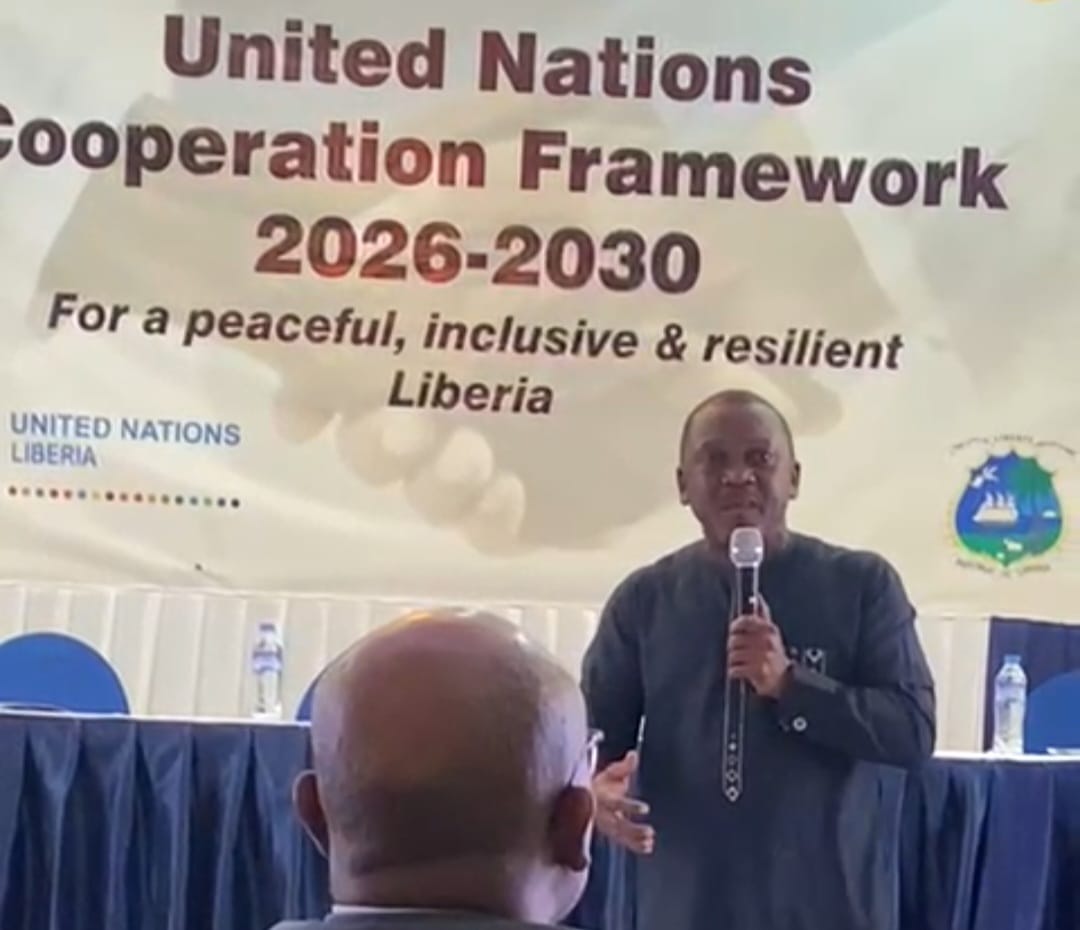
Assistant Minister for Planning at the Ministry of Finance and Development Planning, Wellington Barchue, made the assertions during the launch of the United Nations Sustainable Development Cooperation Framework (UNSDCF) 2026–2030, a roadmap designed to support a “peaceful, inclusive, and resilient Liberia.”
Transport Costs Drop by Over 60% Amid Road Improvements
Barchue highlighted what he called one of the most visible indicators of progress:
the dramatic reduction in transport fares from the southeastern counties to Monrovia, driven primarily by ongoing national road construction.
Transport fares from Maryland County to Monrovia once as high as L$13,000 have fallen to approximately L$5,000, representing a more than 60% reduction.
“When citizens from Maryland County no longer pay thirteen thousand Liberian dollars to come to Monrovia, but instead five thousand, the difference is being used to address the bread-and-butter issues at home,” Barchue said.
The Minister argues that the reduced travel cost is directly improving household disposable income across rural Liberia.
Electricity Access Rises From 33% to 39%
The Assistant Minister also reported an increase in national electricity access from 33% to 39% of the population, one of the largest single-period expansions since the end of the civil conflict.
He described improved power availability as a “game changer” for small businesses, markets, and low-income communities.
“Expanding power access means families spend less on generators and businesses stay open longer. These are critical shifts in people’s everyday lives”, he added.
International development indicators consistently show that every 10% increase in electricity access correlates with measurable gains in productivity and household stability.
Local Jobs Through Infrastructure Projects
Barchue emphasized that many ongoing road projects are being implemented by Liberian-owned companies, creating income opportunities for engineers, machine operators, traders, and local laborers.
“Liberians working on road projects are earning incomes to feed their families. This contributes directly to economic stability,” he noted.
The Assistant Minister estimates that thousands of workers are currently employed through government and donor-supported infrastructure schemes.
Market Prices Stabilizing as Domestic Production Grows
The Assistant Minister also cited price trends in major commercial centers such as Red Light and Duala, where he says an increase in locally produced goods has helped stabilize or reduce market prices.
According to the Minister, the cost of key commodities including vegetables, cassava, palm products, and the nation’s staple food, rice has shown improvement compared to the same period last year.
“Today at our major markets, you see more domestically produced commodities at cheaper prices. Even the price of rice has seen reductions in several areas,” Barchue said.
Independent market data shows that increases in local food supply often reduce reliance on imports and help buffer communities against global price shocks.
Government Counters Opposition Criticism
While opposition groups argue that the government has failed to provide meaningful relief to struggling households, Barchue insisted that the evidence contradicts those claims.
“Though we are not where we want to be, we are not where we used to be when this government took over,” he stated.
He pointed to the broader development strategy under the UNSDCF 2026–2030 crafted with UN agencies and international partners as proof of the administration’s long-term commitment to economic stabilization.
EDITOR’S NOTE
The statements by Assistant Finance Minister Wellington Barchue come at a time when ordinary Liberians are demanding clearer evidence that the administration’s development promises are translating into real-life economic relief.
His assertions declining transport fares, expanded electricity access, job creation through local contracting, and stabilizing market prices present an optimistic narrative of gradual progress.
But these claims also invite deeper scrutiny.
For many families, the “bread-and-butter issues” remain immediate and pressing, shaped not only by government policies but also by volatile global markets, post-conflict infrastructure gaps, and persistent unemployment.
Reductions in transport costs and improvements in power distribution, if sustained, could indeed ease daily burdens.
Yet, the long-term impact depends on whether these initiatives are scaled, monitored, and shielded from political cycles.
Moreover, while the government touts a more than 60% drop in transport fares and a rise in electricity coverage from 33% to 39%, opposition parties argue that isolated improvements cannot substitute for systemic reforms needed to stabilize the broader economy.
As Liberia aligns its development agenda with the United Nations Sustainable Development Cooperation Framework (2026–2030), the coming years will test whether these early indicators mark genuine national progress or simply incremental shifts overshadowed by wider structural challenges.
This publication will continue to follow and assess the administration’s performance on the economic front where, ultimately, numbers matter, but lived realities matter even more.
