
By: Julius Konton
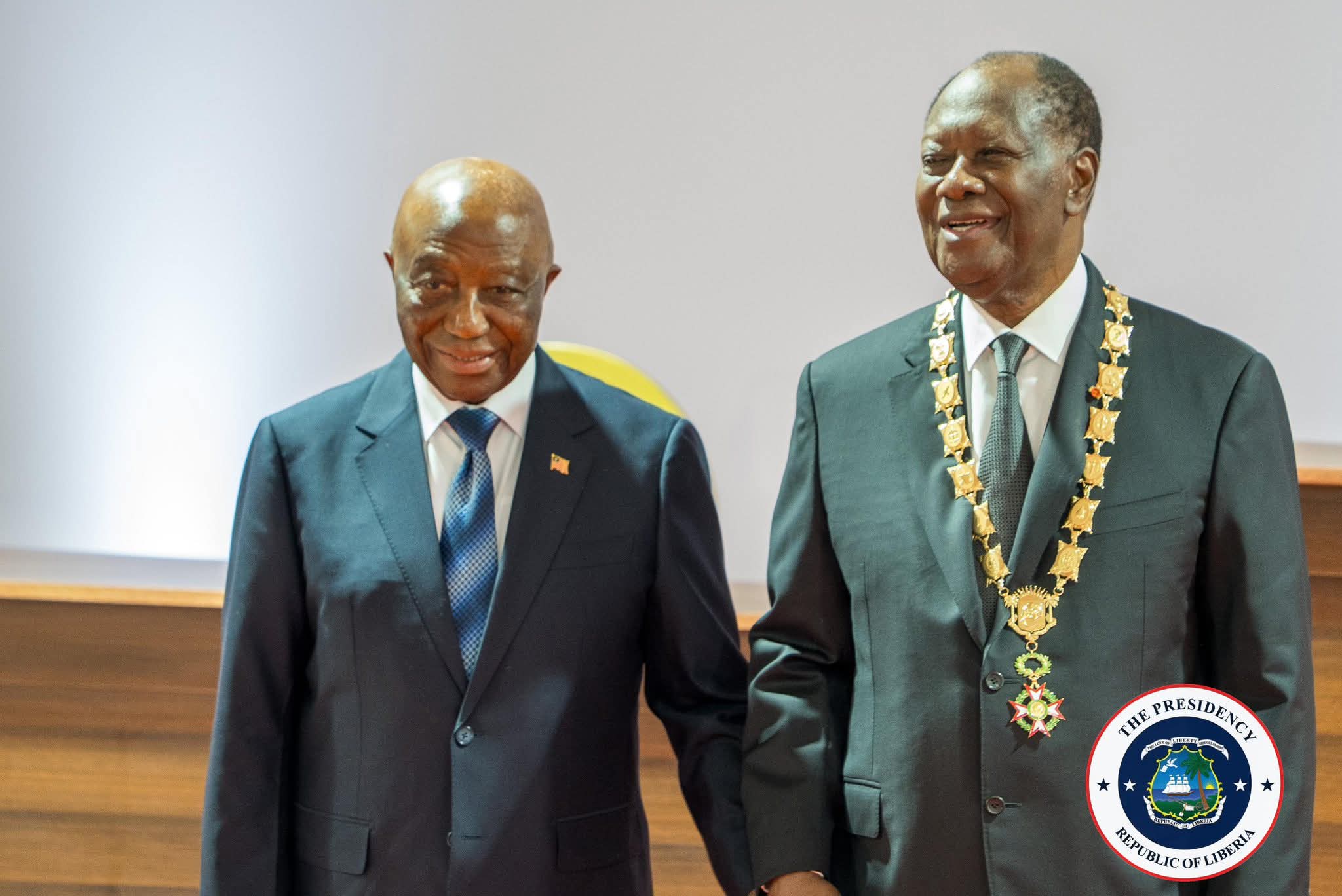
President Joseph Nyuma Boakai on has returned to Liberia after representing the country at the inauguration ceremony of Ivorian President Alassane Dramane Ouattara in Abidjan, an event that brought together an exceptional gathering of West and Central African leaders, underscoring the region’s desire for democratic continuity and political stability.
President Ouattara’s inauguration, held at the Palais de la Présidence, comes at a sensitive moment for the region, where five West African countries have experienced coups or attempted coups since 2020, and where ECOWAS has continued to push for stronger democratic norms and constitutional order.
A Strong Regional Turnout
The high-level ceremony drew some of the most influential leaders in West Africa and beyond, showcasing Côte d’Ivoire’s rising diplomatic weight. Among the attendees were:
Julius Maada Bio, President of Sierra Leone and current ECOWAS Chair
John Dramani Mahama, President of Ghana
Bassirou Diomaye Faye, President of Senegal
Adama Barrow, President of The Gambia
Brice Clotaire Oligui Nguema, President of Gabon
Denis Sassou Nguesso, President of Congo (Brazzaville)
The presence of multiple Heads of State at a time of widespread political tension in the region was widely viewed by analysts as a strong endorsement of Côte d’Ivoire’s stability, given its role as one of West Africa’s fastest-growing economies, recording an average annual GDP growth rate of 7–8% over the last decade, according to regional economic estimates.
Boakai Reaffirms Liberia–Côte d’Ivoire Cooperation
During the sidelines of the ceremony, President Boakai held brief bilateral engagements with President Ouattara, extending warm congratulations on his new term and reaffirming Liberia’s commitment to expanding cooperation with its neighbor.
Boakai praised Ouattara’s leadership, noting improvements in Côte d’Ivoire’s infrastructure, financial stability, and contributions to regional security frameworks.
“Liberia stands ready to broaden collaboration with Côte d’Ivoire in ways that strengthen peace, enhance economic opportunities, and support collective development across our shared borders,” Boakai said.
The Liberian leader emphasized priority areas including:
Cross-border trade improvement, especially along Liberia’s eastern corridor
Joint security operations to curb transnational crime and illicit trafficking
Investment cooperation that benefits both economies
Transport and energy interconnectivity, including ongoing regional electricity-sharing mechanisms
A Region Facing Security and Economic Pressure
Boakai used the occasion to highlight a growing consensus among West African leaders: that economic resilience and peace can no longer be pursued in isolation.
He stressed that a united front is essential as ECOWAS contends with challenges such as:
Growing violent extremism in the Sahel
Trade disruptions caused by political instability
Youth unemployment, which remains above 60% in several ECOWAS countries
The withdrawal of three Sahel states (Mali, Burkina Faso, Niger) from ECOWAS structures
“The future of West Africa depends on collective action,” Boakai remarked.
“We must strengthen cooperation to ensure a stable environment where our citizens can thrive.”
A Symbol of Liberia’s Renewed Diplomatic Presence
President Boakai’s participation in the inauguration demonstrates Liberia’s re-engagement in regional diplomacy after years of perceived inconsistency.
Analysts note that Liberia’s active presence sends a message of stability and renewed interest in shaping regional dialogue.
Diplomatic observers also highlight that Côte d’Ivoire remains one of Liberia’s most critical partners:
Over 30% of Liberia’s cross-border trade flows through Ivorian corridors.
Both nations share a border stretching more than 700 kilometers.
Côte d’Ivoire remains a major transit route for Liberian goods heading to international markets.
Homecoming With a Regional Message
Upon his return to Monrovia, President Boakai was received by senior government officials and reaffirmed that Liberia would continue strengthening its ties not only with Côte d’Ivoire but with the wider ECOWAS community.
His Abidjan visit, short but symbolically significant, signals Liberia’s ambition to reposition itself as an active contributor to regional peace, democratic governance, and multilateral development cooperation.
