
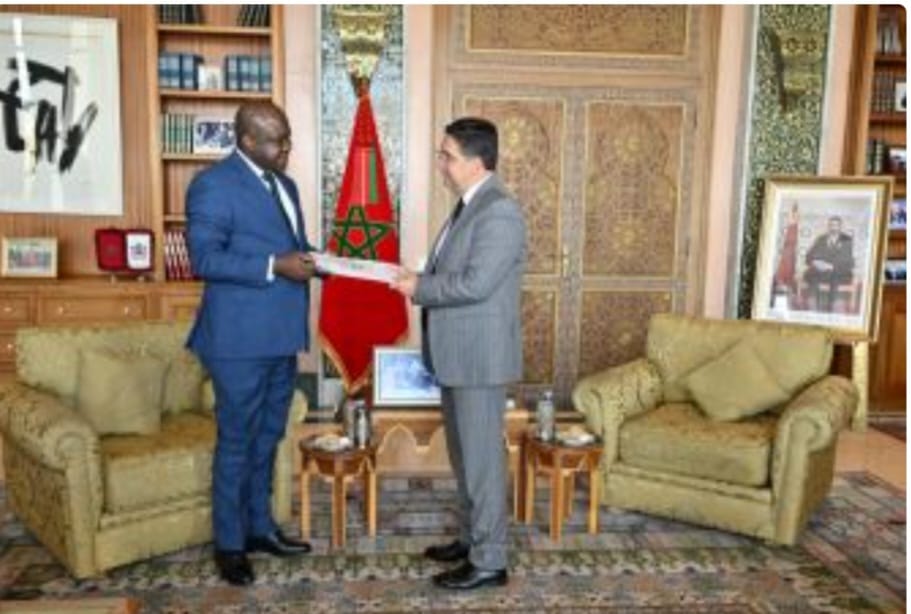
Diplomatic ties between the Kingdom of Morocco and the DR Congo gained renewed momentum as Moroccan Foreign Minister received Congolese Deputy Foreign Minister in Rabat, in a meeting underscoring deepening bilateral cooperation and growing regional solidarity.
Mbadu Phanzu, who serves as Deputy Minister attached to the Minister of State and Minister of Foreign Affairs of the DRC in charge of Francophonie and Congolese nationals living abroad, delivered an official message to His Majesty King of Morocco from Congolese President .
The meeting comes at a critical time for the International Organisation of La Francophonie (OIF), a 54-member global institution representing more than 321 million French speakers across five continents and accounting for nearly 16% of the world’s GDP.
The DRC, home to over 110 million people, remains the world’s largest French-speaking country by population, making its leadership ambitions within the Francophone bloc increasingly significant.
Speaking to reporters after the high-level discussions, Mbadu Phanzu praised the “excellent” and historic bilateral relationship between Rabat and Kinshasa, describing the partnership as one rooted in decades of political trust, economic cooperation, and mutual respect.
“Our two nations share a long-standing friendship built on solidarity and common aspirations for Africa’s progress,” he said.
Beyond diplomatic exchanges, the Congolese envoy revealed that part of the mission was to rally support for the DRC’s candidacy for the position of Secretary-General of the OIF, one of the most influential cultural and political institutions in the Francophone world.
Accompanying the delegation was , Kinshasa’s official candidate for the top Francophonie post and daughter of Congo’s independence icon .
Lumumba highlighted the enduring bonds between the two African nations, recalling a symbolic historical moment when her father was decorated by the late King during the height of Africa’s anti-colonial liberation era.
Political analysts note that Morocco has increasingly expanded its diplomatic footprint across Africa, with more than 45 African countries now maintaining diplomatic representation in Rabat, while bilateral trade between Morocco and sub-Saharan Africa has grown by over 65% in the last decade, according to regional economic reports.
Lumumba emphasized what she called a “shared vision” between Morocco and the DRC on key principles including sovereignty, inclusiveness, African unity, and social cohesion.
“We need a Francophonie of the people, with the people, and for the people,” she declared.
The visit signals not only Kinshasa’s strategic lobbying ahead of future OIF leadership deliberations but also reflects the broader reconfiguration of African diplomacy, where alliances within regional and linguistic blocs are becoming increasingly central to geopolitical influence.
For Morocco, the engagement reinforces Rabat’s role as a major diplomatic bridge between North and sub-Saharan Africa.
For the DRC, it represents another step toward consolidating its voice on the global Francophone stage.
