
By: Julius Konton
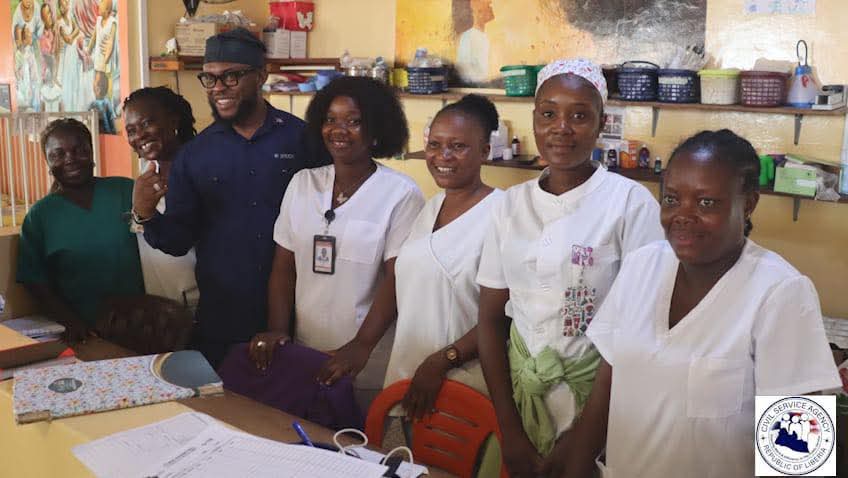
In a significant move aimed at strengthening Liberia’s healthcare system and improving welfare for frontline medical professionals, the Director-General of the Civil Service Agency (CSA), Dr. Josiah F. Joekai Jr., toured the renowned ELWA Hospital in Paynesville and commended the institution’s administration and staff for their enduring contribution to the country’s health sector.
The high-level visit followed a landmark announcement by the CSA confirming that 304 employees of ELWA Hospital have officially been placed on the Government of Liberia payroll , a decision widely viewed as a major boost to the country’s struggling healthcare workforce.
Dr. Joekai described ELWA Hospital as one of Liberia’s most dependable medical institutions, noting that its healthcare professionals have consistently demonstrated dedication and resilience in serving thousands of Liberians despite years of financial and logistical challenges.
“Healthcare workers remain the backbone of every functioning society, and institutions like ELWA Hospital continue to play a pivotal role in national development and public health delivery,” Dr. Joekai stated during the visit.
The CSA Director-General emphasized that the payroll inclusion aligns with President Joseph Nyuma Boakai Sr.’s broader governance and public sector reform agenda, which prioritizes healthcare accessibility, workforce stabilization, and improved service delivery across government-supported institutions.
Hospital administrators and staff members welcomed the development with appreciation, describing the government’s intervention as both timely and transformative.
Management expressed gratitude to President Boakai and the Civil Service Agency for recognizing the sacrifices and contributions of healthcare professionals working at ELWA Hospital.
According to hospital officials, the inclusion of 304 workers on the national payroll is expected to improve staff motivation, retention, and operational efficiency while enhancing healthcare services for patients across Liberia.
Liberia’s healthcare system continues to face significant challenges more than a decade after the devastating 2014–2016 Ebola outbreak, which claimed over 4,800 lives in the country and exposed severe weaknesses within the national health infrastructure.
The crisis led to the deaths of hundreds of healthcare workers across West Africa and intensified calls for greater government investment in medical institutions and personnel.
ELWA Hospital itself became internationally recognized during the Ebola epidemic after serving as one of the country’s frontline treatment and response centers.
The institution played a critical role in emergency care, disease containment, and humanitarian response efforts during one of Liberia’s darkest public health emergencies.
Health sector analysts say the latest payroll initiative could contribute to improved healthcare delivery standards in Liberia, where the World Health Organization estimates that the ratio of healthcare workers to population remains below global recommendations for developing nations.
Liberia, a nation of more than five million people, continues to rely heavily on partnerships between government agencies, faith-based institutions, and international organizations to provide healthcare services nationwide.
ELWA Hospital, operated by the Eternal Love Winning Africa (ELWA) network, remains one of the country’s most respected faith-based medical institutions.
Observers believe the government’s decision to absorb additional healthcare workers onto the public payroll signals a growing commitment to strengthening Liberia’s healthcare workforce amid increasing demand for medical services, urban population growth, and persistent public health challenges.
The move also comes at a time when African governments are facing mounting pressure to increase healthcare spending under the African Union’s Abuja Declaration target, which recommends allocating at least 15 percent of national budgets to health services.
For many employees at ELWA Hospital, the government payroll inclusion represents not only financial security but also national recognition for years of dedicated service to Liberia’s healthcare system.
As Liberia continues efforts to modernize its public institutions and improve healthcare access, stakeholders say sustained investment in medical personnel, infrastructure, and training will remain essential to building a resilient and responsive national health sector.
