
By: Julius Konton
Liberia’s Civil Service Agency has opened discussions with U.S.-based Williams College on a potential graduate education partnership aimed at expanding advanced academic and professional development opportunities for the country’s public-sector workforce.
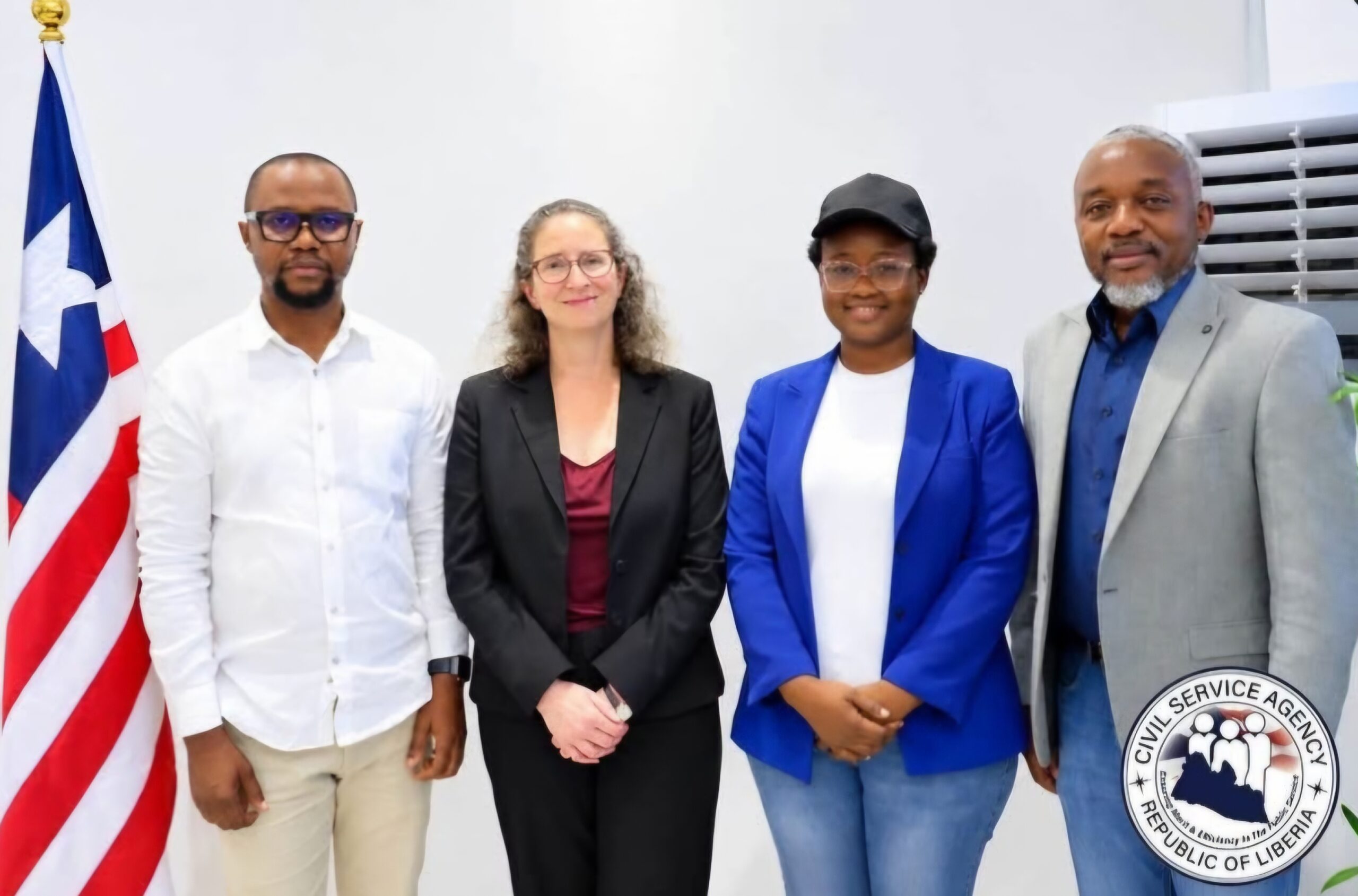
The discussions, held Thursday in Monrovia, brought together CSA officials and Rachel J. Louis, Associate Director at Williams College, to examine the possibility of establishing a specialized Master’s degree program designed for working public-sector professionals.
Under the proposal presented during the meeting, the program would run for approximately 10 months, allowing participants to pursue graduate-level education while continuing their professional responsibilities in government.
An initial cohort of about 26 participants is being considered, with the possibility of expanding enrollment in subsequent cohorts.
The proposed initiative comes as Liberia continues to confront the challenge of strengthening the capacity, professionalism and effectiveness of its public institutions.
The CSA’s 2025 Annual Report shows that the Government of Liberia’s consolidated payroll stood at 63,130 employees during fiscal year 2025, with education accounting for 19,995 workers, security and rule-of-law institutions 13,797, and health 11,471.
Public Administration and Municipal Government together accounted for another 10,548 employees.
Against that backdrop, the proposed graduate program could provide a targeted mechanism for developing higher-level expertise among government employees, particularly professionals already holding bachelor’s degrees and those whose experience and qualifications may warrant consideration under the program’s proposed admission framework.
Liberia’s effort to professionalize its public administration follows years of institutional reform aimed at improving workforce management, accountability and service delivery.
The Civil Service Agency, established by an Act of the Legislature in 1973, serves as the Government of Liberia’s principal human-resource institution and is responsible for managing the civil service workforce and enforcing established personnel policies and regulations.
In recent years, the agency has intensified efforts to improve the accuracy and integrity of government personnel records.
During its 2024 Employee Status Regularization Project, the government workforce was reduced from 67,746 employees to 60,900 by October 2024, while the reported monthly wage bill declined from US$23.5 million to US$21.1 million, according to the CSA’s 2024 Annual Report.
The agency has also expanded personnel and credential verification across government institutions, part of a broader effort to ensure that employee records accurately reflect qualifications, employment status and workforce needs.
The proposed partnership with Williams College therefore comes at a time when Liberia is attempting to combine workforce rationalization with professional development and institutional capacity building.
International development institutions have increasingly emphasized the importance of strengthening the skills and professional capabilities of government employees as part of broader public-sector reform.
The World Bank’s US$30 million Governance Reform and Accountability Transformation (GREAT) Project, approved for Liberia in 2024, includes efforts to strengthen government institutions and sustainably build the capacity of civil servants to implement reform programs.
The project is also designed to improve public-service delivery, accountability, transparency and the use of digital government systems.
The World Bank has separately highlighted professional learning and development as an important component of effective public administration, alongside improvements in organizational structures, workforce management, compensation systems and digital skills.
Liberia has already experimented with performance-management reforms.
World Bank research on the country’s civil service found that the introduction of a comprehensive performance-appraisal system was associated with reductions in absenteeism and turnover and increased employee satisfaction, illustrating the potential relationship between institutional reform and workforce performance.
During Thursday’s discussions, Louis outlined a potential academic model that would build on participants’ existing bachelor’s-level education while also allowing consideration for experienced professionals and selected exceptions based on relevant qualifications and professional experience.
If ultimately finalized, the program would represent a relatively compact pathway for mid-career government employees seeking advanced qualifications without necessarily leaving the public service for an extended period.
For Liberia, such an arrangement could be particularly significant because the government employs tens of thousands of people across sectors ranging from education and health to security, administration and local government.
The challenge is not simply increasing the size of the workforce, but ensuring that employees possess the specialized skills required to formulate policies, manage public resources, deliver services and implement national development programs.
The initiative could also create opportunities for knowledge transfer between Liberian public institutions and an established U.S. higher-education institution, although the precise academic structure, accreditation arrangements, financing, admissions criteria and delivery format would need to be determined before the program becomes operational.
The meeting was attended by Atty. Dahnu Mianyen, Deputy Director General for Administration and Finance; Claudius Broderick, Director of the Career Management and Training Division; and Mrs. Kumba Zotaa-Kiidii, Assistant Director for Training.
For the CSA, the discussions form part of its broader emphasis on continuous learning, professional development and human-capital management within Liberia’s public sector.
The agency has continued to conduct manpower hearings and workforce assessments across government institutions.
In 2026, the CSA said its annual manpower hearings were being conducted for 109 government spending entities, with the process intended to identify personnel needs, workforce gaps and development priorities while promoting fiscal discipline.
The potential partnership reflects a broader question facing Liberia’s public sector: how to translate educational advancement into measurable improvements in government performance.
A graduate degree alone does not automatically guarantee better public services.
Its impact would depend on whether participants acquire practical skills relevant to policy development, leadership, public financial management, digital transformation, human-resource administration and institutional accountability and whether those skills are subsequently applied within government institutions.
The proposed Williams College initiative, if finalized, could therefore become part of a larger strategy to link education and professional advancement with Liberia’s ongoing civil-service reforms.
The CSA and Williams College have yet to publicly announce a finalized agreement, tuition arrangements, accreditation details or a confirmed launch date.
But the talks signal Liberia’s continuing search for partnerships capable of strengthening the professional foundations of its public administration at a time when the government is seeking to improve efficiency, accountability and the quality of services delivered to citizens.
