
By: Julius Konton
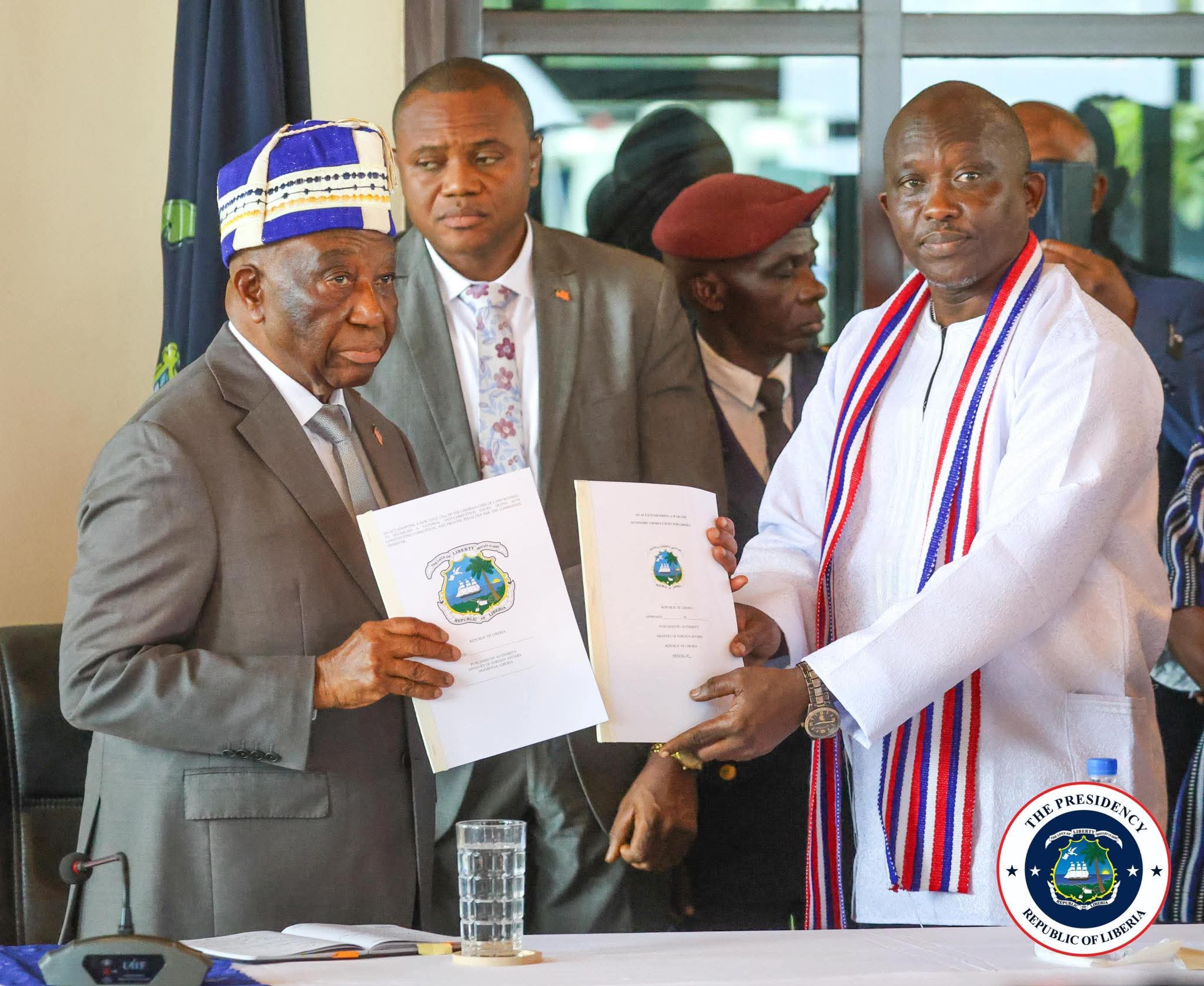
Liberia has taken another major step toward confronting decades of impunity and rebuilding public confidence in state institutions after President Joseph Nyuma Boakai received draft legislations seeking the establishment of a Special War Crimes Court and a National Anti-Corruption Court.
The proposed legislation, formally presented at the Executive Mansion on May 6, 2026, represents one of the most ambitious governance and accountability initiatives in Liberia’s post-war history.
The bills were submitted by the Office of the War and Economic Crimes Court for Liberia (OWECC-L), whose mandate was recently extended for an additional year through Executive Order No. 164 signed by President Boakai on May 1, 2026.
The extension is intended to accelerate the legal, institutional, and operational framework necessary to establish both courts, which are expected to address wartime atrocities and large-scale corruption cases that have undermined Liberia’s democratic and economic progress for decades.
Speaking during the presentation ceremony, President Boakai described the initiative as a defining pillar of his administration’s governance and reform agenda.
“I didn’t come to this position to look for precedence. We came on a rescue mission,” President Boakai declared, emphasizing that the courts are designed to strengthen Liberia’s justice system rather than target political opponents or individuals.
The President stressed that Liberia must reaffirm its commitment to justice, accountability, human rights, and international legal standards after years of domestic and international calls for action against perpetrators of war crimes and economic abuses.
A Long Road to Justice
Liberia’s civil wars, which lasted from 1989 to 2003, claimed an estimated 250,000 lives and displaced nearly half the country’s population, according to international human rights organizations.
Thousands of civilians were subjected to massacres, torture, rape, forced recruitment of child soldiers, and widespread destruction of property.
In 2009, Liberia’s Truth and Reconciliation Commission (TRC) recommended the establishment of a war crimes court to prosecute those responsible for atrocities committed during the conflicts.
However, successive governments failed to fully implement the recommendation, despite increasing pressure from victims’ groups, civil society organizations, and the international community.
Liberia remains one of the few post-conflict countries in West Africa that has yet to establish a domestic tribunal to prosecute wartime atrocities.
International legal experts say the proposed court could become a historic mechanism for justice and national healing, similar to accountability efforts undertaken in countries such as Sierra Leone and Rwanda following periods of violent conflict.
Fighting Corruption and Restoring Trust
Alongside the proposed war crimes tribunal, the draft legislation also seeks to establish a National Anti-Corruption Court, a move analysts say could significantly strengthen Liberia’s fight against public sector corruption.
Corruption has consistently ranked among Liberia’s most persistent governance challenges.
According to recent global governance assessments, Liberia continues to struggle with transparency, accountability, and public financial management despite reforms introduced over the years.
The anti-corruption court would be expected to prosecute major economic crimes, misuse of public funds, illicit enrichment, and abuses of office, while supporting existing anti-graft institutions in ensuring faster adjudication of corruption-related cases.
President Boakai linked the initiative directly to his administration’s ARREST Agenda for Inclusive Development, stressing that ending impunity is critical to restoring public confidence in government institutions and ensuring equitable management of national resources.
“This exercise is to make our country respected again,” the President said, calling on lawmakers and citizens to support the passage of the draft bills.
Political observers believe the establishment of specialized courts could also improve Liberia’s international image and strengthen investor confidence in the country’s legal and governance systems.
International Obligations and Democratic Governance
President Boakai further noted that the proposed courts align with Liberia’s international treaty obligations and broader commitments to democratic governance and human rights protection.
The initiative has already attracted attention from regional and international partners who have long advocated for stronger accountability measures in Liberia.
Human rights organizations have repeatedly argued that the absence of prosecutions for wartime crimes has contributed to a culture of impunity and weakened trust in the rule of law.
The submission of the draft bills now places the matter before the Liberian Legislature, where lawmakers are expected to debate the legal structure, jurisdiction, and operational mechanisms of the proposed courts.
If enacted, the legislation would mark a historic turning point in Liberia’s democratic journey and could become one of the most consequential justice reforms since the end of the country’s civil conflict more than two decades ago.
For many Liberians, particularly victims and survivors of the wars, the move represents renewed hope that justice delayed may no longer be justice denied.
