
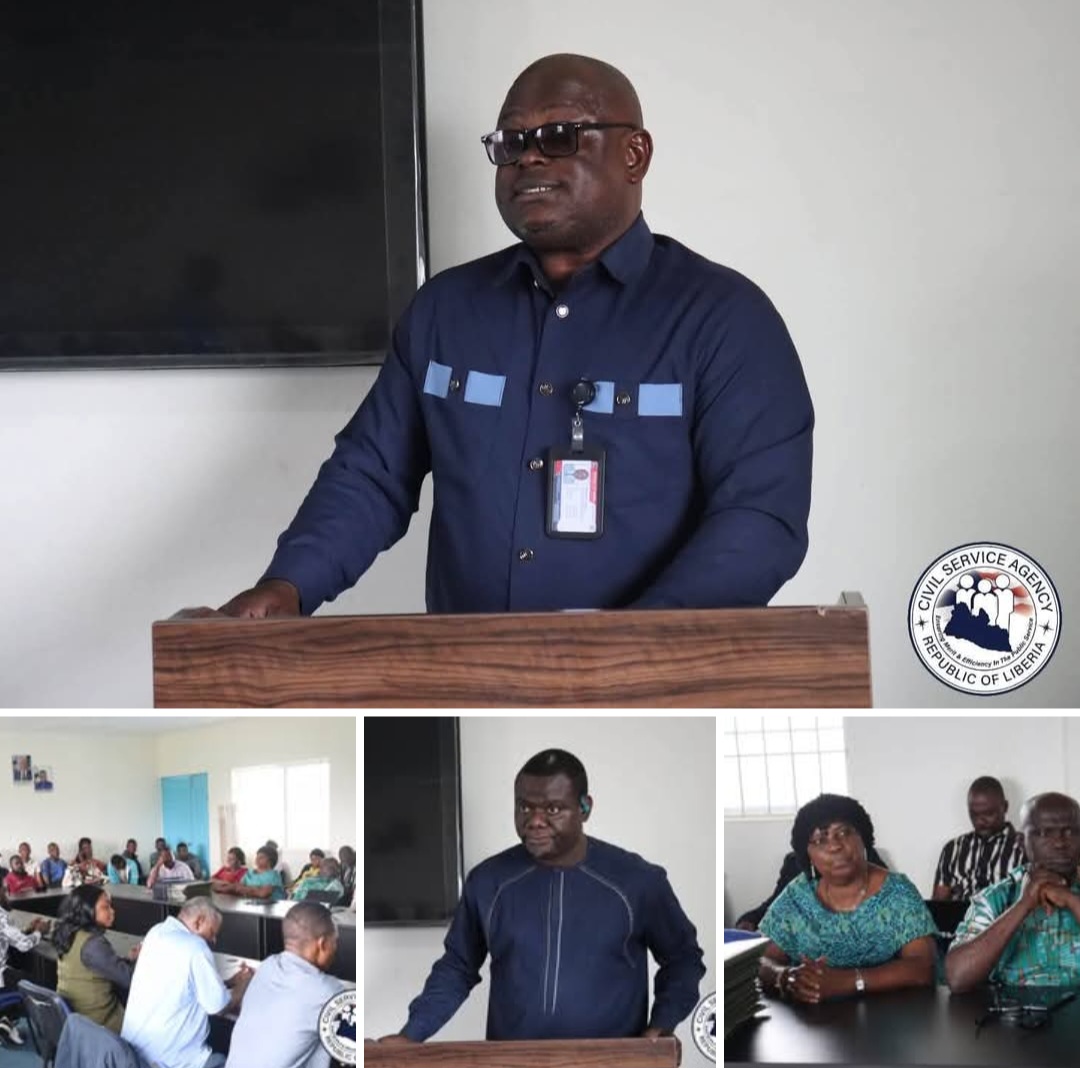
By: Julius Konton
Liberia’s Civil Service Agency (CSA) has launched a four-day personnel and credential verification exercise at the Liberia Institute for Public Administration (LIPA), stepping up efforts to strengthen the accuracy of government workforce records, institutional accountability and integrity across the public service.
The exercise, which began Tuesday at LIPA’s headquarters along the Roberts International Airport Highway in Lower Margibi County, is focused on establishing a more accurate picture of the institution’s workforce and ensuring that personnel records correspond with the requirements governing Liberia’s public service.
The initiative is being led by the CSA under the leadership of its human-resource management structure and is intended to examine key components of personnel administration, including employment and appointment records, academic and professional qualifications, personnel status, attendance and time records, and other documentation contained in employees’ personnel files.
According to Acting CSA Director-General Edwin K. Jallah, the exercise is intended to go beyond a routine administrative inspection.
Jallah said reliable personnel information is fundamental to effective human-resource management and that the verification process will help establish accurate, current and credible records that can support future personnel and institutional decisions.
“This verification exercise will cover personnel files, employment and appointment records, academic and professional credentials, personnel status, and attendance and time records,” Jallah said.
The LIPA exercise comes as the CSA continues a broader program of personnel and credential verification across Liberia’s public institutions.
The Agency’s Compliance and Integrity Management Division describes personnel and credential verification, compliance audits, forensic investigations, ethics promotion and data-integrity management as part of its institutional mandate to strengthen the civil service and protect the integrity of government personnel systems.
In February 2026, the CSA reported expanding personnel and credential verification to the Governance Commission, Ministry of Mines and Energy and Ministry of Transport.
The Agency said the process was designed to improve workforce data accuracy and strengthen human-resource management across government institutions.
In August, the CSA also reported presenting verification reports to four government entities, the Ministry of Public Works, Liberia Land Authority, National Housing Authority and Liberia Refugee Repatriation and Resettlement Commission.
The reports included information on employment status, credential validation, personnel-file updates, reclassification and redeployment, as well as other human-resource indicators.
The verification initiative therefore forms part of a continuing institutional process rather than an isolated intervention at LIPA.
The exercise has particular significance because of LIPA’s role in developing Liberia’s public-sector workforce.
LIPA was established by an Act of the Liberian Legislature in 1969 and began full operations in 1972.
Its original mandate was centered on improving administrative performance and the professional capabilities of government personnel through training, research and public-administration consultancy.
LIPA’s 2024 annual report describes the institution as a public-sector capacity-building and management-development institution with responsibilities that include in-service training, professional development, leadership development, research and consultancy.
That mandate places the institution at the center of Liberia’s efforts to build a professional and capable public administration.
LIPA’s importance has also been reflected in collaboration with other government institutions.
In October 2024, the CSA, Governance Commission and LIPA signed a memorandum of understanding aimed at strengthening public-sector reform and capacity-building through greater institutional cooperation.
According to Alexander Bassey, Director of the Credentials and Integrity Management Division at the CSA, LIPA employees participating in the exercise will first complete consent forms authorizing third-party verification of their academic and professional credentials.
Personnel files will subsequently be reviewed against an established verification checklist.
Bassey said employees will also have an opportunity to provide missing documentation as part of the process, allowing the exercise to distinguish between incomplete records and matters requiring further administrative review.
The approach is intended to establish facts, validate existing information, identify gaps and improve the quality of personnel records.
Rather than treating verification solely as a compliance exercise, the CSA says the process is designed to generate reliable human-resource information that can support workforce planning and institutional decision-making.
For LIPA, the exercise comes against the backdrop of its responsibility to train and strengthen the capabilities of Liberia’s public servants.
LIPA Deputy Director-General for Administration Michael Wah welcomed the CSA team and described the verification process as an important step toward strengthening accountability, professionalism and institutional capacity.
Wah emphasized the importance of maintaining credible personnel information at an institution whose mandate is closely connected to the professional development of Liberia’s public workforce.
Accurate government workforce data has implications beyond individual personnel files.
The CSA says reliable personnel information supports human-resource planning, recruitment, performance management, career development and service delivery.
The Agency was established in 1973 by an Act of the Legislature to increase efficiency in Liberia’s civil service and serves as the central personnel agency for ministries, agencies and commissions of government.
The World Bank likewise identifies reliable public-sector employment and workforce data as an important component of understanding state capability, workforce composition, wages and the fiscal implications of public employment.
Its Worldwide Bureaucracy Indicators compile public-sector employment and wage information across 202 economies.
For Liberia, strengthening administrative systems remains particularly important as the country continues to expand its institutional capacity.
World Bank data put Liberia’s population at approximately 5.73 million in 2025, with the economy estimated at about US$5.25 billion in current-dollar terms.
The country recorded approximately 5 percent GDP growth in 2025, according to the World Bank.
These broader economic and demographic indicators underline the importance of an efficient public administration capable of managing public resources and delivering government services to a growing population.
Lessons from previous verification exercises
The CSA’s ongoing verification program has already produced substantial personnel-management findings in other parts of government.
In May 2026, the Liberia Broadcasting System reported that the CSA recommended blocking 1,381 unverified employees from the Ministry of Local Government payroll pending verification.
The report also said the Agency identified 305 employees associated with attendance anomalies and recommended administrative action.
The figures illustrate why the government has increasingly focused on personnel verification, payroll integrity and accurate workforce information.
At the same time, verification exercises can provide government institutions with information needed to correct incomplete personnel records, regularize employment documentation and improve workforce planning.
Toward a more data-driven civil service
The LIPA exercise is expected to contribute to the CSA’s wider objective of creating accurate and dependable personnel information across Liberia’s public service.
The Agency has increasingly linked verification exercises with broader reforms in human-resource management, digital personnel systems and institutional workforce planning.
In a 2026 report on verification work involving the Ministry of Local Government, the CSA highlighted the importance of personnel data in strengthening workforce management and supporting institutional reform.
For LIPA, the exercise also presents an opportunity to ensure that the institution responsible for strengthening the capacity of public servants maintains strong internal personnel-management systems.
As Liberia continues efforts to professionalize its public administration, the credibility of personnel records from appointment letters and employment status to academic qualifications and attendance is likely to remain an important component of government accountability.
The four-day verification exercise at LIPA is therefore part of a larger national conversation about how Liberia manages its public workforce, safeguards the integrity of government records and builds institutions capable of delivering effective services to citizens.
The CSA says its broader objective is to strengthen the integrity, accuracy and reliability of personnel records across Liberia’s public service and ensure that such information provides a sound basis for human-resource management and future institutional decision-making.
