
By: Julius Konton
President Joseph Nyuma Boakai Sr. has welcomed a new initiative by the Friends of Providence Island aimed at preserving and promoting one of Liberia’s most historically significant landmarks, as his administration moves to strengthen heritage conservation and develop cultural tourism.
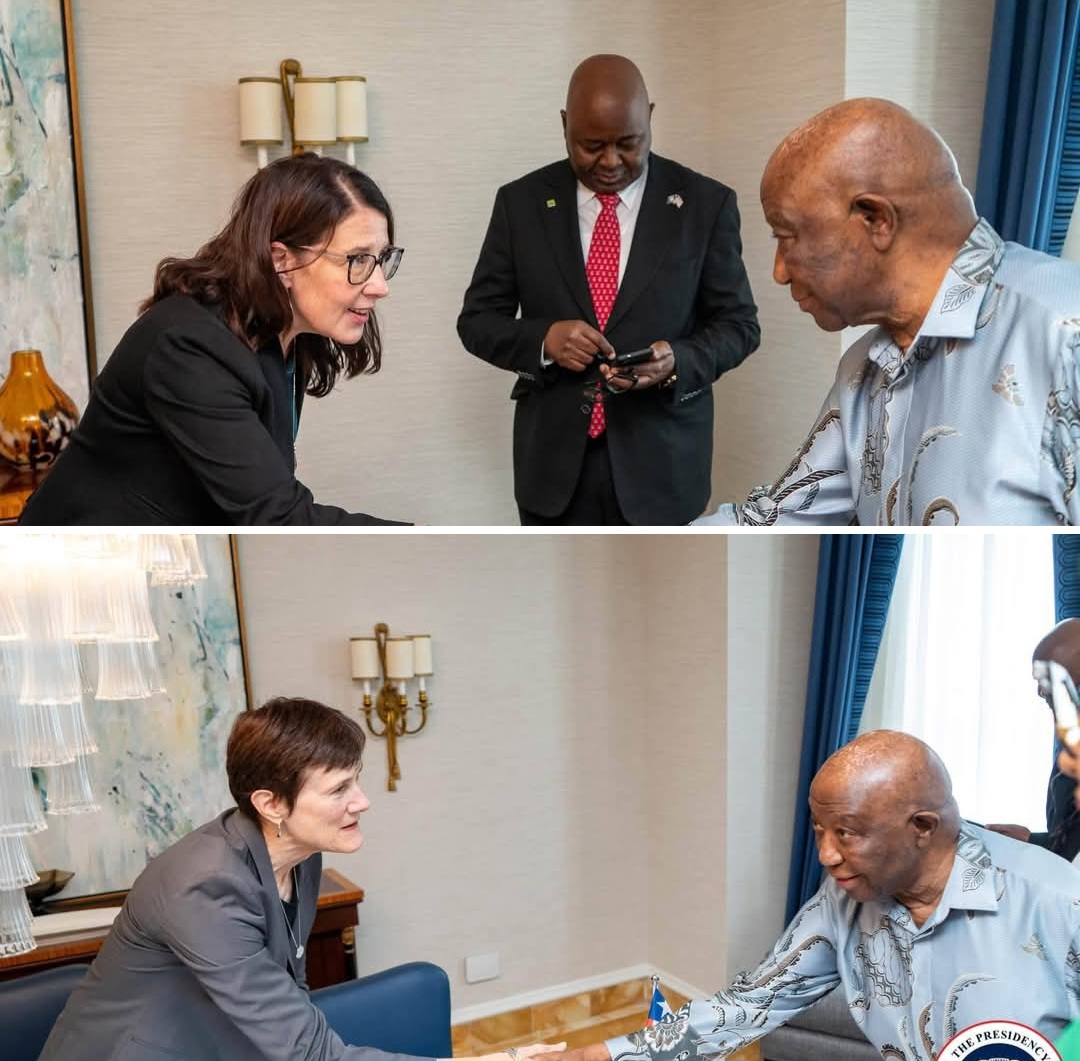
President Boakai met with representatives in Washington, D.C., with Friends of Providence Island, who presented proposals for supporting the preservation of the historic site and increasing public awareness of its role in Liberia’s national story.
The delegation was led by Alison Grunder, a former U.S. diplomat who served as Chargé d’Affaires in Liberia from 2018 to 2021, and Allison James, Memorialization Project Director at James Madison’s Montpelier, a historic preservation institution in the United States.
The meeting was also attended by Liberia’s Ambassador to the United States, Dr. Al-Hassan Conteh; Minister of State Without Portfolio Hadja Mamaka Bility; Director General of the Cabinet Nathaniel T. Kwabo; and Deputy Minister for Administration at the Ministry of State, Bill McGill Jones.
The Liberian Embassy confirmed the engagement in an official statement.
The initiative comes amid renewed government attention to Providence Island.
In August, President Boakai broke ground for a government-backed development project on the island, with the Liberia National Tourism Authority describing the site as an important component of the country’s tourism and heritage-development strategy.
The project is intended to support tourism infrastructure, destination development and preservation of the historic location.
Located in the Mesurado River area of Monrovia, Providence Island historically known as Dozoa covers approximately 11.22 acres and lies between the Mesurado River and Stockton Creek.
UNESCO identifies the island as a site of major cultural and historical significance, citing its association with the arrival of freed Black Americans and the formation of the Liberian state.
The site contains remnants including an old landing dock, an ancient water well, foundations associated with early settlements and a large cotton tree estimated in Liberia’s historical record to be about 250 years old.
UNESCO has placed Providence Island on Liberia’s Tentative List for World Heritage, meaning it has been identified for possible future nomination but is not currently inscribed on the World Heritage List.
Providence Island is closely connected to the emergence of modern Liberia.
In 1822, settlers supported by the American Colonization Society established themselves around Cape Mesurado after an earlier settlement attempt at Sherbro Island in present-day Sierra Leone encountered severe difficulties.
The Library of Congress records that the first group reached Cape Mesurado in April 1822, while historical accounts associate Providence Island with the early arrival and settlement of free Black Americans.
The island’s significance extends beyond the story of migration.
The U.S. Department of State noted during the 2022 bicentennial that roughly 16,000 Black Americans immigrated to Liberia during the 19th century with support from the American Colonization Society, while thousands of Africans rescued from the transatlantic slave trade were also resettled in Liberia.
The department also acknowledged the complex and contested history surrounding the American Colonization Society, including the racial conditions that shaped the movement and the fact that slavery continued in parts of the United States after the first settlers arrived in Liberia.
The development of Liberia eventually culminated in independence in 1847, when the colony became the Republic of Liberia.
The Library of Congress records that several settlements merged in 1838 to form the Commonwealth of Liberia, while independence was declared in 1847.
For Liberia, therefore, Providence Island represents more than a potential tourist attraction. UNESCO describes it as a place associated with the transition from the history of the transatlantic slave trade to the establishment of a new Black-led political community in West Africa.
The organization also identifies the island’s potential role in education, cultural memory, reconciliation and social cohesion.
At the same time, UNESCO has warned that the site remains vulnerable to urban development, riverbank erosion and other environmental pressures.
President Boakai, according to the Liberian Embassy, welcomed the Friends of Providence Island initiative and emphasized the potential benefits of preservation for historical education, sustainable tourism and communities connected to the site.
He also encouraged continued cooperation among relevant Liberian institutions and other stakeholders to develop a coordinated and sustainable approach to the island’s preservation and development.
The renewed focus places Providence Island at the intersection of history, heritage conservation, tourism and national identity.
If preservation, infrastructure development and historical interpretation advance together, the island could become an important destination for Liberians, members of the African diaspora, researchers and international visitors seeking to understand the complex history behind the founding of Africa’s oldest modern republic.
With Liberia already pursuing a broader tourism-development strategy, the challenge will be to ensure that physical redevelopment does not overshadow the archaeological, cultural and historical character that gives Providence Island its significance.
UNESCO’s existing assessment underscores the need to protect the site’s remaining historic features while managing development and environmental pressures.
The engagement between President Boakai and the Friends of Providence Island consequently adds an international dimension to Liberia’s renewed effort to preserve the site.
It also highlights a growing recognition that Providence Island’s historical value extends beyond Liberia’s borders, connecting the country’s national story to the wider history of the African diaspora, slavery, emancipation and the formation of new political communities in Africa.
