
By: Julius Konton
Liberia’s historic crossing of the US$1 billion mark in domestic revenue collection has become the subject of growing public debate, with Finance and Development Planning Minister Augustine Kpehe Ngafuan defending the achievement and arguing that the milestone must be measured not only in fiscal figures but also in the infrastructure and development gains it is helping to finance.
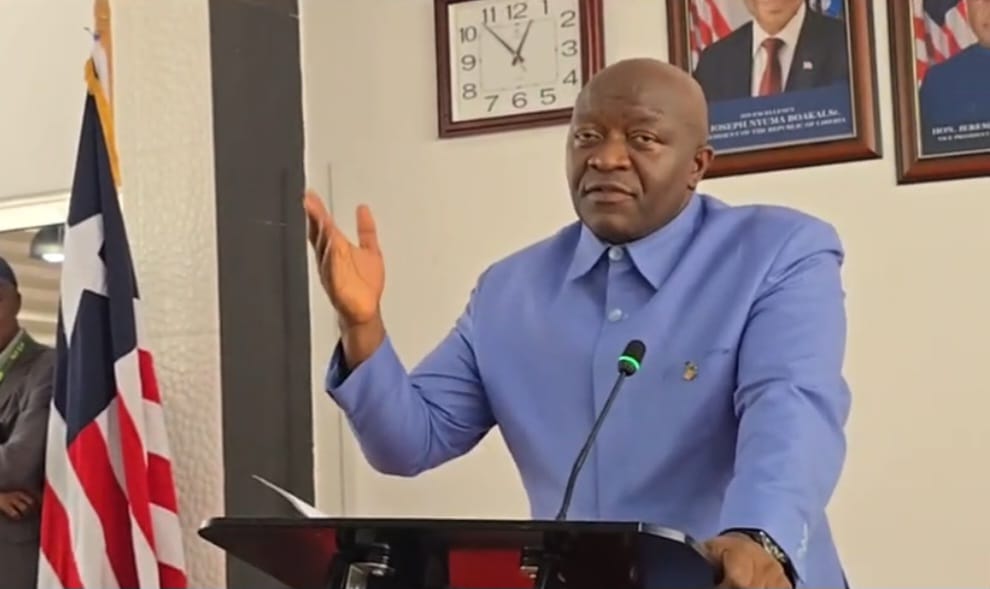
Addressing professional women of the Ministry of Finance and Development Planning during a ceremony marking the second anniversary of his formal assumption of office, Ngafuan pushed back against criticism questioning the tangible impact of the revenue achievement.
He said the government’s record should be judged against visible developments across the country, particularly improvements in roads and connectivity.
“I’m knocking on the billion because some people, you will have to knock the billion before they know,” Ngafuan said, emphasizing that the milestone represents more than a figure in a government ledger.
The Liberia Revenue Authority reported that domestic collections increased from approximately US$699 million in 2024 to US$848 million in 2025, surpassing the 2025 target of US$804.6 million.
By August 18, 2026, collections had reached US$904.7 million. Liberia subsequently crossed the US$1 billion threshold in September, according to the government.
President Joseph Nyuma Boakai has described the achievement as the first time in Liberia’s 179-year history that the country has generated more than US$1 billion in domestic revenue in a single year without relying on borrowing or foreign aid for that milestone.
The government has set a broader US$1.3 billion revenue target for fiscal year 2026.
Ngafuan said his recent trip to southeastern Liberia provided him with an opportunity to observe some of the practical effects of increased public investment.
“I saw the roads, yes, the roads have improved,” he said, recounting his journey through the Southeast.
He also pointed to the operation of National Transit Authority buses serving routes between Monrovia and southeastern Liberia as evidence of improved connectivity.
“When I was coming from the Southeast, I saw two NTA buses: one going to Monrovia and one coming to Harper. Before that was inconceivable,” he said.
The minister challenged those who argue that development remains insufficient to identify the areas where progress should be measured, while stressing that national development should transcend political party affiliations.
“Those who do not see development, tell me what you see. The best way to unite this country is through development,” he told the gathering.
His comments come as Liberia seeks to translate increased domestic resource mobilization into infrastructure, social services and economic activity.
The Ministry of Finance’s fiscal responsibilities include national budgeting, fiscal policy and public financial management, making the sustainability and utilization of domestic revenue central to the government’s development agenda.
Ngafuan also placed Liberia’s revenue achievement within the broader economic context of neighboring West African countries.
“A billion for an entire country is not too big, especially when all our neighbors had been in the billions long ago and looking at our age,” he said, arguing that Liberia’s achievement should be understood as a starting point rather than an endpoint.
Available World Bank data illustrate the different economic scales of the three Mano River Union economies.
In 2025, Liberia’s GDP was estimated at approximately US$5.25 billion, compared with US$7.46 billion for Sierra Leone and US$28.35 billion for Guinea.
The figures help explain the minister’s broader argument that Liberia continues to operate from a comparatively small economic base.
At the same time, revenue comparisons across countries require caution because national tax systems, natural-resource earnings, grants, public enterprises and accounting methodologies differ.
Ngafuan said the revenue achievement should therefore be viewed as a national accomplishment rather than a partisan one.
“It is not the matter of UP, CDC, or whatever; it is a matter of the country as a whole,” he said.
He also acknowledged that some people had initially doubted the government’s ability to reach the milestone, but said the achievement should now be recognized as an important development in Liberia’s fiscal history.
Liberia’s revenue performance has accelerated significantly over the past two years.
The LRA reported that 2025 collections of about US$818 million represented the highest domestic revenue level recorded at that point and exceeded the annual target.
The government’s FY2026 budget was initially presented at approximately US$1.211 billion, with domestic resources accounting for about US$1.13 billion, or 94 percent, of the financing framework.
The dramatic increase in domestic resource mobilization consequently creates a larger fiscal space for government, but it also places greater emphasis on public financial management, accountability and the conversion of revenue into measurable public services.
Ngafuan acknowledged that responsibility, saying the Ministry of Finance occupies a critical position in the country’s development equation.
“Based on what we do or fail to do, people could cry or laugh,” he said, describing the magnitude of the ministry’s responsibility as a source of motivation.
He compared the pressure of public service to the force required to launch a rocket into space.
“Fire is not a bad thing. Fire is what shoots up a rocket to space,” he said, describing what he called “positive pressure” from President Boakai.
“When the President puts me under positive pressure, the pressure will cascade. It must come down because we must deliver,” he added.
Among the infrastructure projects highlighted by Ngafuan was the Cavalla River Bridge, a major cross-border transport project linking Liberia with neighboring Côte d’Ivoire.
The bridge forms part of the regional transport and trade infrastructure connecting southeastern Liberia with western Côte d’Ivoire.
Liberia’s Ministry of Public Works has said the project is being implemented under the Mano River Union Road Development and Transport Facilitation Program, with the broader objective of improving cross-border movement and regional trade.
The project follows the completion of a 16-kilometer road from Harper City to the Cavalla River, while construction of the bridge has proceeded on the Liberian side.
Ngafuan said the project is expected to be delivered in March 2028, describing it as an important corridor for commerce and movement between Liberia and Côte d’Ivoire.
Once completed, the bridge is expected to reduce reliance on ferry crossings at the border and provide a more reliable transportation link, particularly during periods of heavy rainfall when river conditions can make crossings more difficult.
For southeastern Liberia, the project has implications extending beyond transportation.
Improved road and bridge infrastructure can reduce travel barriers, facilitate movement of agricultural commodities, strengthen cross-border commerce and improve access to markets and public services.
Reflecting on his return to government, Ngafuan said his decision to accept President Boakai’s request to join the administration was not immediate.
He said he had initially wanted to step away from Liberia’s public-service environment after spending four years in Uganda, where he managed a portfolio valued at approximately US$2.2 billion, according to his remarks.
“I wanted to rest a bit from the public service heat because sometimes you need to run away from the public service heat in order to maintain your mental stability,” he said, explaining that he initially intended to support the administration from outside government.
But after President Boakai approached him again in July 2024, Ngafuan said he found it difficult to decline the invitation.
“It was difficult to tell him no,” he recalled.
He also spoke emotionally about a promise he had made to his mother while he was in Uganda, saying he had planned to return home to visit her before accepting the ministerial appointment.
Ngafuan said the ultimate measure of government performance should be whether ordinary citizens benefit from public policy and national resources.
“On Election Day, politicians win, but every day is an election day in the life of all people,” he said.
For government, he added, the responsibility is to ensure that citizens also “win” through improved services, infrastructure and economic opportunities.
The minister’s remarks come at a critical point in Liberia’s fiscal development.
The country is moving from a period in which domestic revenue remained below the US$1 billion threshold to one in which the government is targeting substantially higher annual collections.
The LRA says its new 2025–2029 Corporate Strategic Plan is designed to strengthen domestic resource mobilization through improved tax compliance, digital transformation, better taxpayer services, trade facilitation and more efficient revenue administration.
The central challenge now shifts from achieving the billion-dollar milestone to sustaining revenue growth while demonstrating that additional resources translate into roads, schools, healthcare, public infrastructure, employment opportunities and stronger institutions.
For Ngafuan, that responsibility is the real test.
“The enormity of the burden should serve as the fire to our rocket,” he said.
As Liberia enters what government officials describe as a new phase of domestic resource mobilization, the debate is therefore likely to move beyond whether the country can raise US$1 billion toward the more consequential question of how effectively those resources can be converted into broad-based and measurable improvements in the lives of Liberians.
