
By: Julius Konton
President Joseph Nyuma Boakai has called for a stronger culture of responsibility among banks and borrowers as Liberia intensifies efforts to resolve a persistent non-performing loan (NPL) problem that has constrained credit expansion and raised concerns about the efficiency of financial intermediation in the West African country.
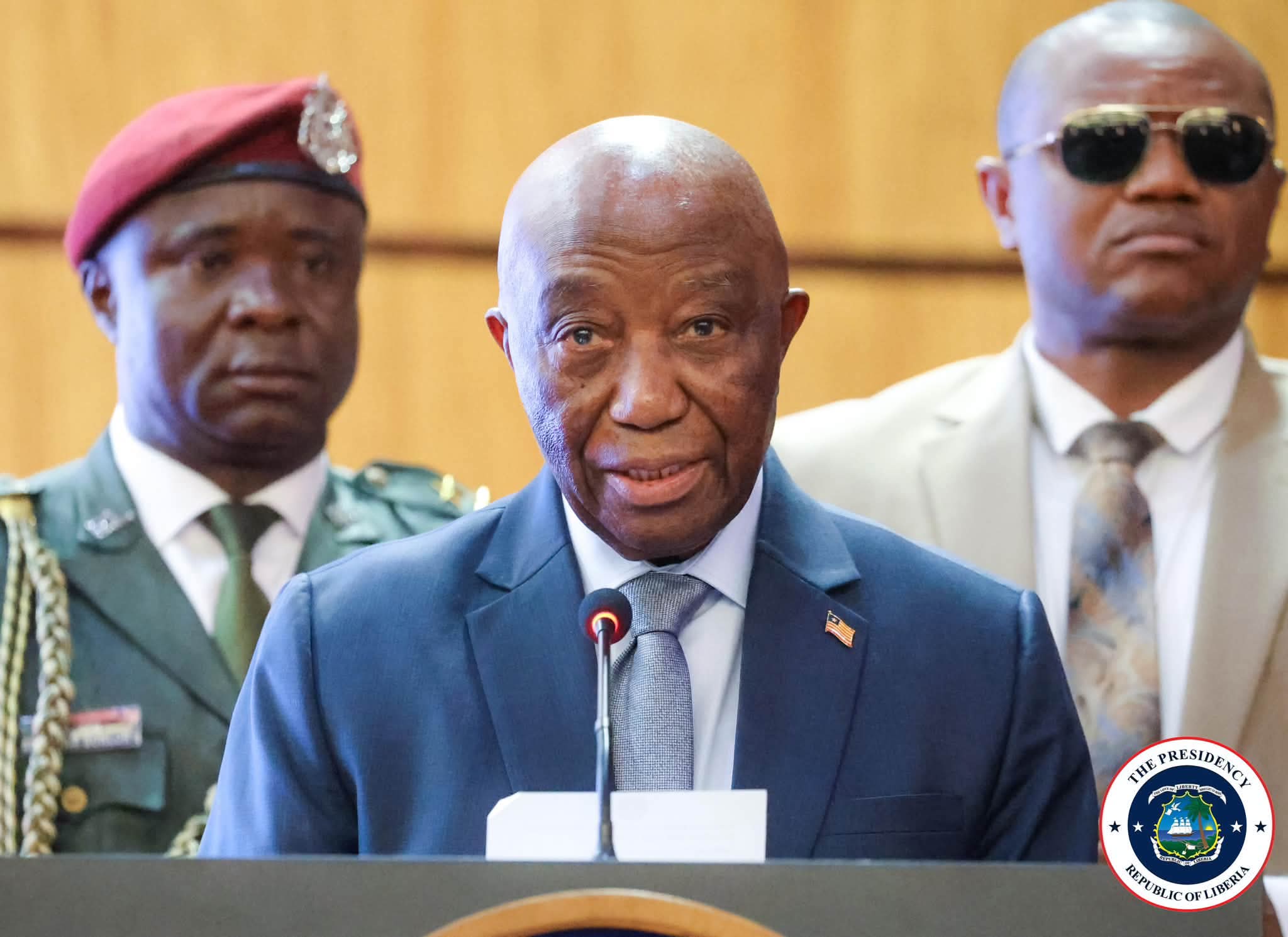
Speaking Wednesday the National Conference on the Resolution of Non-Performing Loans in Liberia’s Financial Sector at the Ellen Johnson Sirleaf Ministerial Complex in Congo Town, President Boakai said restoring confidence in the lending system requires obligations to be honored, contracts to be enforceable and financial institutions to maintain responsible lending standards.
“For a system to work, there must be confidence and responsibility on both sides,” President Boakai said.
The President described the NPL challenge as more than a banking-sector problem, arguing that its consequences extend to entrepreneurs, farmers, manufacturers, women-owned businesses, young people, depositors and other Liberians seeking capital to expand economic activity and create employment.
The latest Central Bank of Liberia data show that the banking sector has made measurable progress in reducing the proportion of bad loans, although the problem remains above the regulator’s prescribed limit.
According to the CBL’s 2025 Annual Report, non-performing loans stood at L$12.87 billion at the end of December 2025, equivalent to 12.6 percent of gross loans. That represented a significant decline from the previous year.
The CBL has separately reported that the NPL ratio fell from 17.9 percent at the end of 2024 to 12.58 percent at the end of 2025.
The improvement followed a period of considerably higher credit stress. In 2023, the CBL reported an NPL ratio of 15.8 percent, compared with its regulatory threshold of 10 percent.
In the first quarter of 2024, the ratio declined to 15.5 percent, but remained above the regulatory limit.
The Central Bank has also previously warned that persistent delinquency could threaten the viability of financial institutions and undermine the protection of depositors’ funds.
In December 2022, the regulator gave delinquent borrowers until the end of the first quarter of 2023 to settle or restructure outstanding obligations, while directing commercial banks to strengthen loan-recovery systems and improve underwriting practices.
The scale of the issue is significant when measured against Liberia’s overall banking-sector credit portfolio.
CBL data show that loans and overdrafts stood at approximately L$102.33 billion in 2025, a slight 0.7 percent decline from the previous year.
Trade remained the largest recipient of bank credit, accounting for 26.8 percent of total industry loans.
Agriculture, construction, personal lending, extractive activities and other sectors accounted for the remainder of the banking system’s credit portfolio.
The figures highlight the importance of credit quality to Liberia’s broader economic ambitions.
When loans become delinquent, banks must allocate resources to provisions and recovery rather than recycling those funds into new productive investments.
President Boakai therefore argued that the consequences extend beyond individual borrowers and financial institutions.
“When too many loans remain unpaid, funds that should circulate within the economy become tied up,” he said, warning that banks may consequently become more cautious, making financing harder or more expensive for businesses and individuals.
President Boakai said resolving the NPL problem is essential to the implementation of his administration’s ARREST Agenda for Inclusive Development, Liberia’s five-year national development strategy covering 2025–2029.
The agenda places emphasis on agriculture, roads and infrastructure, the rule of law, education, health and sanitation, tourism, private-sector development and broader economic inclusion.
Government planning documents identify private-sector development, human-capital development and inclusive growth among the strategy’s central objectives.
Boakai said the government’s objeectives including job creation, youth and women’s empowerment, agricultural expansion, food security, infrastructure development and the growth of Liberian-owned businesses cannot be achieved without a financial sector capable of providing sustainable and affordable credit.
“Contracts must have meaning and collateral must have meaning,” the President said, emphasizing the importance of an effective legal and judicial environment capable of resolving commercial disputes fairly and efficiently.
The President identified several structural factors contributing to Liberia’s NPL challenge, including weaknesses in credit assessment and risk management, gaps in credit information, difficulties in enforcing collateral, limitations within legal and judicial processes, and weaknesses in repayment discipline.
The CBL has similarly identified elevated NPLs as a constraint on credit expansion, profitability and financial intermediation.
The regulator says it has intensified supervision of loan classification, provisioning and write-offs while strengthening credit infrastructure through collateral registries and credit-reference systems.
Liberia has also continued to develop its collateral infrastructure.
The CBL lists a Revised Collateral Registry Regulation 2026 among regulations issued during the year, signaling continued efforts to improve the framework for secured lending and collateral enforcement.
For businesses, particularly smaller enterprises that often lack conventional fixed assets, an efficient collateral system can be critical to obtaining financing.
Liberia’s NPL problem is not new.
The Central Bank has described high non-performing loans as a perennial challenge to financial stability.
Historical CBL records show that NPLs reached 22.2 percent in 2012, before declining to 14.4 percent in 2013 following measures that included strengthening the credit-reference system and restricting access to financial services for delinquent borrowers.
The problem resurfaced at elevated levels in more recent years. In 2023, the CBL reported NPLs at 15.8 percent, while an earlier assessment placed the ratio at 18.5 percent.
In 2024, the regulator reported substantial volatility in asset quality, before the ratio declined significantly during 2025.
The improvement in 2025 suggests that regulatory intervention and stronger recovery measures can produce results, but the ratio remains above the CBL’s 10 percent threshold, meaning the issue has not been fully resolved.
President Boakai said no single institution can resolve the problem, calling for coordinated action involving the Central Bank, commercial banks, borrowers, the Executive Branch, Legislature, Judiciary, private sector and development partners.
He urged commercial banks to strengthen due diligence, improve credit-risk assessment and lend responsibly, while borrowers must recognize that obtaining a loan creates a legal and financial obligation that must ultimately be repaid.
The President also called for stronger credit-reporting systems, improved land administration and collateral registration, expanded use of financial technology, responsible digital financial services and a modern insolvency framework capable of dealing with distressed businesses and borrowers.
Such reforms, he argued, should not only address existing bad loans but also prevent a new accumulation of distressed credit.
From Conference to Implementation
President Boakai challenged participants to ensure that the conference produces measurable actions rather than another round of policy discussions.
The conference is bringing together financial regulators, commercial banks, government institutions, the private sector, development partners and other stakeholders to assess the scale and causes of non-performing loans and develop a coordinated national response.
Its objectives include reviewing the regulatory and legal framework, strengthening credit infrastructure, improving debt recovery and collateral enforcement, examining international best practices and developing mechanisms to prevent future accumulation of bad loans.
Boakai said Liberia has an opportunity to build a financial system in which responsible borrowers can obtain capital, lenders can have confidence that legitimate obligations will be honored, and businesses can invest in productive activities.
For Liberia’s broader economic transformation, the stakes are substantial. A banking system that can effectively mobilize deposits and convert them into productive credit is central to expanding private investment, supporting agriculture and manufacturing, creating employment and broadening economic opportunity.
The President therefore declared the National Conference on the Resolution of Non-Performing Loans officially open, urging participants to move from diagnosis to implementation and from policy recommendations to concrete reforms capable of strengthening Liberia’s financial system and supporting inclusive economic growth.
