
By Julius Konton
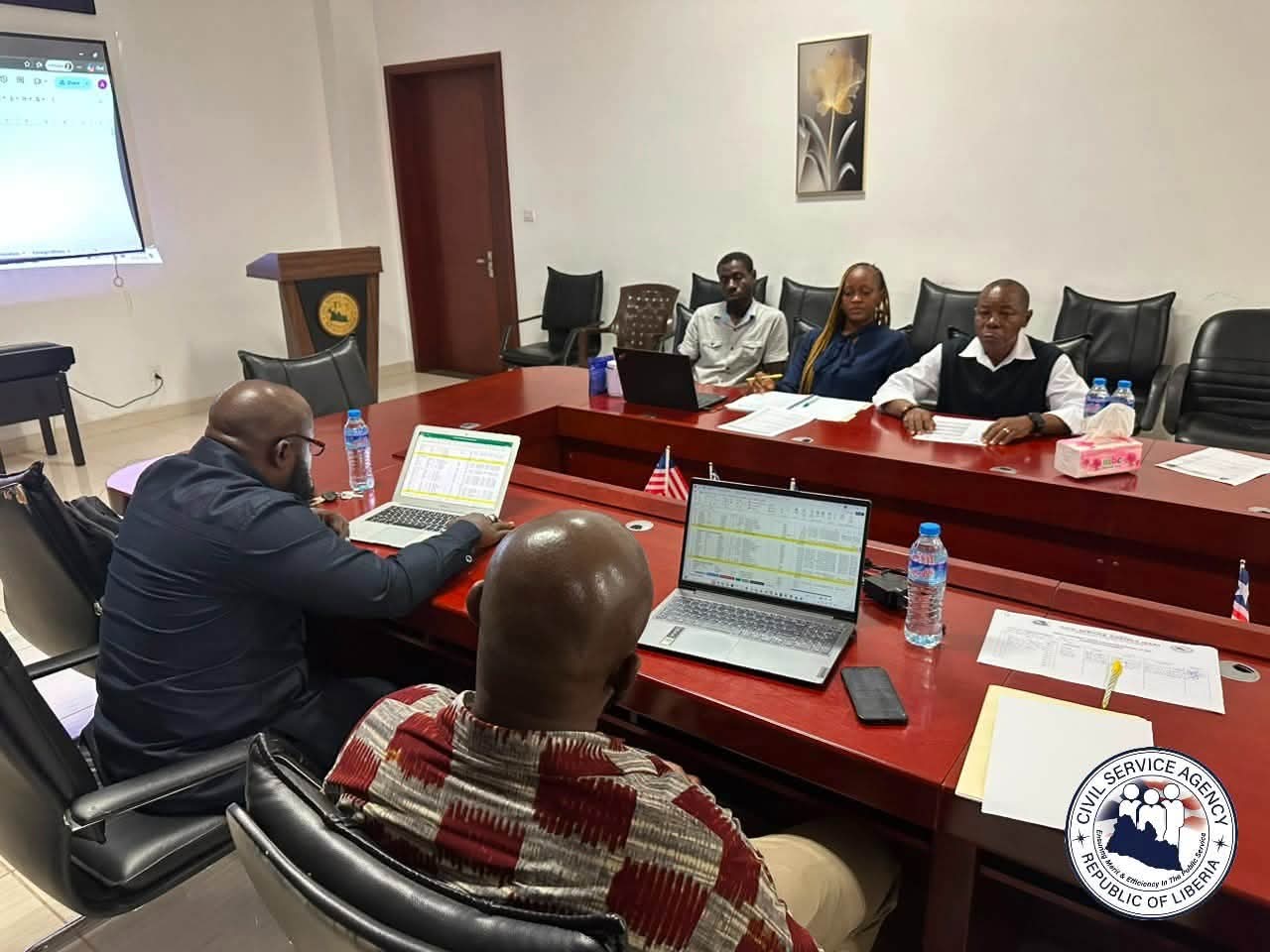
Liberia’s Civil Service Agency (CSA) has commenced its Fiscal Year 2027 Annual Manpower Planning and Budget Hearings, opening a critical review of government staffing requirements as the administration of President Joseph Nyuma Boakai moves to strengthen payroll management, workforce planning and fiscal discipline.
The hearings, which began Tuesday in Monrovia, bring Government of Liberia spending entities before the CSA to defend and justify their proposed personnel requirements for the 2027 fiscal year.
The exercise forms part of Liberia’s broader annual budget process and is designed to ensure that requests for new positions, staffing increases and workforce adjustments are based on genuine institutional needs, approved mandates and the government’s available fiscal space.
According to the CSA, 109 government spending entities are expected to participate in the manpower-planning process.
The Agency previously announced that the exercise would run alongside the preparation of the FY2027 national budget to create greater coordination between personnel planning and overall budget formulation.
The first day of hearings brought together representatives of the Civil Service Agency; Ministry of Finance and Development Planning; Office of the Vice President; Ministry of Information, Ministry of Foreign Affairs; Liberia Institute of Public Administration; Liberia Institute of Statistics and Geo-Information Services; General Services Agency; and Bureau of State Enterprises.
Officials from the participating institutions presented their proposed manpower structures and explained the positions and staffing requirements they believe are necessary to implement their respective mandates during FY2027.
The CSA is expected to scrutinize the submissions by examining existing staffing levels, vacant positions, proposed new posts, critical skills gaps and the relationship between requested personnel and institutional functions.
The process is particularly significant because compensation is one of the largest recurring components of government expenditure. CSA Director-General Dr. Josiah F. Joekai Jr. has previously warned that better manpower planning can help reduce unplanned requests for additional compensation and strengthen fiscal discipline.
The manpower hearings also underscore the long-standing role of the CSA in Liberia’s public-sector administration.
The Agency was established by an Act of the Legislature in 1973, making it more than five decades old.
Its statutory responsibilities include human-resource planning, recruitment and selection, training and development, performance management and career development within the civil service.
The Civil Service Act also places the CSA at the center of government personnel administration, while subsequent reforms have expanded its role in standardizing public-sector pay and grades.
In 2019, the National Standardization and Remuneration Act authorized the CSA, working with the Ministry of Finance and Development Planning, to determine and implement a standardized pay and grade system across government spending entities.
That framework makes the annual manpower hearings more than a routine administrative exercise: they are part of a broader effort to connect staffing decisions with compensation management and national budget priorities.
The current exercise comes amid wider efforts by the CSA to improve the integrity and accuracy of Liberia’s public payroll.
In recent years, the Agency has undertaken employee verification and headcount exercises aimed at identifying potential ghost workers, duplicate accounts and other payroll irregularities.
The CSA has said such exercises are intended to establish a clearer picture of who is actually employed within the public service and to strengthen accountability in personnel management.
The Agency has also pursued credential-verification initiatives designed to ensure that public servants possess the qualifications and skills required for their positions, linking workforce management to competence, merit and institutional performance.
For Liberia, the challenge extends beyond controlling the number of government employees.
The country must simultaneously ensure that ministries and agencies have enough qualified personnel to deliver essential public services while avoiding unnecessary expansion of the government wage bill.
The CSA’s official mandate therefore places emphasis on improving human-resource capacity and service delivery while advising government on organization, staffing, pay, benefits, pensions, conditions of employment and workforce development.
The FY2027 hearings are consequently expected to test whether proposed staffing increases are supported by measurable institutional needs and whether existing personnel can be deployed more efficiently before additional positions are created.
The hearings also fit into the Boakai administration’s broader emphasis on institutional reform, accountability and more effective use of public resources.
The CSA is currently implementing a 2025–2029 Strategic Plan, while decentralization efforts are also underway.
The Agency has reported progress toward establishing regional offices, including a headquarters project in Gbarnga, Bong County, and plans for a regional office in Zwedru, Grand Gedeh County, intended to serve several southeastern counties.
For a country where government institutions remain major employers and service providers, the outcome of the FY2027 manpower hearings could have implications well beyond the payroll.
A carefully structured workforce could help ministries and agencies fill critical capacity gaps, improve public-service delivery and ensure that scarce budgetary resources are directed toward priority functions.
Conversely, unchecked personnel expansion could increase recurrent expenditure and place additional pressure on the national budget.
As Liberia advances toward the FY2027 budget, the manpower hearings provide an opportunity to establish a clearer link between people, positions, performance and public money.
The CSA’s review will ultimately determine whether proposed staffing levels are justified, whether critical vacancies should be filled, whether organizational structures remain appropriate and whether new personnel costs can be accommodated within the government’s broader fiscal framework.
With 109 spending entities involved in the process, the exercise represents one of the government’s most extensive annual reviews of public-sector manpower requirements.
For Liberia, the central question is increasingly straightforward: How many public servants does the government need, what skills should they possess, where are they needed most, and can the country sustainably afford them?
The FY2027 manpower hearings are intended to provide part of that answer.
Source: Civil Service Agency, Government of Liberia.
