
By: Julius Konton
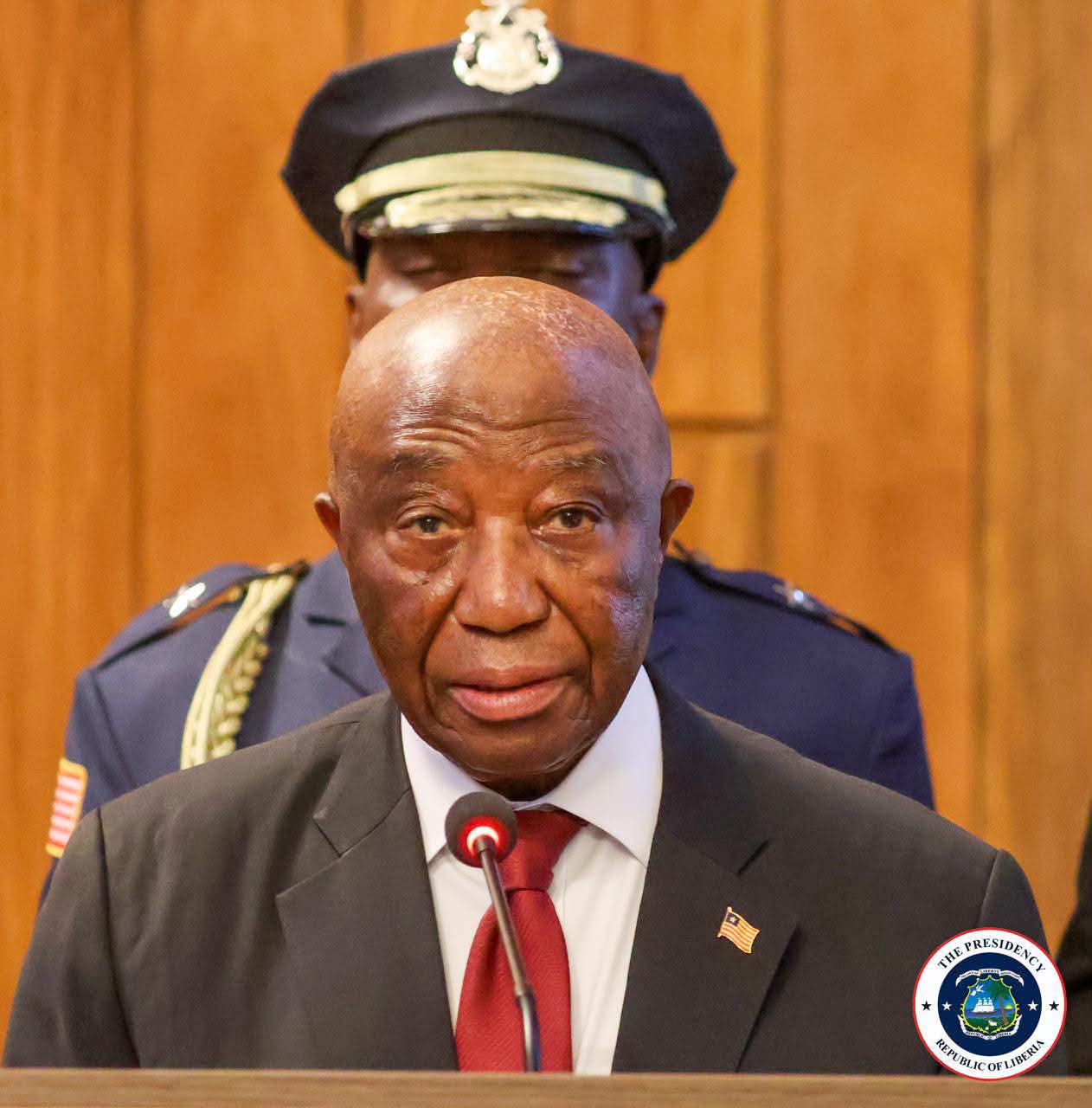
President Joseph Nyuma Boakai, Sr. has declared that his administration will show “no sacred cows” in its escalating campaign against illegal narcotics trafficking, organized crime, corruption, and impunity, while commissioning a new cadre of judges and court marshals to strengthen Liberia’s justice system.
Speaking Thursday during an official commissioning ceremony at the Executive Mansion in Monrovia, President Boakai described an independent, credible, and efficient judiciary as indispensable to Liberia’s democratic governance, economic transformation, and national security.
Addressing senior government officials, members of the judiciary, diplomats, legislators, security personnel, youth representatives, and the newly commissioned judicial officers, the Liberian leader urged the appointees to view their offices not as positions of privilege but as solemn public trusts.
“Every decision you make, every case you hear, and every action you take will either strengthen or weaken the confidence of the Liberian people in our justice system,” President Boakai said.
The President emphasized that judicial reform remains a central pillar of his government’s ARREST Agenda for Inclusive Development, describing the rule of law as the foundation upon which sustainable development, peace, and prosperity are built.
He noted that without strong legal institutions, economic growth suffers, foreign and domestic investment declines, criminality flourishes, and public confidence in government institutions deteriorates.
According to the World Justice Project Rule of Law Index, countries with stronger judicial institutions consistently experience higher investor confidence, lower corruption levels, stronger economic performance, and greater political stability.
Across Africa, justice-sector reforms continue to rank among the most important governance priorities identified by international development partners.
President Boakai stressed that Liberia’s Executive Branch would continue to act decisively within constitutional limits to protect citizens while preserving judicial independence.
The strongest portion of the President’s address focused on what he described as one of Liberia’s greatest national security threats , the growing proliferation of illegal drugs and organized criminal enterprises.
He warned that narcotics trafficking threatens Liberia’s youth population, undermines legitimate businesses, weakens public institutions, compromises national security, and risks damaging the country’s international reputation.
Delivering one of the most forceful statements of his presidency, Boakai issued a direct warning to criminals.
“We will identify you. We will pursue you. We will find you. And we will deal with you in accordance with the law.”
He emphasized that no individual regardless of political influence, government position, financial status, or family connections would receive special treatment.
“There will be no sacred cows in this Joseph Nyuma Boakai Administration,” he declared.
The President also clarified that the government’s recent arrests, suspensions, dismissals, and investigations involving individuals linked to narcotics trafficking and other criminal activities are part of a broader national strategy rather than politically motivated actions.
Praise for Liberia’s Joint Security Forces
President Boakai paid tribute to Liberia’s Joint Security agencies, applauding their professionalism, patriotism, and resilience in confronting increasingly sophisticated criminal networks.
He praised officers who continue protecting Liberia’s borders, combating narcotics trafficking, enforcing the law, and safeguarding citizens despite significant operational challenges.
International agencies, including the United Nations Office on Drugs and Crime (UNODC), have repeatedly warned that West Africa remains an important transit corridor for international narcotics trafficking due to its strategic geographic location between Latin America and Europe.
Regional governments have therefore intensified cross-border security cooperation and anti-drug enforcement initiatives over the past decade.
While reaffirming the constitutional independence of Liberia’s judiciary, President Boakai argued that independence must be accompanied by integrity, diligence, professionalism, efficiency, and accountability.
He expressed concern over lengthy court proceedings, warning that justice delayed too often translates into justice denied.
“The wheels of justice may turn slowly,” he observed, “but they must never turn so slowly that our courts become revolving doors through which criminals repeatedly pass without consequence.”
The President disclosed that he held discussions with Chief Justice and Associate Justices regarding ongoing judicial reforms and pledged full Executive support for initiatives aimed at improving court efficiency, reducing case backlogs, strengthening judicial integrity, and expanding access to justice.
Addressing the newly commissioned judges, President Boakai encouraged them to uphold fairness, impartiality, courage, and constitutional fidelity throughout their careers.
He reminded them that their ultimate legacy would not be measured by the number of cases they adjudicate but by the confidence their judgments inspire among ordinary Liberians.
He urged every judge to ensure that courtrooms remain places where justice is accessible to all citizens, irrespective of wealth, political affiliation, or social standing.
The President also highlighted the critical role of court marshals in maintaining order, enforcing judicial decisions, and protecting the dignity of judicial proceedings.
He encouraged them to discharge their duties with discipline, impartiality, professionalism, restraint, and unwavering respect for the constitutional rights and human dignity of every individual appearing before the courts.
President Boakai reaffirmed the constitutional responsibilities of Liberia’s three branches of government.
He stated that while the Executive provides national leadership and the Legislature enacts laws, the Judiciary bears the constitutional responsibility of interpreting and applying those laws fairly and independently.
According to Liberia’s 1986 Constitution, judicial authority is vested in the Supreme Court and subordinate courts, reflecting the nation’s commitment to democratic governance following decades of political transition and institutional reform.
Political analysts widely agree that strengthening judicial institutions remains essential for consolidating Liberia’s democracy, promoting economic recovery, and improving investor confidence nearly two decades after the country’s civil conflicts ended.
The ceremony concluded on a warm personal note as President Boakai publicly acknowledged the birthday of First Lady Mrs. Kartumu Y. Boakai, his wife of 54 years.
Drawing laughter from the audience, the President humorously remarked that he was “not allowed” to reveal her age while wishing her God’s continued blessings and many more years of life.
The commissioning of Liberia’s newest judges and court marshals represents another significant milestone in President Boakai’s broader governance reform agenda, which seeks to strengthen democratic institutions, reinforce the rule of law, combat corruption, and create an environment conducive to sustainable economic growth and national development.
As Liberia continues navigating complex security, governance, and economic challenges, the effectiveness, independence, and integrity of its judiciary will remain central to safeguarding constitutional democracy, protecting human rights, encouraging domestic and foreign investment, and fostering public confidence in the nation’s institutions.
Concluding his address, President Boakai renewed his call for national unity under his administration’s enduring message:
“Think Liberia, Love Liberia, and Together Build Liberia.”
