
By: Julius Konton
Liberian President Joseph Nyuma Boakai has intensified Africa’s demand for reparatory justice over the transatlantic slave trade, declaring that the world must move beyond symbolic apologies and historical acknowledgments toward concrete action to address what he described as “history’s unpaid debt.”
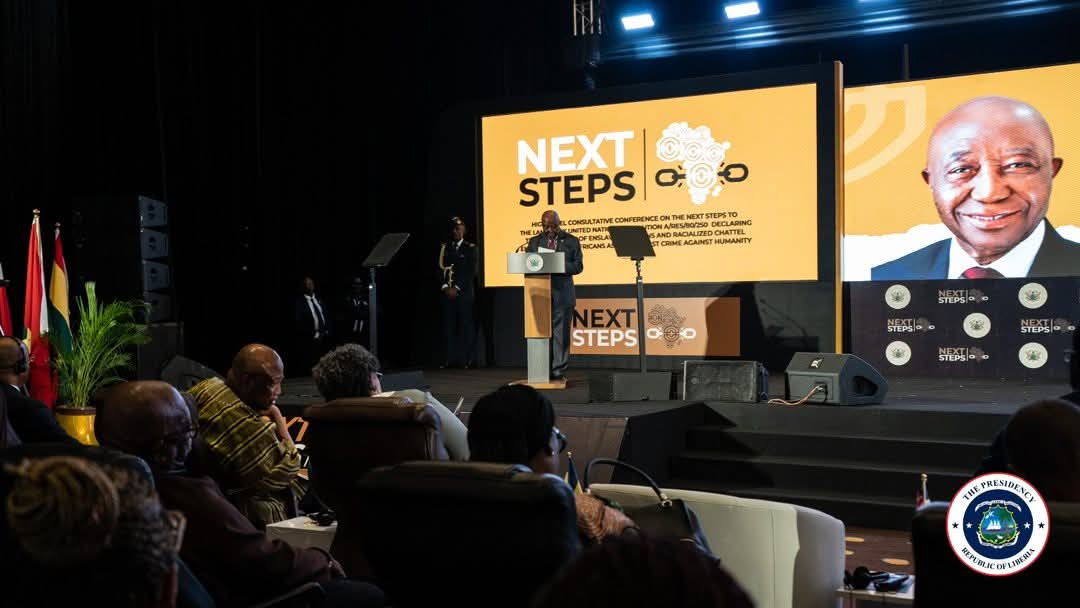
Speaking Thursday at the High-Level Consultative Conference on the implementation of United Nations Resolution A/RES/80/250 in Accra, Ghana, President Boakai described slavery as one of humanity’s “gravest crimes against humanity” and warned that its consequences remain deeply embedded in Africa’s economic and social realities.
The two-day conference, themed “Next Steps,” brought together African Heads of State, diplomats, development institutions, civil society organizations, and representatives of the global African diaspora to chart a pathway for global reparatory justice.
Boakai’s intervention comes amid growing momentum across Africa and the Caribbean for reparations, with the African Union and the Caribbean Community (CARICOM) increasingly aligning their demands for compensation, restitution, and institutional reforms tied to centuries of enslavement and colonial exploitation.
“The past has helped shape the inequities of the present,” Boakai said. “There is no doubt that the slave trade and its aftermath contributed profoundly to inequality and underdevelopment in Africa and across the Global South.”
Historians estimate that between 12 million and 15 million Africans were forcibly taken across the Atlantic between the 16th and 19th centuries, with nearly 2 million dying during the Middle Passage.
Economic scholars argue that the labor extracted from enslaved Africans generated trillions of dollars in wealth, fueling industrial revolutions in Europe and the Americas while simultaneously draining Africa of its human capital and productive capacity.
A 2023 report by the African Development Bank estimated that Africa loses between $88 billion and $100 billion annually through illicit financial flows, an enduring structural weakness some analysts link to historical patterns of extraction established during slavery and colonialism.
Boakai said the adoption of the UN resolution recognizing the trafficking and enslavement of Africans as among the gravest crimes against humanity should serve as more than a symbolic milestone.
Instead, he called for the establishment of an African Union, United Nations Expert Commission tasked with designing a Global Reparatory Justice Mechanism, a framework he said must include truth-telling, reconciliation, restitution, cultural restoration, educational reforms, and strategic development partnerships.
“The world has reached a defining moment,” Boakai asserted. “Future generations will judge us not by the eloquence of our declarations, but by the courage of our actions.”
The Liberian leader also emphasized the urgent need for the return of stolen African cultural artifacts, noting that more than 90 percent of sub-Saharan Africa’s cultural heritage remains outside the continent, according to UNESCO estimates.
He argued that reclaiming these artifacts is central to restoring historical dignity and identity.
The reparations debate has gained renewed international traction in recent years. In 2023, CARICOM renewed its Ten-Point Reparatory Justice Plan, demanding formal apologies, debt cancellation, public health support, and educational investment from former colonial powers.
Meanwhile, several European nations have begun returning looted African artifacts, though calls for direct financial reparations remain contentious.
Boakai stressed that the pursuit of reparatory justice should not be interpreted as an effort to assign personal guilt to current generations, but rather as an opportunity for collective moral responsibility and global healing.
“This is not about blame,” he said. “It is about understanding, recognition, and taking responsibility for the enduring legacy of historical injustice.”
Liberia’s historical connection to the transatlantic slave trade gives Boakai’s position added significance.
Founded in 1822 as a settlement for freed African-Americans, Liberia remains one of Africa’s oldest republics and a symbol of both the scars and resilience of the African diaspora.
Boakai concluded with a stark warning that history would judge the global community harshly if it allows the momentum for reparations to dissipate.
“Let this not be remembered as another conference or another resolution that stirred consciences briefly before fading into history,” he said. “Let it be remembered as the moment humanity chose justice, dignity, and equity.”
The Accra conference is expected to produce a roadmap for coordinated African and diaspora advocacy ahead of the next United Nations General Assembly, where reparatory justice is expected to remain a major issue on the global agenda.
