
By: Julius Konton
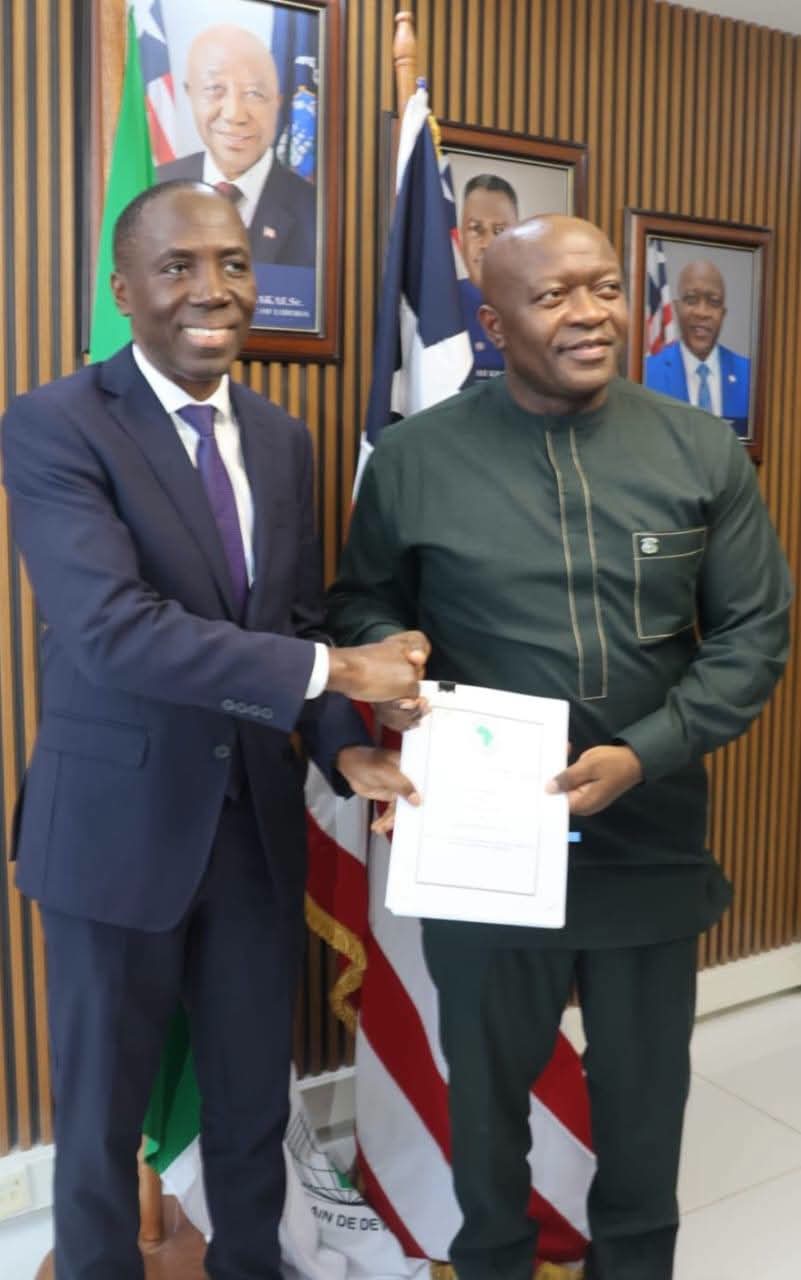
The Government of Liberia and the African Development Bank have signed a landmark US$16.7 million financing agreement aimed at strengthening fiscal sustainability, improving mining sector governance, and accelerating private sector-led job creation in one of West Africa’s most resource-rich but underdeveloped economies.
The agreement, signed in Monrovia, marks another significant chapter in Liberia’s long-standing partnership with the continental lender, as the country pushes to consolidate macroeconomic gains while reforming key sectors critical to economic transformation.
Speaking during the official signing ceremony, , Liberia’s Minister of Finance and Development Planning, Augustine Kpehe Ngafuan described the agreement as “a clear manifestation of the strength and durability” of Liberia’s partnership with the AfDB.
“This signing is not just about financing; it is about transforming sectors that hold the greatest potential for inclusive growth.
The private sector, especially young people, stands to benefit immensely,” Ngafuan said.
The financing package is expected to support reforms in domestic revenue mobilization, debt management, mining sector transparency, and institutional governance, areas that remain central to Liberia’s fiscal reform agenda.
According to Minister Ngafuan, a project management team has already been recruited under the supervision of the Ministry of Commerce and Industry to oversee implementation of an ambitious employment and enterprise support initiative linked to the agreement, which is projected to create over 100,000 jobs, particularly for youth and small-scale entrepreneurs.
Liberia, a nation of approximately 5.5 million people, continues to grapple with high unemployment, with youth unemployment estimated at over 60%, making job creation one of the government’s top priorities.
Ngafuan emphasized the urgency of implementation.
“We have talked the talk; now we must move quickly. The opportunities embedded in this project are transformative. This is about private sector expansion and creating pathways for young Liberians to thrive,” he stated.
The Finance Minister praised the AfDB for what he called its “consistent and strategic support” to Liberia, noting that the bank has remained one of the country’s most reliable development partners since the end of Liberia’s 14-year civil conflict in 2003.
Historically, the AfDB played a pivotal role during Liberia’s Heavily Indebted Poor Countries (HIPC) Initiative, helping the country secure debt relief and rebuild critical institutions after the war.
Since then, the bank has financed major infrastructure, agriculture, and governance projects valued at hundreds of millions of dollars.
Ngafuan specifically highlighted the Special Agro-Industrial Processing Zone (SAPZ) project in Buchanan, a flagship initiative designed to industrialize Liberia’s agricultural sector, increase value addition, and reduce post-harvest losses.
Agriculture contributes nearly 35% of Liberia’s GDP and employs more than 70% of the rural population, yet productivity remains among the lowest in the region.
He also reflected on AfDB’s historic role in Liberia’s road sector development, particularly the Ganta-Harper Highway, one of Liberia’s most critical transport corridors spanning over 510 kilometers, connecting the country’s north to the southeast.
“The African Development Bank was among the first development partners to engage Liberia on the Fish Town to Harper corridor, and today we are seeing additional connectivity through the Cavalla River bridge project,” Ngafuan noted.
Liberia’s infrastructure gap remains significant, with only about 1,600 kilometers of paved roads out of more than 10,000 kilometers nationwide, according to government estimates.
The AfDB remains one of the largest financiers of road connectivity projects in the country.
Beyond roads, the bank is currently spearheading financing discussions for Liberia’s ambitious Coastal Highway Project, a transformative corridor expected to link several coastal counties and unlock trade, tourism, and agricultural access.
Ngafuan also referenced the recently launched US$18 million Domestic Resource Mobilization Project, which seeks to improve government revenue collection, especially from extractive industries.
Liberia’s mining sector, dominated by gold, iron ore, and diamonds, contributes nearly 15% of GDP but remains underperforming due to governance challenges and illicit leakages.
The latest AfDB agreement comes as Liberia seeks to strengthen economic resilience amid global financial uncertainty.
The country recorded an estimated 5.1% GDP growth in 2025, according to the , driven largely by mining, agriculture, and public sector investments.
Analysts say the new financing could significantly improve Liberia’s fiscal outlook if reforms are effectively implemented, particularly at a time when the Boakai’s administration is pushing its ARREST Agenda for Inclusive Development (AAID), a national framework prioritizing agriculture, roads, rule of law, education, sanitation, and tourism.
For the AfDB, the agreement further cements its role as one of Liberia’s largest multilateral financiers and strategic partners in the country’s post-war reconstruction and long-term economic modernization.
