



By: Julius Konton
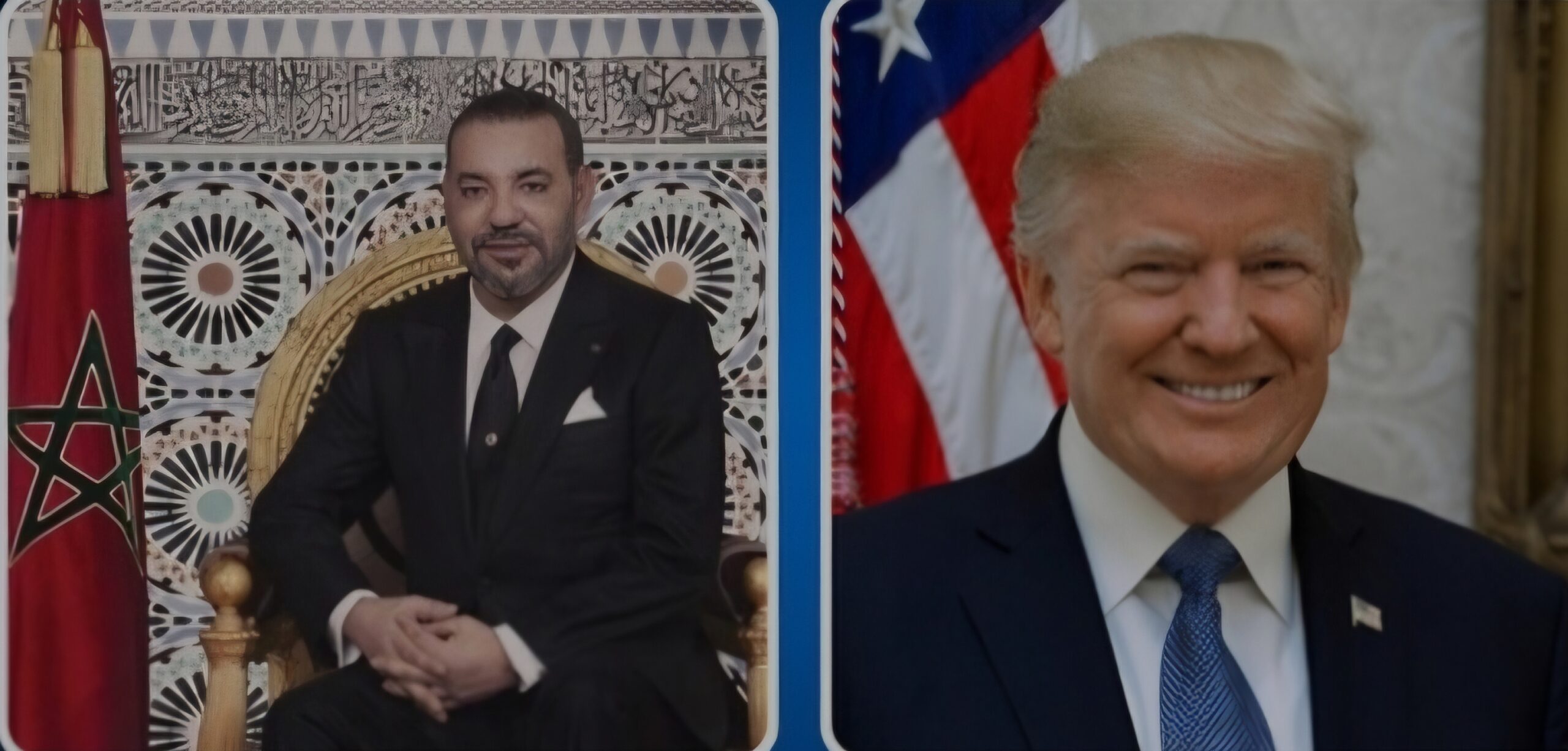
The United States has renewed its strong support for Morocco’s position on the Western Sahara dispute, with President Donald J. Trump declaring that Washington’s recognition of Moroccan sovereignty over the territory remains firm and that Morocco’s autonomy initiative represents the only realistic pathway toward a lasting political settlement.
In a message addressed to His Majesty King Mohammed VI on the occasion of Morocco’s 27th anniversary of Throne Day, President Trump reaffirmed the depth of the historic relationship between the United States and Morocco, describing the partnership as one built on “trust and mutual respect” and strengthened by centuries of diplomatic engagement.
“The United States is unequivocal: We recognize Moroccan sovereignty over Western Sahara and support Morocco’s serious, credible, and realistic autonomy proposal as the only basis for a just and lasting solution,” President Trump stated in his message.
He added that alternative approaches would only prolong the decades-old dispute, stressing: “This dispute must end now, and the United States will continue to push toward that goal.”
President Trump highlighted the long-standing ties between the two nations, noting that 2026 marks 250 years of American history and enduring friendship with Morocco.
The relationship between the United States and Morocco dates back to 1777, when Morocco became the first country to recognize the newly independent United States.
The two nations later formalized their friendship through the Treaty of Peace and Friendship in 1787, considered one of the longest-standing unbroken treaties in U.S. history.
Over the centuries, Morocco has remained a key American partner in North Africa, cooperating in areas including security, trade, counterterrorism, energy, and regional stability.
Western Sahara has remained one of Africa’s longest-running territorial disputes, dating back to Spain’s withdrawal from the region in 1975.
Morocco administers most of the territory and considers it an integral part of the Kingdom, while the Algeria-backed Polisario Front seeks independence for the territory under the banner of the Sahrawi Arab Democratic Republic.
The United Nations has classified Western Sahara as a non-self-governing territory and has for decades supported a negotiated political solution.
Morocco’s autonomy initiative, presented to the United Nations in 2006, proposes granting Western Sahara broad self-government powers while maintaining Moroccan sovereignty.
In December 2020, during President Trump’s first administration, as part of a diplomatic agreement that also saw Morocco normalize relations with Israel under the Abraham Accords framework.
In his message, President Trump praised King Mohammed VI’s leadership, describing Morocco as a pillar of stability in a strategically important region.
“Your Majesty’s wise leadership is an anchor of stability,” President Trump stated, emphasizing Morocco’s contributions to peace, counterterrorism efforts, and regional security.
The American leader also highlighted Morocco’s participation in the Abraham Accords, describing the Kingdom’s role as valuable to strengthening cooperation between the United States, Morocco, Israel, and other regional partners.
The two countries are also expected to continue cooperation in addressing security challenges in the Sahel region, where instability, terrorism, and organized crime remain major concerns.
Beyond diplomacy and security, President Trump emphasized expanding economic cooperation between Washington and Rabat, pointing to emerging opportunities in technology, energy, artificial intelligence, critical minerals, and defense industries.
The message noted that the United States would encourage increased economic and social development cooperation with Morocco, including projects in Western Sahara.
“Reliable American technology and innovation will continue to serve as partners for Morocco for the next 250 years in all strategic sectors,” President Trump said.
Morocco has increasingly positioned itself as a regional economic hub, supported by investments in renewable energy, infrastructure, manufacturing, automotive industries, and technology.
The Kingdom is home to one of Africa’s largest renewable energy projects, including the Noor Ouarzazate Solar Complex, one of the world’s largest concentrated solar power facilities.
President Trump concluded his message by emphasizing a shared vision for the future of both nations.
“Together, we are ushering in a new era, one that prioritizes the interests of our two peoples,” he said.
Political analysts say the reaffirmation signals Washington’s continued commitment to strengthening its strategic partnership with Morocco at a time when North Africa faces growing security, economic, and geopolitical challenges.
With deep historical ties, expanding trade relations, and shared interests in regional security, the United States and Morocco appear set to enter what both sides describe as a new phase of cooperation built around stability, innovation, and mutual prosperity.


