

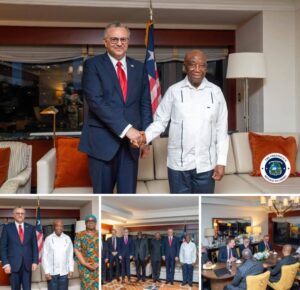


By: Julius Konton
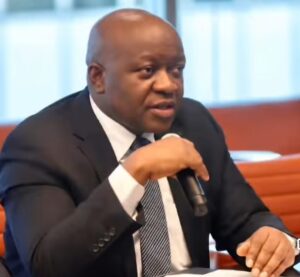
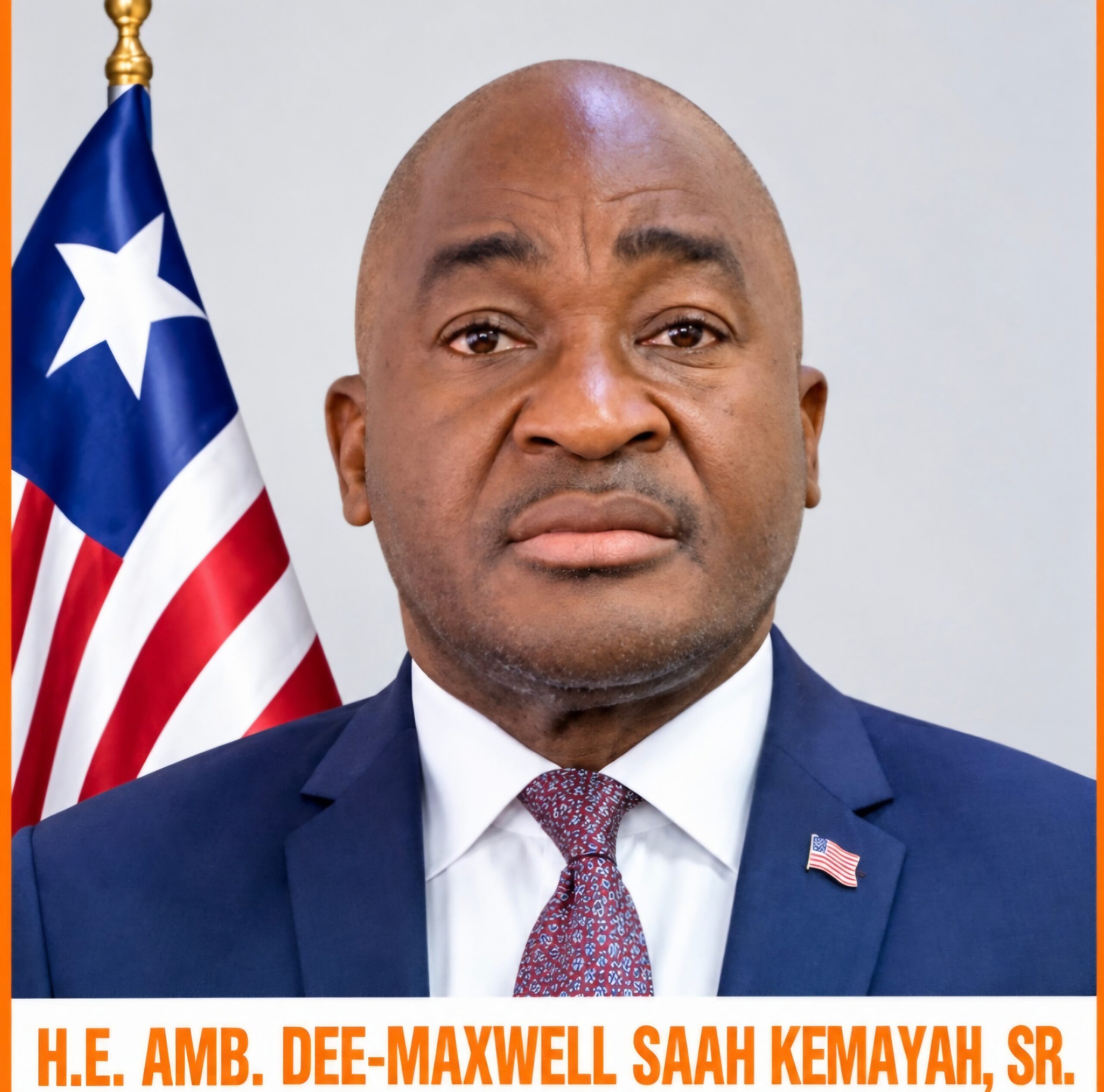
Former Liberian Foreign Minister and former Dean of the Cabinet, Ambassador Dee-Maxwell Saah Kemayah Sr., has called for a renewed global commitment to preventive diplomacy, impartial justice and credible public institutions, warning that societies become increasingly vulnerable to conflict when political divisions deepen and citizens lose confidence in the institutions meant to protect them.
Delivering a special keynote address at the First International Peace Summit 2026 at the International Day of Peace, Kemayah argued that sustainable peace cannot be secured simply by ending wars after they begin.
Instead, he said, governments and international organizations must identify political and social tensions early, maintain channels of communication and strengthen institutions capable of resolving disputes peacefully.
The summit was held under the theme “Peace in a Fractured World: Restoring Dialogue, Justice and Confidence in Institutions,” with the broader message “One World, One Humanity, One Future.”
The former foreign minister’s remarks came against a backdrop of worsening global conflict.
The Institute for Economics & Peace’s Global Peace Index 2025 reported 59 active state-based conflicts, the highest number recorded since the end of the Second World War, while conflict-related deaths reached 152,000 in 2024.
The index also found that internationalized internal conflicts had increased substantially since 2010.
The United Nations, meanwhile, marked the 2026 International Day of Peace under the official theme “Invest in Peace: For Everyone, Everywhere, Every Day.”
The UN said this year’s observance comes as conflicts are becoming more complex and communities face violence, division and weakening dialogue, while emphasizing diplomacy, negotiation, peacebuilding and trusted institutions as important tools for peace.
Drawing on his experience in diplomacy and government, Kemayah said diplomacy should be treated not simply as a crisis-management mechanism but as a first line of defense against conflict.
“It is always less costly to prevent a conflict than to resolve one, after it begins,” he argued, warning that once violence erupts, political positions harden, trust deteriorates, economies suffer and populations are displaced.
He called for greater investment in early-warning systems, preventive diplomacy, mediation, confidence-building measures and sustained political dialogue.
“Dialogue is not capitulation. Negotiation is not surrender. Diplomacy is not weakness,” Kemayah said.
Instead, he described diplomacy as “the disciplined search for alternatives to destruction,” arguing that even governments and political movements with profound differences should preserve channels of communication.
His call echoes a broader international emphasis on prevention.
The United Nations has repeatedly promoted diplomacy, mediation and dialogue as mechanisms for addressing disputes before they develop into armed conflict.
The UN’s 2026 Peace Day message similarly calls for stronger investment in diplomacy, dialogue, negotiation and peacekeeping.
Kemayah also placed the rule of law at the center of sustainable peace, arguing that political stability becomes fragile when citizens believe that justice is applied selectively.
“Peace without justice is inherently fragile,” he said.
He called for legal institutions that protect citizens regardless of political affiliation and stressed that accountability should apply to both serving and former public officials when credible evidence of wrongdoing exists.
At the same time, he argued that investigations and prosecutions must be based on evidence, transparency, impartiality and due process.
“Otherwise, prosecution can be persecution in disguise,” Kemayah said.
He warned against what he characterized as two competing dangers: impunity on one side and politically motivated prosecution on the other.
“The answer to impunity is credible justice; not selective justice and political witch-hunt,” he said.
The former foreign minister further argued that democratic elections and transfers of political power should be treated as constitutional processes rather than opportunities for retaliation against political opponents.
Kemayah devoted particular attention to the judiciary, describing courts not only as mechanisms for interpreting and enforcing law but also as institutions capable of preventing political disputes from turning into confrontation.
“Courts provide an orderly alternative to confrontation,” he said.
In his view, judicial institutions can provide peaceful avenues for resolving disputes over constitutional authority, electoral outcomes and other political disagreements.
He therefore called for greater investment in judicial independence, legal capacity, access to justice and institutional resources.
His argument reflects a broader peacebuilding principle: durable political stability depends not only on elections but also on credible institutions capable of resolving disputes after elections and between elections.
Kemayah used Liberia’s history as a central case study in his argument.
Liberia experienced two civil wars between 1989 and 2003.
According to the United Nations, the conflicts killed almost 250,000 people, mostly civilians, while large sections of the country’s institutions and infrastructure collapsed.
The UN also says nearly one-third of the population was displaced and more than 100,000 former combatants eventually participated in disarmament, demobilization and reintegration programs.
The United Nations Mission in Liberia, UNMIL, was established in 2003 following the Comprehensive Peace Agreement.
Over its nearly 15-year deployment, UNMIL supported security-sector reform, disarmed more than 100,000 combatants and helped Liberia conduct presidential and legislative elections in 2005, 2011 and 2017.
The mission formally completed its mandate in March 2018.
UN figures show the scale of the international intervention: more than 180,000 peacekeepers served in Liberia over the mission’s lifetime, while UNMIL’s total expenditure over 14 years was approximately US$7.5 billion.
For Kemayah, Liberia’s history demonstrates why peace cannot be taken for granted.
He argued that conflict does not necessarily begin with the firing of the first gun.
“It begins when trust dies, institutions lose credibility, political opponents become enemies, and citizens cease to believe that justice will protect them equally,” he said.
Addressing Liberia’s current political environment, Kemayah expressed concern about what he described as highly charged prosecutions involving former government officials and growing questions surrounding the administration of justice.
Those remarks represent Kemayah’s assessment of Liberia’s political climate, rather than an independent determination that prosecutions are politically motivated.
He warned that if citizens come to perceive national institutions as selective or politically driven, the consequences could extend beyond political competition to demonstrations, social unrest and broader security concerns.
“ We have paid too high a price for peace to gamble with it again,” he said.
Liberia’s post-war experience provides important context for the warning.
The UN has previously identified national reconciliation as a strategic component of long-term peace consolidation, while noting that implementation of several recommendations of Liberia’s Truth and Reconciliation Commission remained incomplete years after the civil war.
Amb. Kemayah also placed responsibility on political leaders to moderate rhetoric and maintain channels of communication.
He argued that political opponents should not automatically be treated as enemies of the state and that governments and opposition parties can disagree sharply while remaining participants in the same constitutional system.
“A healthy democracy requires a government to be capable of tolerating criticism and opposition,” he said.
He extended the same principle to international relations, saying states will inevitably disagree over security, trade, territory, ideology and foreign policy, but that disagreement does not have to produce confrontation.
For Kemayah, the measure of statesmanship is not simply the ability to defeat opponents but the capacity to find enough common ground for competing interests to coexist peacefully.
Moving from principles to practical proposals, Kemayah outlined what he described as an agenda for strengthening national and international peace architecture.
Strengthen Preventive Diplomacy
He called for stronger early-warning systems capable of identifying political, economic, social and security indicators of instability before they develop into crises.
Among the warning signs he cited were disputed elections, violations of the rule of law, inflammatory political rhetoric, restrictions on civic space, constitutional disputes and deteriorating relations between political actors.
He proposed that regional and international organizations maintain standing mediation teams capable of responding rapidly to emerging crises.
Such teams, he said, should include diplomats, constitutional experts, mediators, women leaders, youth representatives and civil society actors.
He also urged governments to establish confidential communication channels between political parties before crises escalate.
“Do not wait for the fire before building the fire brigade,” he said.
Protect independent Institutions
Kemayah called for greater protection of judicial institutions, electoral bodies, legislatures, public accountability institutions and other constitutional bodies.
He advocated transparent and merit-based appointments, clearly defined terms of office and lawful procedures for removing officials.
He also argued that institutional independence requires predictable financing.
Without adequate resources, he said, institutions can become vulnerable to political pressure.
International assistance, in his view, should strengthen national institutions rather than permanently substitute for them.
Apply the Rule of Law Consistently
The former foreign minister urged governments to strengthen prosecutorial and judicial institutions, expand access to legal representation, reduce delays in court proceedings and ensure that citizens have lawful mechanisms for challenging abuses of public authority.
He emphasized that accountability and due process must operate simultaneously.
“Justice must be firm enough to confront impunity and restrained enough to prevent injustice,” he said.
He also called for stronger systems for asset declaration, procurement transparency, public financial management and independent oversight.
Keep Dialogue Open Among Adversaries
Kemayah proposed institutionalizing national dialogue mechanisms that bring together government, opposition parties, civil society, business leaders, youth, women and traditional authorities.
He stressed that dialogue should complement rather than replace constitutional institutions.
He also encouraged regional organizations to develop mediation panels involving former heads of state, senior diplomats, jurists and other respected figures.
The media, he said, has an important responsibility to provide citizens with verified information without deliberately deepening political divisions.
At the same time, he called for responses to disinformation and incitement that respect legitimate freedom of expression.
Rebuild Confidence in Multilateralism
Kemayah concluded his policy proposals with a call for stronger international institutions.
He argued that multilateral organizations must become more transparent, representative and responsive, particularly toward smaller states and developing countries.
He called for clearer public communication about how international decisions are made, how resources are used and what outcomes are achieved.
“Transparency is therefore not merely an administrative virtue. It is a foundation of legitimacy,” he said.
His argument comes amid broader international debate over the effectiveness and credibility of multilateral institutions.
The 2025 Global Peace Index reported that the global economic impact of violence reached almost US$20 trillion, equivalent to 11.6 percent of global GDP, underscoring the enormous economic stakes associated with conflict and insecurity.
Liberia’s post-war trajectory provides a concrete example of both the cost of conflict and the resources required to rebuild.
The UN has described the country’s transition from civil war as a significant peacebuilding experience, noting the reconstruction of security institutions, disarmament of combatants and support for democratic elections.
Yet the country’s peacebuilding experience has also demonstrated that ending armed conflict is only one stage of a much longer process.
Reconciliation, justice, institutional credibility, economic opportunity and public trust remain central to sustaining peace.
The country’s economy has continued to recover from decades of instability. World Bank data show Liberia recorded 5.0 percent GDP growth in 2025, with nominal GDP reaching approximately US$5.25 billion.
GDP per capita stood at about US$915 in the same year, illustrating both economic progress and the country’s continuing development challenges.
‘One World, One Humanity, One Future’
In closing, Kemayah returned to the central message of the summit: that peace is a continuing responsibility rather than a one-time political achievement.
“Peace is preserved when governments exercise power responsibly,” he said. “Peace is preserved when opposition is respected.
Peace is preserved when courts are independent. Peace is preserved when justice is impartial.”
He called for governments to prioritize dialogue over confrontation, diplomacy over escalation, justice over vengeance, institutions over personalities and cooperation over isolation.
“Lasting peace cannot be imposed by force alone,” he said. “It must be built through trust, protected by justice, sustained through dialogue, and anchored in institutions that command the confidence of the people they serve.”
His final appeal was framed around the summit’s unifying message:
One World.
One Humanity.
One Future.
As the international community marked the 2026 International Day of Peace, the message from the summit was consistent with the UN’s broader call for greater investment in peacebuilding not only after violence erupts, but every day through institutions, dialogue, human rights, development and cooperation.


