


By: Julius Konton
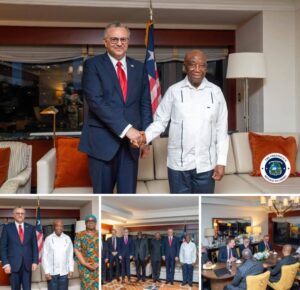
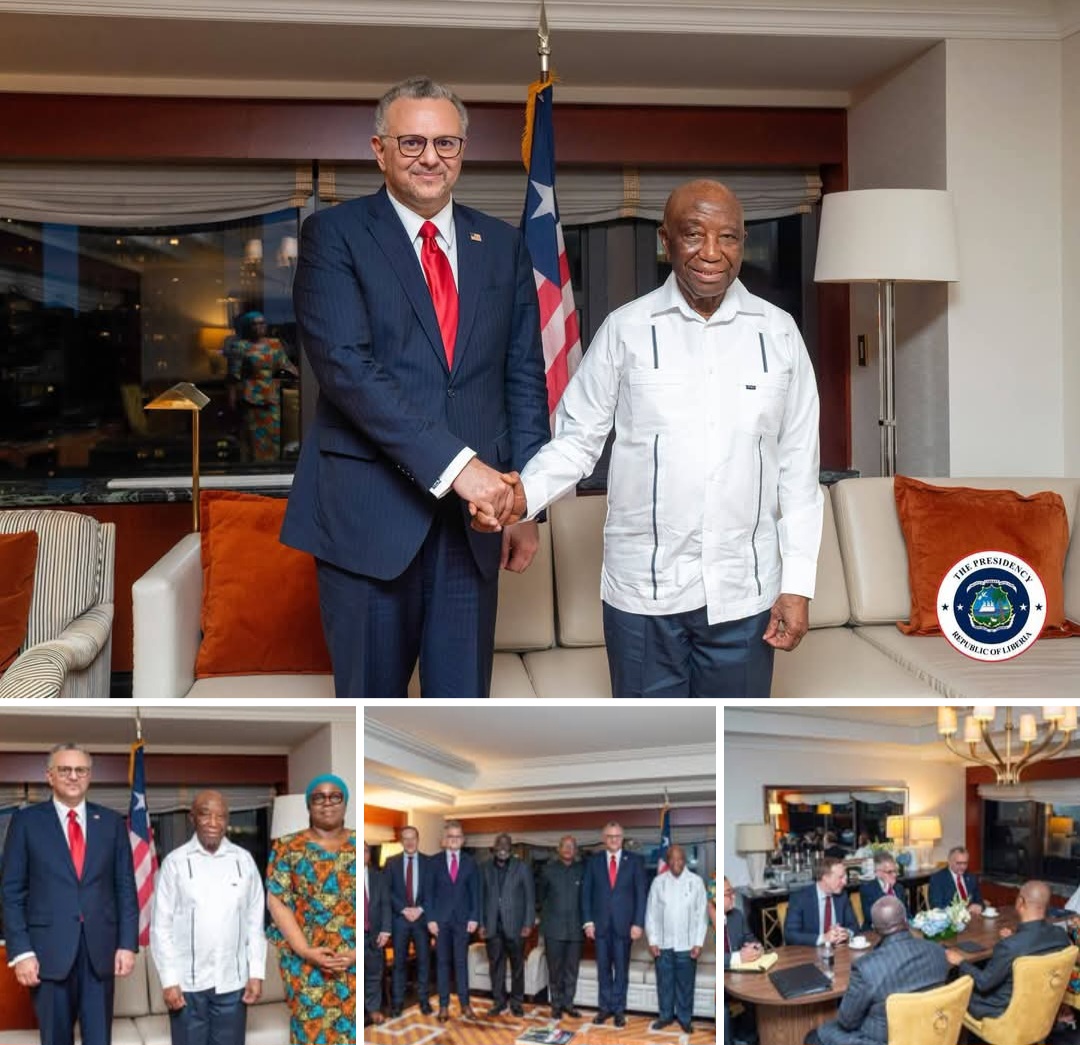
President Joseph Nyuma Boakai Sr. has held high-level discussions with Massad Boulos, White House Senior Advisor for African Affairs, as Liberia seeks to deepen its longstanding relationship with the United States and expand cooperation in development, investment, security and diplomacy.
The meeting, held in New York during President Boakai’s broader diplomatic engagements in the United States, focused on issues of mutual interest and opportunities for closer collaboration between Monrovia and Washington, according to information released on the Liberian side.
President Boakai reaffirmed Liberia’s commitment to its historic partnership with the United States, while emphasizing the importance of sustained international engagement in advancing the country’s development priorities and responding to regional and global challenges.
The discussions come at a time when Liberia is seeking to translate improving macroeconomic indicators into broader investment, employment and infrastructure opportunities.
World Bank data show that Liberia’s economy expanded by about 5.1 percent in 2025, supported by a strong rebound in mining, alongside growth in services and agriculture.
The World Bank estimates Liberia’s population at approximately 5.73 million in 2025, with nominal gross domestic product of about $5.25 billion and GDP per capita of roughly $915.
At the same time, the country continues to face significant development needs, including infrastructure gaps, limited fiscal space and the challenge of creating productive employment for a growing population.
The Boakai-Boulos meeting also comes against the backdrop of one of Africa’s longest-standing diplomatic relationships with the United States.
Washington formally recognized Liberia in 1862, when the two countries concluded a treaty of commerce and navigation.
Diplomatic relations were established in 1864, while the U.S. Legation in Monrovia was elevated to embassy status in 1949.
The relationship has roots extending even further back.
Liberia’s modern history is closely connected to the American Colonization Society, which established a settlement for freed African Americans on the West African coast beginning in 1822.
Liberia declared independence in 1847, creating an independent republic whose political institutions were significantly influenced by American constitutional traditions.
Over subsequent decades, relations expanded beyond historical ties to encompass diplomacy, commerce, development assistance, public health, democratic governance and security cooperation.
For Liberia, the United States has remained an important development and diplomatic partner, including during periods of civil conflict and the country’s recovery from the 2014–2016 Ebola epidemic. U.S.
engagement has also included support for governance, economic development, health, education and security-sector professionalization.
Economic cooperation represents another important dimension of the relationship.
According to the Office of the United States Trade Representative, two-way U.S. goods and services trade with Liberia totaled an estimated $493.9 million in 2025, a 15.4 percent decline from 2024.
U.S. goods exports to Liberia were approximately $108.7 million, while U.S. goods imports from Liberia totaled about $72.2 million.
Services trade was considerably larger, with U.S. services exports to Liberia estimated at $117 million and services imports from Liberia at approximately $196 million.
Liberia is also eligible for preferential trade benefits under the African Growth and Opportunity Act (AGOA), while the two countries maintain a Trade and Investment Framework Agreement signed in 2007.
The figures highlight both the existing commercial relationship and the potential for expansion, particularly in sectors such as mining, agriculture, energy, transportation, telecommunications, financial services and infrastructure.
The economic dimension of Liberia’s engagement with Washington has gained additional significance through the Millennium Challenge Corporation.
In December 2024, the MCC Board selected Liberia as an eligible country to develop a new compact with the United States.
The selection process considers areas including economic freedom, good governance and investment in people.
For Monrovia, potential future U.S.-backed investment could complement domestic reforms and help address longstanding infrastructure and private-sector constraints.
Any eventual compact, however, would depend on the completion of the MCC development and due-diligence process and subsequent agreements.
Security, Democracy and Regional Stability
Beyond economics, the Liberia–U.S. relationship has an important security and governance dimension.
Liberia emerged from two devastating civil wars that ended in 2003, followed by internationally supported efforts to rebuild state institutions, strengthen democratic governance and professionalize the security sector.
The United States has been among Liberia’s long-term international partners in these areas.
President Boakai’s latest engagement therefore places diplomatic cooperation within a wider framework encompassing democratic institutions, regional stability, development and economic opportunity.
The meeting with Boulos was attended by Liberian Foreign Minister Sara Beysolow Nyanti, National Security Advisor Samuel Kofi Woods and Ambassador Lewis G. Brown.
The New York meeting represents another chapter in a relationship that has evolved from its 19th-century origins into a modern partnership involving diplomacy, trade, development and security.
For President Boakai’s administration, the challenge is increasingly to convert diplomatic goodwill into measurable economic and development outcomes including greater investment, improved infrastructure, expanded trade and stronger institutional capacity.
As Liberia seeks to build on its recent economic growth while confronting persistent development constraints, closer engagement with Washington could remain an important component of its broader international economic and diplomatic strategy.
The Boakai-Boulos discussions consequently come at a moment when Liberia is seeking to position its historic relationship with the United States not only as a legacy of shared history, but also as a platform for future cooperation in a changing West African and global environment.


