





By: Julius Konton
One year after thousands of Liberians took to the streets in a historic national anti-drug campaign, advocates, rehabilitation institutions, former drug users and families affected by substance-use disorders are preparing to return to the Samuel Kanyon Doe Sports Complex on Friday to assess progress and renew calls for a stronger national response.
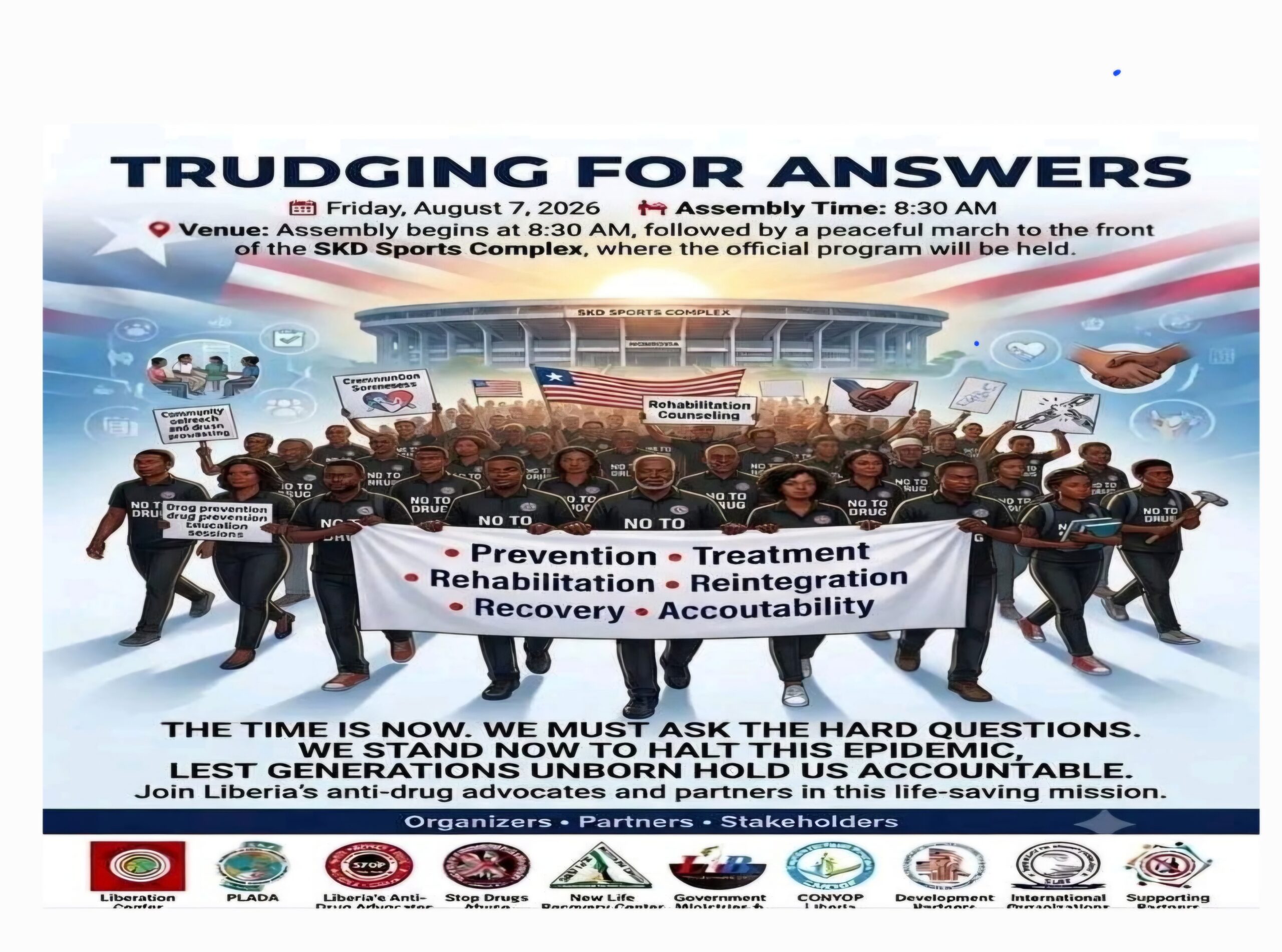
The follow-up commemoration, organized by the Coalition of Rehabilitation Centers and Advocates (CORCA) in collaboration with prevention institutions, former drug users and people affected by substance-use disorders, will be held under the banner “Trudging for Answers.”
The gathering marks one year since the August 7, 2025 campaign, when citizens marched under the rallying cry “Enough Is Enough” and presented a petition to the Government of Liberia demanding urgent and sustained action against substance abuse.
The organizers say Friday’s event is intended to move the national conversation beyond protest and toward accountability, measurable progress and long-term solutions.
The August 7, 2025 mobilization represented one of Liberia’s most visible civil-society responses to growing concerns over substance abuse, particularly among young people and vulnerable communities.
Participants called for stronger investment in prevention, treatment, rehabilitation, recovery and social reintegration, while urging government and development partners to treat substance-use disorders as both a public-health and social-development challenge.
One year later, CORCA says the anniversary provides an opportunity to examine what has changed since the petition was delivered, what commitments have been implemented and where significant gaps remain.
“Trudging for Answers” is therefore being presented not simply as a commemorative slogan, but as a call for answers to some of Liberia’s most difficult questions:
How many people affected by substance-use disorders are receiving treatment?
Are rehabilitation services sufficiently accessible and adequately funded?
What prevention programs are reaching schools and communities?
And what happens to recovering users after they leave rehabilitation facilities?
Liberia’s struggle with substance abuse comes against the backdrop of wider social and economic vulnerabilities.
The country has a population of roughly 5.5 million people, with a predominantly young demographic profile.
That makes youth protection and prevention central to any long-term national strategy addressing drugs and other harmful substances.
The consequences extend well beyond individual users. Substance-use disorders can contribute to family breakdown, school dropout, unemployment, homelessness, violence, mental-health challenges and other forms of social exclusion.
For rehabilitation advocates, recovery must therefore not end when a person leaves a treatment facility.
They argue that successful rehabilitation requires a continuum of care from early prevention and community education to medical and psychosocial treatment, rehabilitation, vocational training, family support and reintegration.
Liberia has made efforts in recent years to strengthen its response to substance abuse, including greater public discussion of rehabilitation and recovery and increased attention to the country’s growing drug problem.
However, advocates maintain that the scale of the challenge requires a coordinated national system capable of connecting prevention, law enforcement, public health, rehabilitation and social services.
Former drug users are expected to play a prominent role in Friday’s gathering, emphasizing the principle that people who have experienced addiction should be part of designing solutions to it.
Their involvement also underscores a growing international understanding of substance-use disorders as conditions requiring treatment, rehabilitation and long-term support rather than approaches based exclusively on punishment.
The central question confronting Liberia one year after the 2025 march is whether the national outcry has translated into sustainable action.
CORCA and its partners are expected to use the anniversary to review progress, identify continuing challenges and renew demands for stronger collaboration among government agencies, rehabilitation centers, prevention organizations, civil society, development partners and communities.
The coalition is also calling for greater public awareness, stronger family support systems and expanded opportunities for people in recovery to return to productive community life.
Religious institutions, schools, youth organizations, traditional and community leaders, women’s groups, students, diplomatic representatives and the media have all been invited to participate.
The organizers say Liberia’s response to substance abuse cannot rest solely on government institutions or rehabilitation centers.
Families have a critical role in early intervention.
Schools can strengthen prevention and awareness. Religious and traditional leaders can help reduce stigma.
Civil society organizations can support vulnerable communities.
Health professionals can provide treatment and psychosocial care, while former users can provide powerful peer-support networks.
Development partners, meanwhile, can help mobilize technical expertise, financing and evidence-based interventions.
The coalition argues that these efforts must ultimately converge around one objective: protecting Liberia’s young population and ensuring that people struggling with substance-use disorders have a realistic pathway to recovery.
The August 7 gathering is scheduled for 8:30 a.m. on Friday, August 7, 2026, at the Samuel Kanyon Doe Sports Complex in Paynesville.
For organizers, the anniversary is both a moment of remembrance and a renewed call to action.
One year after thousands of Liberians marched with the message “Enough Is Enough,” the movement is seeking to transform public concern into sustained national action.
The message remains direct:
“Say No to Drugs. Restore Lives. Build the Future.”
As Liberia confronts the continuing challenges associated with substance abuse, the organizers say the ultimate measure of the country’s response should not be the number of marches held, but the number of lives prevented from being lost, people successfully supported through recovery, families restored and young Liberians given a future beyond addiction.


