
By: Julius Konton
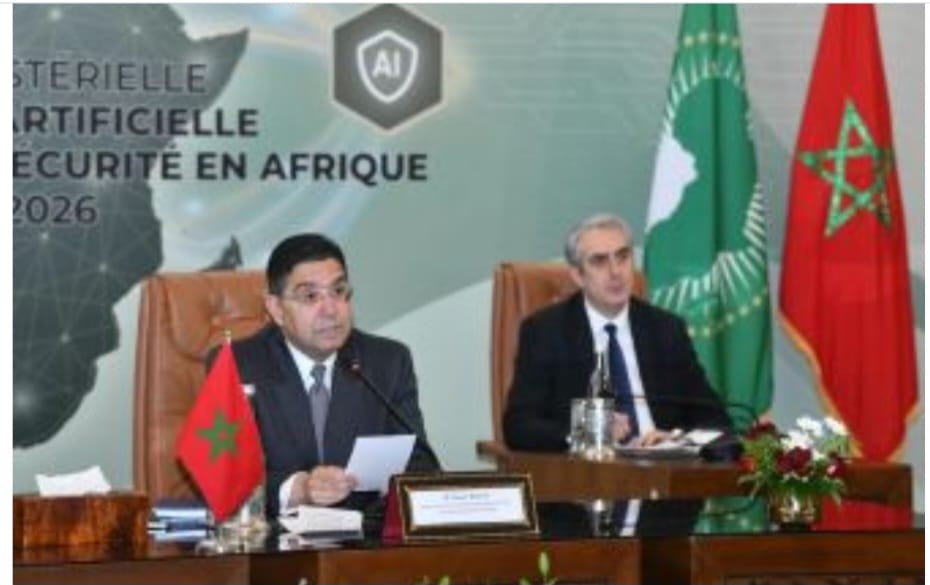
Morocco has renewed its push for a continent-wide artificial intelligence strategy centered on sovereignty, peacebuilding and sustainable development, as Foreign Minister Nasser Bourita addressed a high-level ministerial session of the African Union Peace and Security Council (PSC) on Thursday.
Participating via videoconference, Bourita underscored Morocco’s growing leadership role in shaping Africa’s digital future and called for stronger continental cooperation to ensure AI serves the interests of African nations rather than external powers.
The meeting focused on the expanding role of artificial intelligence in governance, conflict prevention, peacekeeping and national security, at a time when African countries are accelerating digital transformation while also confronting cyber threats, misinformation campaigns and rising geopolitical competition in emerging technologies.
Morocco Builds on Landmark 2025 AU AI Summit
Bourita noted that Thursday’s discussions follow the historic March 20, 2025 PSC ministerial meeting, held under Morocco’s presidency, which was the first African Union security council session dedicated entirely to artificial intelligence.
That summit resulted in key recommendations, including the adoption of the African Declaration on Artificial Intelligence and the announcement of plans to establish an African AI Fund, designed to support innovation, research, training and infrastructure across the continent.
Analysts view the initiative as a major milestone for Africa, which currently accounts for less than 1% of global AI investment, despite being home to more than 1.4 billion people and one of the world’s fastest-growing youth populations.
AI Must Serve African Sovereignty, Says Morocco
Bourita said Morocco’s strategy is inspired by the vision of King Mohammed VI, who has consistently advocated technological sovereignty, South-South cooperation and inclusive development.
He stressed that artificial intelligence must become a “strategic lever” for:
National sovereignty
Economic development
Modern public services
Continental integration
Security cooperation
The Moroccan minister also welcomed the creation of an African Advisory Group on AI, describing it as a critical platform to guide policy and ensure fair access to emerging technologies.
Three Major Threats Facing Africa in the AI Era
In a detailed intervention, Bourita warned that AI also presents serious risks if left unregulated. He identified three urgent areas of concern:
Governance Risks
AI-generated misinformation, manipulated media and deepfake campaigns could interfere with elections, weaken institutions and erode public trust in democratic systems.
Conflict Escalation
Artificial intelligence tools are increasingly being used to spread hate speech, intensify ethnic tensions and manipulate public opinion during crises and armed conflicts.
Peacekeeping Challenges
AU peace operations now face more complex battlefields shaped by cyber warfare, hybrid threats and massive volumes of unverified digital information.
Security experts say these challenges are particularly acute in fragile regions such as the Sahel, Horn of Africa, and parts of Central Africa, where armed groups increasingly exploit digital platforms.
Morocco Proposes Continental AI Security Mechanisms
To confront these risks, Bourita proposed a series of concrete African-led responses, including:
Creation of continental monitoring and early-warning systems against information manipulation
Rapid response mechanisms to tackle digital disinformation crises
AI systems to detect hate speech and incitement to violence
Expanded training of African youth in AI engineering, cybersecurity and data science
Regulatory frameworks for engagement with major global digital platforms
Development of African-built AI tools for conflict prevention and peace operations
Experts say Africa will need an estimated 230 million digital jobs by 2030, making AI skills development essential for future growth.
Morocco’s Domestic AI Ambitions Gain Momentum
Bourita also highlighted Morocco’s own technological progress, citing the Digital Morocco 2030 Strategy and the AI Made in Morocco Initiative, both aimed at transforming the kingdom into a regional innovation hub.
Morocco has invested heavily in digital infrastructure, smart governance systems, startup ecosystems and renewable-powered technology zones, positioning itself among Africa’s emerging leaders in technology policy.
The country ranks among the continent’s stronger performers in connectivity, fintech expansion and e-government services.
Africa’s Race for Technological Independence
As the United States, China and Europe intensify global competition in AI, African leaders are increasingly seeking to avoid dependence on foreign platforms and external data systems.
Morocco’s call for a “sovereign and responsible African AI” reflects broader concerns that without homegrown solutions, Africa risks becoming merely a consumer market rather than a producer of next-generation technologies.
According to the World Economic Forum, AI could contribute more than $1.5 trillion to Africa’s economy by 2030 if investments in infrastructure, education and regulation are accelerated.
Morocco Reaffirms Continental Commitment
Concluding his remarks, Bourita reaffirmed Morocco’s readiness to support collective African action to ensure artificial intelligence advances peace, prosperity and stability.
“Our objective,” he said, “is the emergence of a sovereign, responsible African AI, fully aligned with the interests of the peoples of the continent.”
With Africa’s population expected to reach 2.5 billion by 2050, Thursday’s meeting highlighted that the race to govern AI may become one of the continent’s defining strategic priorities in the decades ahead.
