


By: Julius Konton
Liberia has renewed its support for a negotiated two-state solution to the Israeli-Palestinian conflict, urging all parties to respect international law, refrain from unilateral actions that could alter the situation on the ground, and fully implement relevant United Nations Security Council resolutions.
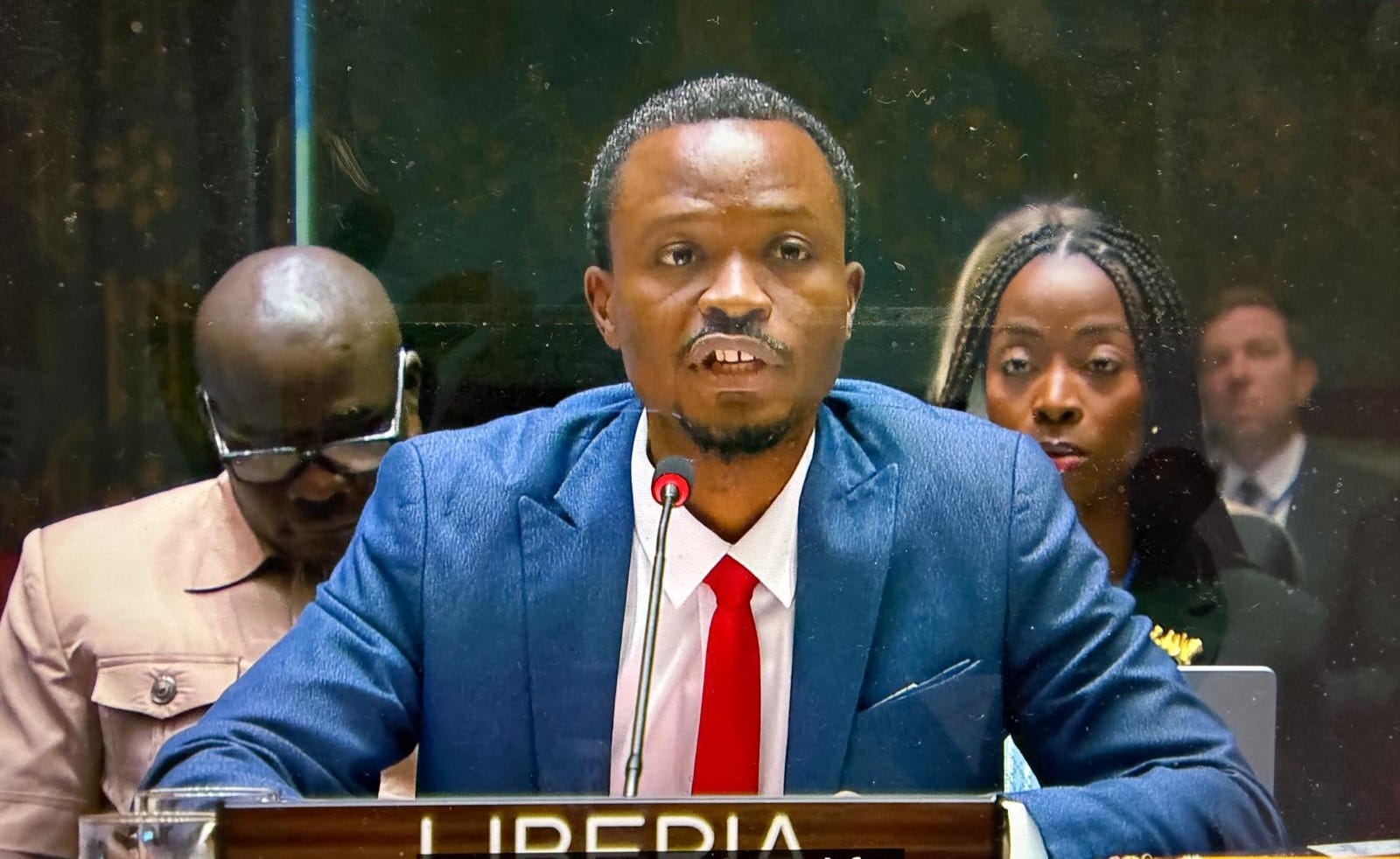
Speaking Monday during the United Nations Security Council’s 10,230th meeting on the situation in the Middle East, including the Palestinian question, Liberia’s Political Coordinator to the Security Council, Prutus Sackie, said a durable settlement requires Israelis and Palestinians to coexist as independent states with secure borders and mutual recognition.
Sackie emphasized that the international community must preserve the political and territorial conditions necessary for such an outcome, warning that continued actions that change realities on the ground could further narrow the space for a negotiated settlement.
A central element of Liberia’s intervention was its call for the complete and faithful implementation of Security Council Resolution 2803 (2025).
Adopted on November 17, 2025, by a vote of 13 members in favor, with China and Russia abstaining, Resolution 2803 endorsed the U.S.-backed Comprehensive Plan to End the Gaza Conflict and authorized the establishment of an International Stabilization Force and transitional arrangements for Gaza.
The resolution also established a framework involving a Board of Peace and transitional governance mechanisms.
Liberia’s position, according to Sackie, is that these transitional and stabilization mechanisms should contribute to creating the political conditions necessary for Palestinian self-government and eventual statehood rather than becoming an alternative to a negotiated two-state settlement.
The United Nations has subsequently continued to monitor implementation of Resolution 2803.
A report submitted in May 2026 said the resolution called for the Comprehensive Plan to be implemented “in its entirety, in good faith and without delay,” while outlining transitional governance and stabilization arrangements for Gaza.
Liberia also reaffirmed its commitment to international law and relevant Security Council decisions, including the 2024 Advisory Opinion of the International Court of Justice (ICJ) concerning Israel’s policies and practices in the Occupied Palestinian Territory, including East Jerusalem.
The ICJ issued its Advisory Opinion on July 19, 2024, following a request from the UN General Assembly.
The Court examined the legal consequences of policies and practices concerning the Palestinian territory occupied since 1967, including the West Bank, East Jerusalem and Gaza Strip.
In its conclusions, the Court stated that Israel’s continued presence in the Occupied Palestinian Territory was unlawful and addressed the consequences arising from policies and practices it found contrary to international law.
The opinion also emphasized the Palestinian people’s right to self-determination.
The ICJ opinion is advisory rather than a Security Council resolution, but it has become an important reference point in international discussions over the legal framework surrounding the Israeli-Palestinian conflict.
Liberia’s intervention comes amid renewed international concern over developments in Gaza and the West Bank and their implications for the prospects of a two-state settlement.
The United Nations reported on September 28 that the Security Council was meeting against a backdrop of heightened tensions in the West Bank, including concerns over settlement expansion and settler violence, while implementation of the Gaza peace framework remained incomplete.
UN records have also highlighted continuing international concern over developments that could affect the territorial continuity required for a future Palestinian state.
In an earlier Security Council intervention, Liberia specifically referenced proposed housing units in the E1 area of the West Bank and called for measures to preserve the territorial conditions necessary for a negotiated two-state outcome.
Against this backdrop, Sackie said Liberia believes the opportunity for a two-state settlement remains available, but the space for achieving it is becoming increasingly constrained.
He urged governments and international actors committed to a negotiated settlement to intensify diplomatic efforts and prevent further deterioration of the conditions required for peace.
Liberia’s position also carries a historical dimension dating back nearly eight decades.
On November 29, 1947, the UN General Assembly adopted Resolution 181 (II), known as the Partition Plan for Palestine, by a vote of 33 in favor, 13 against and 10 abstentions.
The resolution recommended the establishment of independent Arab and Jewish states in Palestine, with Jerusalem receiving a special international regime.
Liberia was among the countries that voted in favor.
The vote placed Liberia among the early UN member states supporting an international framework that envisaged separate Arab and Jewish political entities in the territory of Mandatory Palestine.
Nearly 79 years later, Liberia continues to invoke that historical record as part of its diplomatic position in favor of two states living alongside each other in peace and security.
Liberia’s current position places Israeli security and Palestinian self-determination within the same broader framework.
The country has previously told the Security Council that Israeli security and Palestinian statehood should not be treated as mutually exclusive objectives, while also stressing the need to protect civilians and uphold international humanitarian law.
For Monrovia, the central challenge is therefore not simply ending individual episodes of violence, but establishing political, territorial and institutional conditions capable of sustaining a durable settlement.
Sackie’s intervention reinforced Liberia’s call for compliance with Security Council decisions, respect for international law, protection of civilians and preservation of the possibility of two independent states.
As diplomatic efforts continue, Liberia says the international community must act before further changes on the ground make a negotiated settlement increasingly difficult to achieve.


