




By: Julius Konton
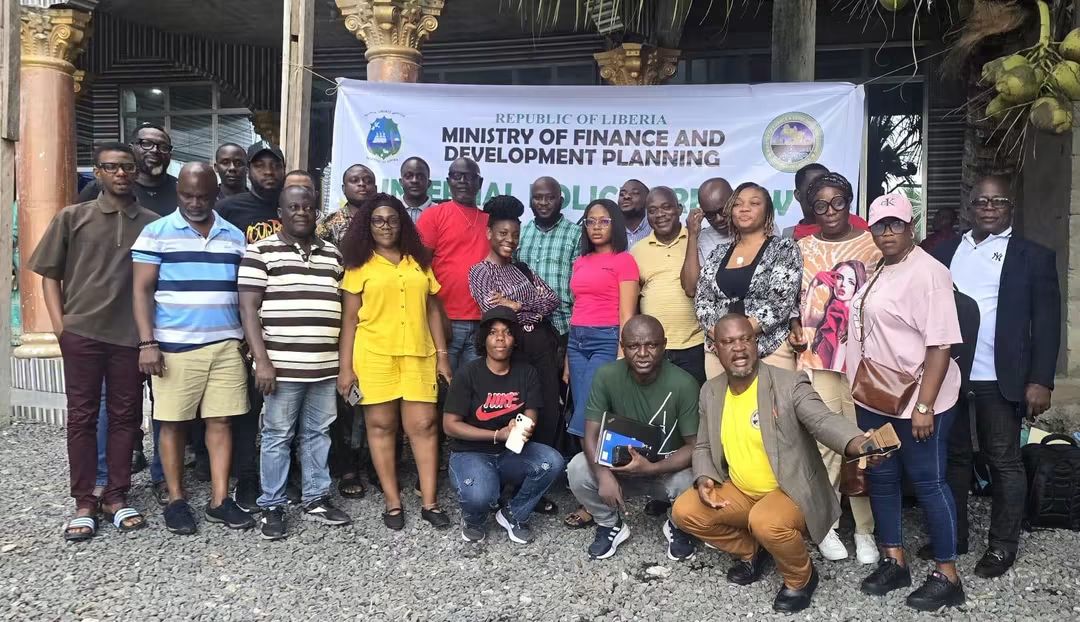
Liberia’s Ministry of Finance and Development Planning (MFDP) has concluded a five-day internal policy review and validation exercise in Kakata, Margibi County, as the government institution moves to strengthen administrative discipline, employee welfare, risk management and accountability across its operations.
The exercise, held from September 23–27, brought together key stakeholders to examine and validate a broad package of draft policies, manuals and operational guidelines intended to modernize the Ministry’s internal governance framework.
Officials described the exercise as an important institutional reform measure designed to establish clearer standards for how the Ministry manages its personnel, assets, security, technology and day-to-day administrative functions.
Among the principal documents reviewed were a draft Security Standard Operating Procedures Manual and a Draft Administrative Policy Manual, both of which are expected to provide clearer operational guidance across the Ministry.
Participants also reviewed proposed policies covering fleet management, inventory and fixed-asset management, occupational health and safety, employee medical and healthcare assistance, study leave and educational assistance, as well as broader human-resource administration.
The review also extended to institutional ethics and accountability.
Stakeholders examined the Human Resources Handbook, Employee Code of Conduct, Honorarium Policy, Risk Mitigation Plan, and Gender and Social Inclusion Policy.
In the area of technology and information management, proposed Information Security and ICT Governance Policies were scrutinized, reflecting the increasing importance of protecting government information, strengthening digital oversight and establishing appropriate controls around technology-driven public administration.
The breadth of the exercise is significant given the MFDP’s central role in Liberia’s fiscal and economic management.
The Ministry currently operates through five major departments covering fiscal affairs, budget and development planning, economic management, treasury and accounting, and internal services. Its responsibilities include fiscal policy, national budget coordination, government accounting, treasury operations, economic management and public financial management.
The Ministry’s institutional importance is also reflected in the scale of Liberia’s public-finance system.
MFDP’s official website currently lists the FY2026 national budget at approximately US$1.3 billion, while the Ministry has published the FY2026 national budget, supplementary-budget documents and mid-year budget-performance reports as part of its public-finance reporting framework.
Against that backdrop, officials say strengthening the internal systems of the institution responsible for managing public resources is critical to improving efficiency and maintaining public confidence.
The policy review comes at a time when the Ministry is also publishing regular fiscal, budget-performance and public-debt reports, including the FY2026 second-quarter Public Debt Management Report and the consolidated mid-year budget review.
Speaking at the opening of the Kakata exercise, Deputy Minister for Administration Benedict Y. Harleyson described the review as more than an administrative requirement, emphasizing its potential long-term impact on the Ministry’s institutional culture.
“What we are doing here in Kakata is bigger than paperwork,” Harleyson told participants. “We are building the foundation on which the next generation of public servants will stand.”
He said stronger internal policies would reinforce the Ministry’s responsibility to manage public resources with integrity, discipline and care, while urging participants to view themselves as custodians of institutional standards that should extend beyond individual officeholders and administrations.
“This is our chance to get it right,” Harleyson said, adding that a strong institution depends on people willing to ask difficult questions and commit themselves to standards that can withstand changes in leadership.
The Deputy Minister further linked the exercise to Liberia’s public financial management framework, urging participants to ensure that the revised policies improve the Ministry’s output and remain consistent with applicable public financial management laws and regulations.
Also addressing participants, James M. Tokpawhiea, Deputy National Coordinator of the PFM Reform Coordinating Unit at MFDP, emphasized the importance of designing policies around the people who will ultimately use them.
He urged stakeholders to keep both targeted end-users and political decision-makers in view during the validation process, particularly where the policies affect the protection and management of public resources.
The reform effort has historical significance for the Ministry.
MFDP was established by an Act of the National Legislature in 2013, consolidating core public-finance, economic-management and development-planning functions that had previously been handled by separate government institutions.
The restructuring was intended to improve coordination and enable government to focus more effectively on fiscal policy, economic planning and public-resource management.
The Ministry’s current institutional framework includes not only fiscal and budgetary functions but also internal services covering finance, human resources, information and communications technology, communications and procurement.
This makes the policies reviewed in Kakata relevant not only to administrative personnel but to the broader systems through which the Ministry operates.
The five-day exercise concluded on September 27 with plenary discussions and the formal validation of the proposed policy and manual revisions.
The outcome is expected to provide the basis for further institutional action, including the refinement, adoption and implementation of the reviewed instruments.
For the MFDP, the exercise represents a broad internal governance initiative spanning security, human resources, employee welfare, asset management, occupational safety, risk management, gender and social inclusion, information security and ICT governance.
Officials say the ultimate objective is to establish a more consistent internal operating environment capable of supporting the Ministry’s wider mandate: strengthening public financial management, improving institutional accountability and ensuring that the systems governing public resources are supported by clear, modern and enforceable administrative standards.


