


By : Julius Konton
Five of Liberia’s opposition political organizations have announced a renewed framework for cooperation, calling for a broader national dialogue and presenting what they describe as a coordinated alternative agenda on governance, democracy, economic opportunity and institutional accountability.
The initiative brings together the Alternative National Congress (ANC), Coalition for Democratic Change (CDC), Movement for Economic Empowerment (MOVEE), Movement for Progressive Change (MPC), and Union of Liberian Democrats Party (ULDP).
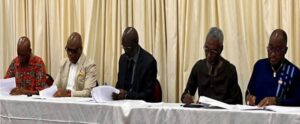
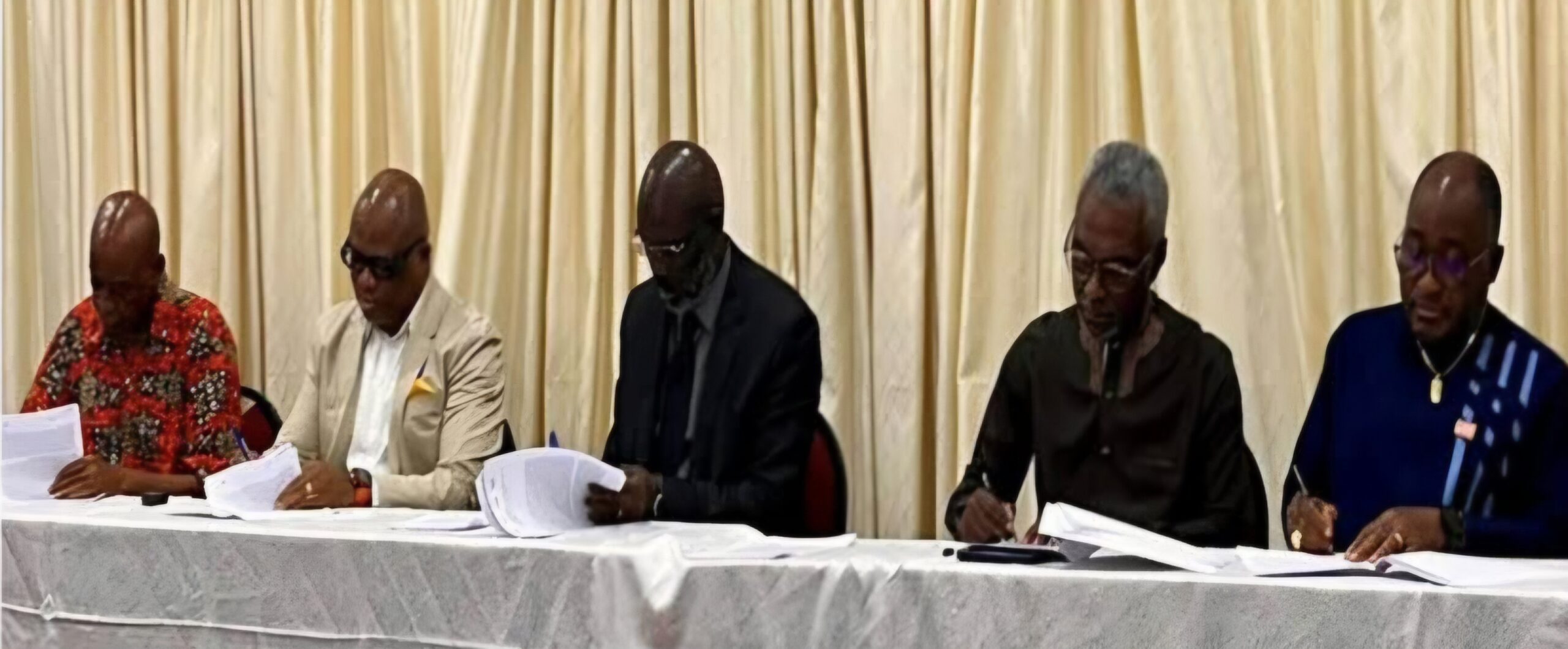
Their leaders signed a joint communiqué in Monrovia on Sunday, September 27, following political roundtables held earlier in September and a subsequent meeting at Sinkor Palace.
The document was signed by Alexander B. Cummings of the ANC, former President George Manneh Weah of the CDC, former Foreign Minister and MOVEE political leader Dee-Maxwell Saah Kemayah, Simeon C.M. Freeman of the MPC, and Jonathan A. Mason of the ULDP.
The parties said their objective is not simply to oppose the government, but to develop a wider platform for national engagement and what they call a “people-centered alternative” to governance.
The announcement comes less than three years after Liberia’s closely contested 2023 presidential election, in which Joseph Nyuma Boakai defeated incumbent George Weah by 20,567 votes, receiving 50.64% of the runoff vote against Weah’s 49.36%.
Weah subsequently conceded, allowing Liberia to complete another peaceful transfer of presidential power.
The 2023 election was particularly significant because it was the first general election conducted primarily under Liberian national responsibility following the closure of the United Nations Mission in Liberia in 2018. The United Nations subsequently described the peaceful transition as an important milestone in Liberia’s post-conflict democratic development.
The opposition communiqué therefore places considerable emphasis on the independence and credibility of the National Elections Commission (NEC) ahead of the 2029 general elections.
The parties say any attempt to undermine the commission’s independence, deregister political parties improperly or interfere with the electoral process would be resisted.
The concern carries added significance because the 2023 presidential contest involved more than 2.47 million registered voters, while the first round attracted a turnout of about 78.9%.
Liberia’s electorate is expected to remain a major political force as preparations for the next general elections gradually take shape.
One of the strongest sections of the communiqué focuses on national territorial sovereignty and the situation along Liberia’s northern frontier with Guinea, particularly in Foya District, Lofa County.
The opposition parties accuse the government of failing to adequately protect Liberia’s territorial integrity and demand stronger diplomatic action involving regional and international institutions.
These are political allegations contained in the communiqué and are not presented as independently established findings.
The border issue is nevertheless a documented regional concern.
In March 2026, the Liberian government itself acknowledged heightened tensions along the Liberia-Guinea border around Sorlumba in Foya District and said it was pursuing bilateral and multilateral diplomatic efforts involving the Mano River Union and ECOWAS.
Government agencies also reported that residents had fled some border communities amid the tensions, prompting food and humanitarian assessments in Foya.
The dispute has taken on additional economic significance because Foya is becoming an increasingly important transport and commercial corridor.
In June 2026, President Boakai’s administration announced plans for an 86-kilometer asphalt highway linking Mendicorma in Foya District with Voinjama, describing the road as an investment in regional connectivity and trade.
The opposition parties have also challenged what they describe as insufficient public information surrounding Liberia’s agreement with the United States to accept up to 1,200 third-country nationals facing deportation from the United States.
The agreement was publicly reported in August 2026, when Liberia accepted an initial group of 20 people.
Reuters reported that the arrangement could involve as many as 1,200 people over a 12-month period and that the Liberian government said the individuals would be treated as guests and could seek asylum in Liberia.
The opposition communiqué demands greater transparency concerning the arrangement, arguing that Liberians should understand its financial, humanitarian, legal and national-security implications.
The issue has international significance because Liberia has historically maintained close political and social links with the United States, while the country itself emerged in the 19th century from a settlement project involving formerly enslaved and free Black Americans.
The five parties argue that government policies have not sufficiently translated economic growth into jobs, stronger businesses or improved living standards.
They specifically highlight difficulties facing small businesses, access to credit, employment and the enforcement of regulations affecting wholesalers and retailers.
These statements represent the opposition parties’ assessment rather than independently verified conclusions.
Official international data, however, illustrates the scale of Liberia’s economic challenge.
The World Bank estimates Liberia’s population at approximately 5.73 million in 2025, with nominal GDP of about US$5.25 billion, GDP per capita of roughly US$915, and real GDP growth of approximately 5% in 2025. Inflation was estimated at 8.3% for the same year.
Liberia’s economic structure remains heavily dependent on commodities, agriculture, mining, services and international financial support, while remittances remain significant.
World Bank data indicates that personal remittances amounted to approximately 21.3% of GDP in 2024, underscoring the importance of the Liberian diaspora to household incomes and the wider economy.
The opposition says future economic policy should place greater emphasis on domestic entrepreneurship, employment generation, access to financing and equal economic opportunity.
The communiqué also raises several corruption and public-finance allegations, including concerns surrounding a multimillion-dollar construction project in Foya.
The opposition describes the project as a roughly US$10 million development and questions its financing, procurement process and purpose. It also calls for investigation into an US$8 million Central Bank intervention involving SIB Liberia.
The Foya construction controversy has generated competing explanations.
Government officials have described the development as connected to a proposed Mano River Union Presidential Center for Regional Peace and Development, while other reports have cited varying estimates of its cost and ownership.
The government has rejected the characterization of the project as a personal presidential residence.
Separately, the Central Bank of Liberia’s audited 2024 financial statements confirm that its Board of Governors approved US$8 million in emergency liquidity assistance to SIB Liberia in May 2024 following financial difficulties involving legacy loans and deposits inherited from the failed First International Bank Liberia.
The opposition is demanding further scrutiny, while the documented financial records establish the existence of the US$8 million liquidity support but do not, by themselves, establish the broader political allegations contained in the communiqué.
The opposition parties also place Liberia’s growing narcotics problem at the center of their call for greater accountability.
Their communiqué references two major drug seizures, including a shipment valued at approximately US$19 million and a much larger seizure estimated at more than US$300 million.
The underlying seizures are independently documented.
In June 2026, Liberian authorities intercepted approximately 237.6 kilograms of cocaine at Roberts International Airport, with an estimated street value exceeding US$19 million.
In July, authorities announced the seizure of nearly 4,000 kilograms of cocaine near Monrovia, valued at approximately US$317 million. Reuters described the latter as one of Liberia’s largest-ever drug seizures.
The investigations have since expanded into an international narcotics case.
In August, Liberia’s Ministry of Justice announced charges against former Vice President Jewel Howard-Taylor and several foreign nationals in connection with an alleged transnational narcotics network.
The government emphasized that criminal charges constitute allegations and that defendants remain entitled to due process and the presumption of innocence.
The opposition, however, is demanding an independent and broadly constituted investigation into the drug cases, arguing that public confidence requires transparency and equal application of the law.
Another major component of the opposition’s declaration concerns the judiciary and freedom of expression.
The parties accuse the government of undermining judicial independence and selectively applying the law.
They also criticize what they describe as growing restrictions on public criticism and political speech, particularly in relation to the recently approved cybercrime framework.
These are contested political claims.
The communiqué does not constitute an independent legal finding, and the allegations would require examination against court records, legislation, government responses and other evidence.
The wider issue is significant for Liberia because the country’s democratic institutions have developed against the background of two civil wars, which ended with the 2003 peace agreement.
The United Nations notes that Liberia experienced civil wars from 1989–1997 and 1999–2003, followed by a long international peacebuilding process.
The UN Mission in Liberia eventually closed in 2018, leaving national institutions with greater responsibility for maintaining peace, constitutional governance and democratic accountability.
The opposition communiqué criticizes the government’s handling of its diplomatic dispute with European Union Ambassador Nona Deprez.
The government did formally request the EU to recall and replace Deprez in a March 2026 diplomatic communication, according to reports.
The dispute reportedly centered on statements the Liberian government considered inappropriate or damaging to its leadership and investment climate.
The EU’s own website identifies Deprez as the Head of its Delegation to Liberia and describes the EU-Liberia relationship as spanning approximately 50 years, with cooperation covering governance, human rights, development, peace and economic growth.
The diplomatic disagreement therefore extends beyond an individual ambassador and touches on Liberia’s relationship with one of its principal development partners.
Rather than forming an immediate electoral alliance, the five parties say they have established an Opposition Political Parties’ Joint Technical Committee, known as OPPIITC.
According to the communiqué, the committee is expected to coordinate working groups, consult civil society, engage opposition lawmakers and develop policy positions and coordinated advocacy on issues considered to be in the national interest.
The parties stress that they intend to maintain their individual political identities and organizational autonomy while cooperating on areas of common concern.
That distinction is important in a political environment where previous opposition collaborations have not always translated into durable organizational structures.
The communiqué says the new approach is intended to build trust through consultations, cooperation and measurable national engagement rather than merely through electoral calculations.
Liberia’s current political debate is unfolding against a remarkable post-war historical backdrop.
The country emerged from more than a decade of civil conflict in 2003 and subsequently held a series of competitive national elections.
The United Nations says the 2023 election marked the country’s second post-conflict democratic transition and was conducted without the large-scale violence that characterized earlier periods of Liberia’s political history.
The challenge now is whether political competition can remain institutionalized while disagreements over economic management, corruption, sovereignty, justice, security and civil liberties intensify.
The opposition parties say their new cooperation is intended to contribute to that process by creating a structured alternative political platform.
For President Boakai’s administration, the development represents an increasingly organized opposition preparing to scrutinize government performance ahead of the 2029 electoral cycle.
For the opposition parties themselves, the communiqué establishes a framework for cooperation while preserving separate party identities.
The parties conclude by calling on Liberians who believe in constitutional democracy, economic opportunity, accountable government and equal justice to participate in what they describe as a peaceful national conversation.


