




By: Julius Konton
Liberia is seeking to reposition itself from a post-conflict recovery story into an emerging investment destination, with Finance and Development Planning Minister Augustine Kpehe Ngafuan calling on Liberians in the diaspora and international investors to look beyond the country’s troubled past and focus on its expanding economic opportunities.
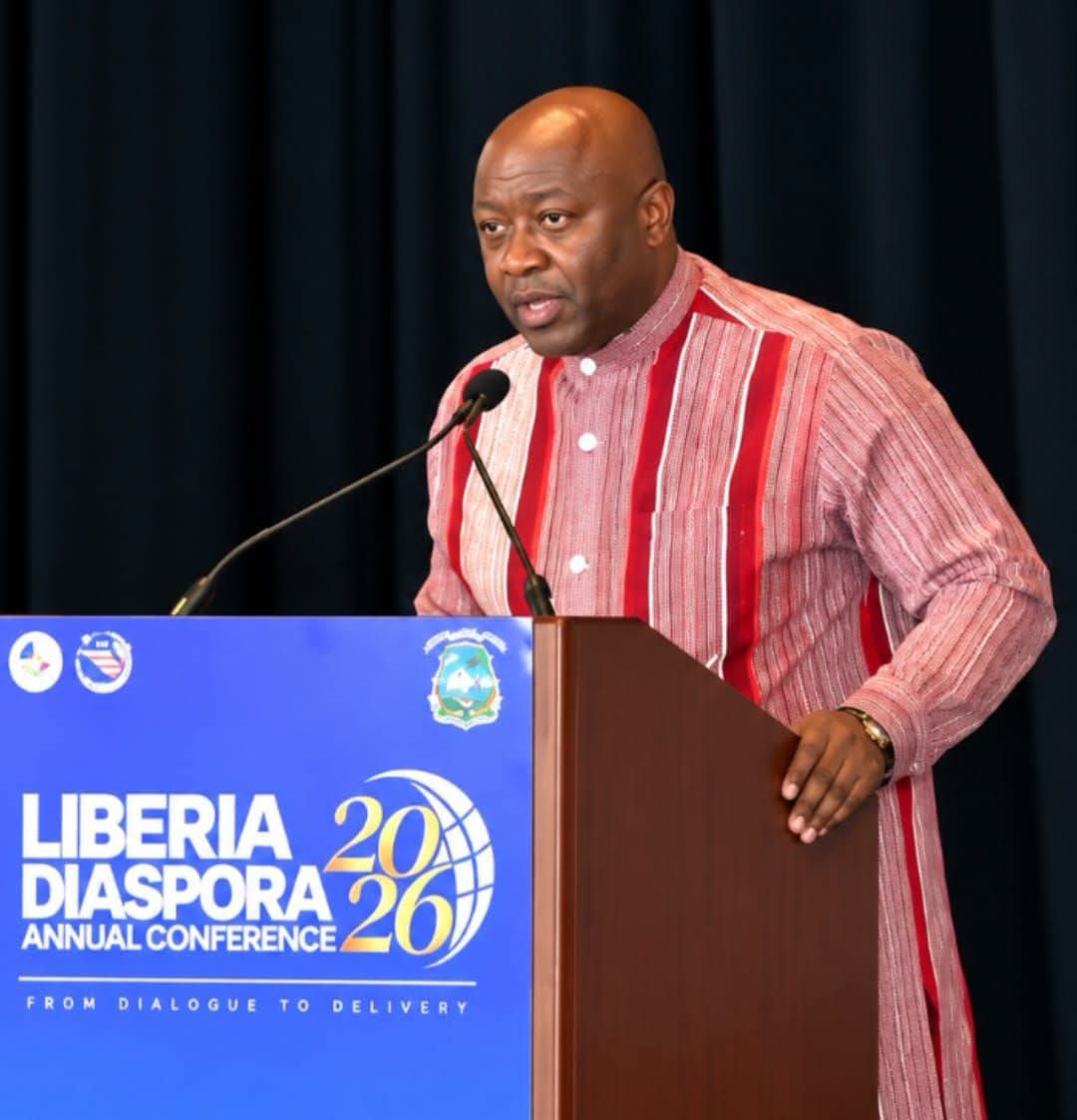
Speaking at the Liberian Diaspora Conference in Washington, D.C., Ngafuan presented what he described as an investment case built around macroeconomic stability, fiscal reform, infrastructure development, digital transformation, natural resources, regional market access and the growing capacity of the Liberian state.
His message was encapsulated in the theme of his address: “Making an Investment Case for Liberia—Betting on Liberia.”
“Liberia offers a rare combination: growing stability and unfinished opportunity; improving institutions and first-mover advantage; abundant resources and a government determined to convert them into jobs and shared prosperity,” Ngafuan told participants that included government officials, development partners, investors, business leaders and members of the Liberian diaspora.
Ngafuan framed Liberia’s investment story against one of Africa’s most difficult recent histories.
Liberia endured two major civil wars between 1989 and 2003.
The conflicts devastated infrastructure, disrupted production and displaced large portions of the population.
World Bank historical assessments have documented the enormous economic damage, including the collapse of GDP and the destruction or abandonment of major infrastructure and productive assets.
The 2003 Comprehensive Peace Agreement opened the way for a political transition, followed by internationally supported elections in 2005. Ellen Johnson Sirleaf’s election and inauguration in January 2006 marked another major milestone in Liberia’s post-war transition.
Since then, Liberia has experienced successive presidential elections and peaceful transfers of political power.
The World Bank has described four democratic presidential elections and peaceful electoral transitions over the two decades following the conflict as significant post-war achievements.
Liberia has also returned to a prominent role in international diplomacy. The country began a new two-year term as a non-permanent member of the United Nations Security Council in January 2026 and is scheduled to serve through the end of 2027.
For Ngafuan, the transformation is central to the investment narrative.
He urged potential investors not to view Liberia solely through the “rear-view mirror” of war and destruction, arguing that the country’s present-day political and economic trajectory requires a different assessment.
“Look through the windshield,” he said, portraying Liberia as a country that has moved from conflict recovery toward institutional rebuilding and economic expansion.
The government’s argument comes as Liberia records stronger economic activity.
The IMF said in July that Liberia’s real GDP growth was expected to accelerate to 5.5 percent in 2026, following growth of approximately 5.1 percent in 2025.
The Fund attributed the expansion principally to mining, construction and manufacturing.
The IMF also reported that inflation averaged about 4.5 percent during the first half of 2026, while the Liberian dollar remained broadly stable during the period.
The Fund projected a primary fiscal surplus, excluding grants, of about 2.4 percent of GDP in 2026, reflecting stronger revenue mobilization and fiscal discipline.
The World Bank’s latest country data puts Liberia’s 2025 GDP at approximately US$5.25 billion, with GDP per capita of about US$915 and annual population growth of roughly 2.1 percent.
The country’s estimated population stood at about 5.73 million in 2025.
The figures illustrate both the progress and the scale of the opportunity.
A relatively small economy, combined with a young and growing population, means that improvements in infrastructure, productivity, financial access, energy and industrial capacity can have significant effects on economic activity.
At the same time, the low level of GDP per capita underscores the development challenges that remain.
One of the most striking claims in Ngafuan’s address was Liberia’s reported crossing of the US$1 billion domestic-revenue threshold during 2026.
According to the minister, domestic revenue increased from approximately US$612 million in 2023 to US$699 million in 2024, then to about US$848 million in 2025, before surpassing US$1 billion by September 14, 2026.
The figures were presented by Ngafuan as evidence of expanding domestic fiscal capacity and improved revenue administration.
The minister, however, cautioned against interpreting the milestone as meaning that Liberia has suddenly acquired enough money to resolve all of its development problems.
Revenue, he noted, must finance competing national obligations, including public-sector salaries, education, healthcare, security, infrastructure, county development and debt servicing.
“The billion-dollar threshold is not a finish line,” Ngafuan said. “It is proof of capacity and a summons to greater responsibility.”
The distinction is important for investors because stronger domestic revenue collection can improve the government’s ability to finance essential public services and meet financial obligations, while also reducing dependence on external grants and concessional financing.
The IMF has independently reported that Liberia’s fiscal performance has continued to exceed program expectations and that revenue mobilization has contributed to the improvement in the country’s fiscal position.
Ngafuan linked the government’s investment strategy to Liberia’s ARREST Agenda for Inclusive Development, which focuses on Agriculture, Roads, Rule of Law, Education, Sanitation and Health, and Tourism.
The strategy is intended to shift Liberia away from an economy heavily dependent on the export of raw commodities toward one with stronger domestic production, processing and value addition.
Infrastructure remains one of the most important pieces of that strategy.
The government is pursuing road construction and rehabilitation, electricity expansion, public buildings, health facilities, schools and urban transport infrastructure.
Among the projects cited by Ngafuan was a 255-kilometer road network involving routes in western and northern Liberia, including the St. Paul Bridge–Klay–Bo Waterside corridor and the Voinjama–Kolahun–Foya–Mendikorma route.
The government is also developing a new bridge across the Cavalla River to strengthen Liberia’s connection with Côte d’Ivoire, with completion targeted for March 2028, according to the minister.
Such infrastructure has implications beyond transportation.
Improved roads can lower the cost of moving agricultural products from rural production zones to markets, facilitate cross-border commerce and expand access to ports and industrial centers.
For a country whose domestic market is relatively small, regional connectivity could be particularly important.
Electricity Remains Both Challenge and Investment Opportunity
Energy access is another major component of Liberia’s economic transformation.
World Bank data shows electricity access at approximately 34.9 percent of the population in 2024, underscoring the size of the infrastructure gap.
Ngafuan said the government is working to increase access toward approximately 40 percent, with new connections and electricity expansion in places including Buchanan and Voinjama.
The energy deficit is simultaneously a development constraint and an investment opportunity.
For manufacturers, agro-processors, telecommunications companies, commercial enterprises and households, electricity availability and cost directly influence operating expenses and competitiveness.
Liberia’s relatively low electricity-access rate therefore leaves significant room for private and public investment in generation, transmission, distribution and renewable-energy solutions.
The government’s investment pitch also places agriculture and agro-processing at the center of its development strategy.
Liberia possesses substantial agricultural potential but remains dependent on imports for significant quantities of food products.
The Special Agro-Industrial Processing Zone in Buchanan, Grand Bassa County, is being developed with support from the African Development Bank and the Liberian government.
The AfDB says the project is intended to attract private investment into agro-industrial processing, create jobs, increase exports, support agricultural value chains and reduce dependence on imported staple foods.
Current project documentation includes infrastructure such as access roads and electricity connections for the Buchanan site, illustrating the effort to create an environment where agricultural commodities can be processed closer to their sources.
For Liberia, the objective is to move beyond exporting raw commodities.
Iron ore, gold, rubber, timber and agricultural products have historically played important roles in the country’s economy.
The next stage, according to the government, is to increase domestic processing, create manufacturing linkages and retain a larger share of value inside Liberia.
One of the less visible but potentially important changes highlighted by Ngafuan is the modernization of Liberia’s payment infrastructure.
The Central Bank of Liberia launched the Inclusive Instant Payment System (IIPS) in December 2025, initially connecting the mobile-money platforms operated by Lonestar MTN and Orange Liberia.
The Central Bank says the system is designed to enable real-time interoperability and strengthen financial inclusion, government payments, transparency and financial-sector efficiency.
Its underlying Mojaloop implementation was completed in 73 business days, according to the bank.
Ngafuan said the initial system processed more than 1.5 million transactions, with a combined value exceeding L$1.4 billion and US$9 million during its first three months.
The government’s longer-term objective is a broader National Electronic Payment Switch capable of connecting banks, mobile-money operators, government payment channels and other financial institutions.
Such infrastructure could be particularly consequential in a cash-heavy economy.
For businesses, interoperability can reduce the friction associated with transferring money between financial platforms. For government, digital payments can create more traceable transaction records.
For consumers, they can expand access to financial services beyond conventional banking infrastructure.
Across Africa, instant-payment systems have expanded rapidly. The Central Bank of Liberia noted in 2025 that dozens of instant-payment systems were already operating across the continent.
Ngafuan also emphasized the role of private capital in financing Liberia’s development ambitions.
The government is looking to public-private partnerships and concessions to complement limited public resources, particularly in infrastructure-intensive sectors.
Potential areas identified in the minister’s presentation include:
Energy and renewable power
Roads and transport infrastructure
Ports and logistics
Housing
Agro-processing
Mining services and beneficiation
Manufacturing
Digital infrastructure
Tourism and hospitality
Fisheries
The investment proposition is reinforced by Liberia’s geographic position on the Atlantic coast and its membership in regional African economic frameworks.
The country can potentially serve not only its domestic market but also regional West African markets through ECOWAS and the wider African market through the African Continental Free Trade Area.
Liberia’s resource base remains one of the principal attractions for investors.
Iron ore and gold production have contributed significantly to recent economic growth, while rubber, agriculture, forestry and fisheries remain important components of the wider productive economy.
The IMF has identified increased mining activity, particularly iron ore production, as a major driver of recent growth.
But resource wealth also creates policy challenges.
Liberia’s historical experience demonstrates the risks of relying excessively on extractive industries without sufficiently broad domestic linkages.
The government therefore wants mining and natural-resource investment to produce wider economic benefits through local employment, supplier development, tax revenues, skills transfer, infrastructure and downstream processing.
The same principle applies to Liberia’s forests.
World Bank data indicate that forest covers approximately 78.1 percent of Liberia’s land area, giving the country significant environmental assets alongside its commercial resources.
Those forests could support conservation, sustainable forestry and emerging carbon-market opportunities, provided such activities are governed by credible environmental, social and community safeguards.
International Partnerships Remain Central
Liberia’s economic program continues to operate alongside substantial international cooperation.
The IMF’s current engagement includes the Extended Credit Facility and the Resilience and Sustainability Facility, the latter designed to help Liberia strengthen resilience to climate-related shocks and other long-term vulnerabilities.
In April 2026, the IMF approved an RSF arrangement of about US$266 million, while also completing a review under the existing ECF program.
The IMF has simultaneously stressed the importance of maintaining fiscal discipline, strengthening financial-sector resilience and addressing structural constraints.
For Ngafuan, international cooperation should reinforce domestic capacity rather than permanently substitute for it.
His message to international partners was therefore one of shared responsibility: Liberia must mobilize more of its own resources, improve its institutions and create the conditions under which international capital can participate in commercially viable projects.
Perhaps the most politically and economically significant part of Ngafuan’s Washington address was his appeal to the Liberian diaspora.
Liberians abroad already make a substantial contribution to the domestic economy through remittances.
World Bank data show personal remittances received by Liberia were equivalent to approximately 21.3 percent of GDP in 2024.
Ngafuan wants to see that relationship evolve.
Instead of diaspora capital being used primarily for household consumption, he called for greater investment in productive enterprises.
Potential areas include agribusiness, logistics, housing, tourism, healthcare, education, energy and digital services.
The minister also urged diaspora investors not to rely solely on patriotism when making investment decisions.
“Patriotism is not a substitute for due diligence,” he said, urging potential investors to examine financial statements, demand sound numbers, structure investments professionally and seek reasonable returns.
That message reflects an increasingly commercial approach to diaspora engagement: Liberia wants its citizens abroad not only to send money home but also to participate in creating companies, jobs, technology and supply chains.
Despite the government’s optimistic investment pitch, Liberia continues to face significant structural challenges.
Electricity access remains limited. Infrastructure gaps persist outside major urban areas. Access to affordable finance remains difficult for many businesses.
Regulatory processes can be slow, and the economy remains vulnerable to commodity-price movements and external financing conditions.
The World Bank has also emphasized that Liberia’s post-war economic gains have not yet translated into sufficiently broad improvements in living standards.
Its recent analysis noted that real per-capita income declined by 6.6 percent to approximately US$716 by 2024, illustrating the gap between headline economic growth and household-level prosperity.
The IMF has likewise identified structural weaknesses and the need for continued reform even as it reports stronger macroeconomic performance.
These realities make the government’s investment argument less about presenting Liberia as a risk-free market and more about positioning the country’s remaining gaps as areas where capital can potentially create economic value.
Ngafuan’s central message in Washington was therefore not that Liberia has completed its transformation, but that the country is entering a different phase of it.
The investment proposition rests on several developments occurring simultaneously: sustained peace, democratic continuity, stronger macroeconomic performance, expanding domestic revenue, infrastructure construction, digital-payment modernization, natural-resource production, agro-industrial ambitions and increasing engagement with international financial institutions.
The country’s economic base remains relatively small. But that also leaves considerable room for expansion.
For investors, the opportunities and risks are therefore closely connected.
The infrastructure deficit creates demand for capital. Low electricity access creates an energy market.
Agricultural imports create opportunities for domestic production and processing. Limited financial inclusion creates space for digital services.
Mineral production creates opportunities for downstream industries and local supply chains.
At the same time, those opportunities depend on continued institutional reform, regulatory predictability, infrastructure delivery, access to finance and effective governance.
For Liberia’s government, the challenge is to convert the country’s growing fiscal and economic capacity into tangible improvements in productivity, employment and living standards.
For investors, the question is whether individual projects can be structured to generate sustainable commercial returns while contributing to that broader development process.
And for the diaspora, Ngafuan’s message was direct: Liberia’s next economic chapter should not be written only through remittances and reconstruction, but through investment, entrepreneurship, knowledge transfer and productive partnerships.
After decades in which Liberia’s international identity was dominated by conflict, the government is now seeking to make a different proposition to the world:
A peaceful country with significant infrastructure gaps, abundant natural resources, a growing economy and a large unfinished development agenda and therefore a market where capital, technology and expertise can potentially create new value.


