


By: Julius Konton
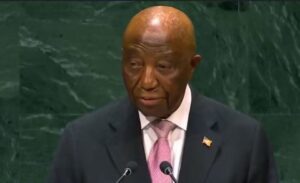
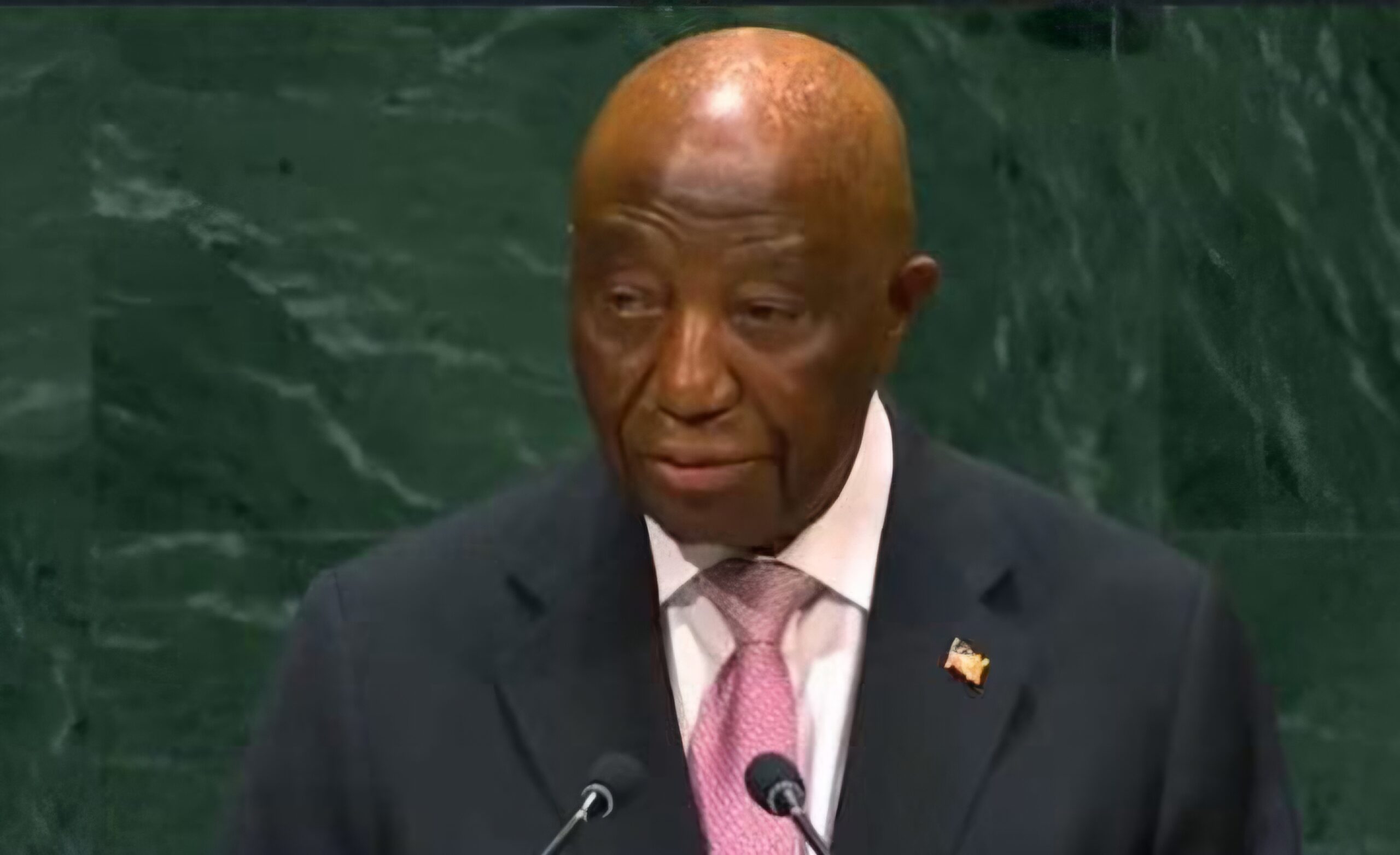
Liberian President Joseph Nyuma Boakai has used the 81st United Nations General Assembly to deliver a broad challenge to the international system, calling for renewed confidence in multilateralism, deeper reform of global institutions and a stronger African voice in decisions affecting international peace, security and development.
Addressing world leaders at United Nations Headquarters in New York on Thursday, Boakai argued that the credibility of the multilateral system depends not simply on preserving existing institutions, but on whether those institutions can produce tangible results for countries and populations confronting war, poverty, debt, climate change and technological disruption.
His address came under the theme of the 81st General Assembly, “Restoring Trust, Managing Transformation: A United Nations that Delivers for All.”
The theme itself reflects a central concern of the session’s presidency: UN General Assembly President Khalilur Rahman has repeatedly argued that trust must be earned through decisions, fulfilled commitments and measurable results.
Boakai placed Liberia’s argument within the country’s unusual historical relationship with the United Nations.
Liberia was one of only four African countries represented at the 1945 San Francisco Conference that produced the UN Charter, alongside Egypt, Ethiopia and the Union of South Africa. Fifty countries participated in the conference, which concluded with the signing of the Charter on June 26, 1945; the United Nations formally came into existence on October 24 of that year.
For Boakai, that history gives Liberia a particular stake in defending international law, human rights and peaceful dispute resolution.
He said the crisis facing multilateralism is not evidence that the principles of the UN Charter have become obsolete. Rather, he argued, inconsistent application of those principles has weakened confidence in the international system.
His prescription was not retreat from multilateral cooperation but what he described as “better multilateralism” ,a system capable of applying international norms consistently while responding more effectively to modern crises.
The argument comes at a time when the Security Council itself has faced growing divisions. UN data show that the Council adopted 44 resolutions in 2025, down from 46 in 2024, while the share adopted unanimously fell to 61 percent from 65 percent the previous year and from an 80 percent average over 2015–2024.
Boakai also made peace and conflict prevention central to Liberia’s message.
He called for an end to ongoing hostilities in conflict zones, unrestricted humanitarian access and respect for international humanitarian law, while arguing that preventive diplomacy, mediation and early-warning mechanisms should receive greater international investment.
The Liberian president linked the global security debate directly to West Africa, citing transnational organized crime, cyber threats and narcotics trafficking along maritime routes in the Gulf of Guinea.
Liberia’s position carries added significance because the country is serving a two-year term on the UN Security Council for 2026–2027.
The UN lists Liberia among the Council’s 10 elected members, alongside five permanent members; China, France, Russia, the United Kingdom and the United States.
The current Security Council agenda demonstrates the continuing importance of African conflicts to the body. In 2025, 18 of the Council’s 24 resolutions adopted under Chapter VII concerned Africa, according to the Council’s annual review.
Rather than portraying security exclusively as a military problem, Boakai called for greater investment in prevention, intelligence cooperation, maritime surveillance, port security and regional capacity.
A major portion of Boakai’s address focused on the international financial system.
With the 2030 Sustainable Development Goals deadline approaching, he argued that developing countries face shrinking fiscal space, debt pressures and repeated external shocks that limit their ability to finance development.
Liberia therefore renewed its call for greater access to concessional financing, debt sustainability measures and predictable development resources, while supporting reforms that would give developing countries greater influence within the International Monetary Fund and World Bank.
The issue is particularly relevant to Liberia, where the IMF projects real GDP growth of about 5.5 percent in 2026, driven largely by mining, construction and manufacturing. The IMF also reported that Liberia’s primary fiscal surplus, excluding grants, was projected to improve to about 2.4 percent of GDP in 2026.
At the same time, IMF debt analysis reported Liberia’s public debt at approximately US$2.86 billion in 2025, equivalent to about 54.9 percent of GDP.
Those figures illustrate the tension facing many low-income economies: stronger growth does not automatically eliminate financing constraints or create sufficient fiscal room for infrastructure, education, healthcare and climate adaptation.
On the domestic front, Boakai presented his administration’s ARREST Agenda for Inclusive Development as the country’s principal framework for economic transformation.
The agenda focuses on Agriculture, Roads, Rule of Law, Education, Sanitation and Tourism, sectors the administration says are central to expanding economic opportunity and improving public services.
Boakai pointed to improvements in revenue administration and infrastructure, including efforts to connect agricultural communities to markets through rural roads.
The Liberian government has simultaneously been operating within an IMF-supported reform program aimed at strengthening macroeconomic stability and structural reforms.
The IMF said in July that Liberia’s economic performance remained strong, with growth projected at 5.5 percent in 2026 and inflation averaging 4.5 percent during the first half of the year.
Boakai also linked domestic governance to international credibility, citing public accountability, financial management, anti-corruption efforts and strengthening confidence in the judiciary as pillars of Liberia’s post-conflict institutional recovery.
Climate change formed another major component of Liberia’s appeal.
Boakai argued that countries with relatively small historical contributions to global greenhouse-gas emissions often face some of the most severe consequences of climate change, including flooding, coastal erosion and disruptions to agriculture.
He called for greater climate financing and implementation of mechanisms intended to address loss and damage associated with climate impacts.
Liberia’s environmental importance is closely linked to the Upper Guinean Forest ecosystem.
UN documentation has previously reported that Liberia contained about 42 percent of the remaining Upper Guinea Forest in West Africa at the end of 2000, the largest national share in the region at that time.
That ecological role has made Liberia an important country in regional conservation efforts, while also exposing it to the economic and social consequences of forest degradation, agricultural pressure and climate change.
Boakai also turned his attention to Africa’s demographic and technological future.
More than 60 percent of Africa’s population is under 25, a demographic reality repeatedly highlighted by the United Nations as both an opportunity and a development challenge.
Boakai called for expanded investment in science, technology, engineering and mathematics, digital literacy and technical education so that African youth can participate directly in the emerging digital economy.
He also reaffirmed Liberia’s commitment to greater participation by women in political, economic and social life, arguing that gender equality must be treated as a core component of sustainable development and peacebuilding.
Boakai supported stronger international governance of AI, particularly concerning its use in warfare, while warning against a technological order in which developing countries remain primarily consumers of systems designed and controlled elsewhere.
The concern mirrors an issue at the center of the 81st General Assembly. Rahman has identified international AI governance as one of his priorities, arguing that developing countries must have a meaningful voice in shaping the technology’s future.
Perhaps the most politically consequential portion of Boakai’s speech was his renewed demand for reform of the UN Security Council.
He argued that the Council’s structure no longer reflects contemporary global realities and described Africa’s exclusion from the permanent membership as a historic imbalance.
The Security Council currently has 15 members: five permanent members with veto power and 10 elected members serving two-year terms. Liberia is one of the elected members for the 2026–2027 period.
Africa has long pressed for permanent representation. UN records show that African governments have repeatedly pointed to the disproportionate attention given to African conflicts by the Security Council while the continent remains absent from the permanent category.
UN discussions have historically cited figures above 60 percent for the Council’s Africa-related agenda.
Boakai therefore reaffirmed Liberia’s support for the African Union’s Common African Position, commonly associated with the Ezulwini Consensus and Sirte Declaration.
Under the African position, the continent seeks at least two permanent seats and additional non-permanent seats, with the permanent members receiving the same rights and responsibilities as existing permanent members, including the veto for as long as the veto remains part of the Council’s structure.
Boakai framed the demand not as a concession to Africa but as part of a broader effort to make the UN system more representative and credible.
A Post-Conflict Country Makes Its Case
Boakai’s argument drew heavily on Liberia’s own history.
The country experienced two civil wars between 1989 and 2003 that killed an estimated quarter of a million people and displaced a substantial portion of the population.
The conflicts left Liberia with severely weakened institutions and infrastructure before a UN-backed peace process helped establish the conditions for democratic reconstruction.
The UN has described Liberia’s 2026–2027 Security Council membership as historically significant because it represents the country’s first full elected term on the Council since the organization’s founding.
That history now forms a central part of Monrovia’s diplomatic narrative: a country once devastated by conflict is seeking to use its position within the UN system to advocate for conflict prevention, institutional reform and international cooperation.
Boakai concluded by presenting the 81st General Assembly with a choice between a multilateral system that merely debates crises and one capable of producing concrete results.
His message was consistent with the broader theme of the session: trust, he argued, must be rebuilt through action.
For Liberia, that means stronger international institutions, greater African representation, more equitable access to development finance, climate justice, responsible technological governance and greater investment in conflict prevention.
The country’s appeal comes at a significant moment for both Liberia and the United Nations.
Eighty-one years after the San Francisco Conference, the organization now has 193 member states, compared with the 51 original members that emerged from the founding process.
Liberia, one of the four African countries present at the organization’s founding, is now using its seat at the Security Council and its voice at the General Assembly to argue that the international system must evolve alongside the world it was created to serve.
For Boakai, the test of that transformation is ultimately practical: whether the United Nations can move beyond declarations, restore confidence among its members and deliver tangible improvements in peace, security, development and human dignity.


