
By: Julius Konton
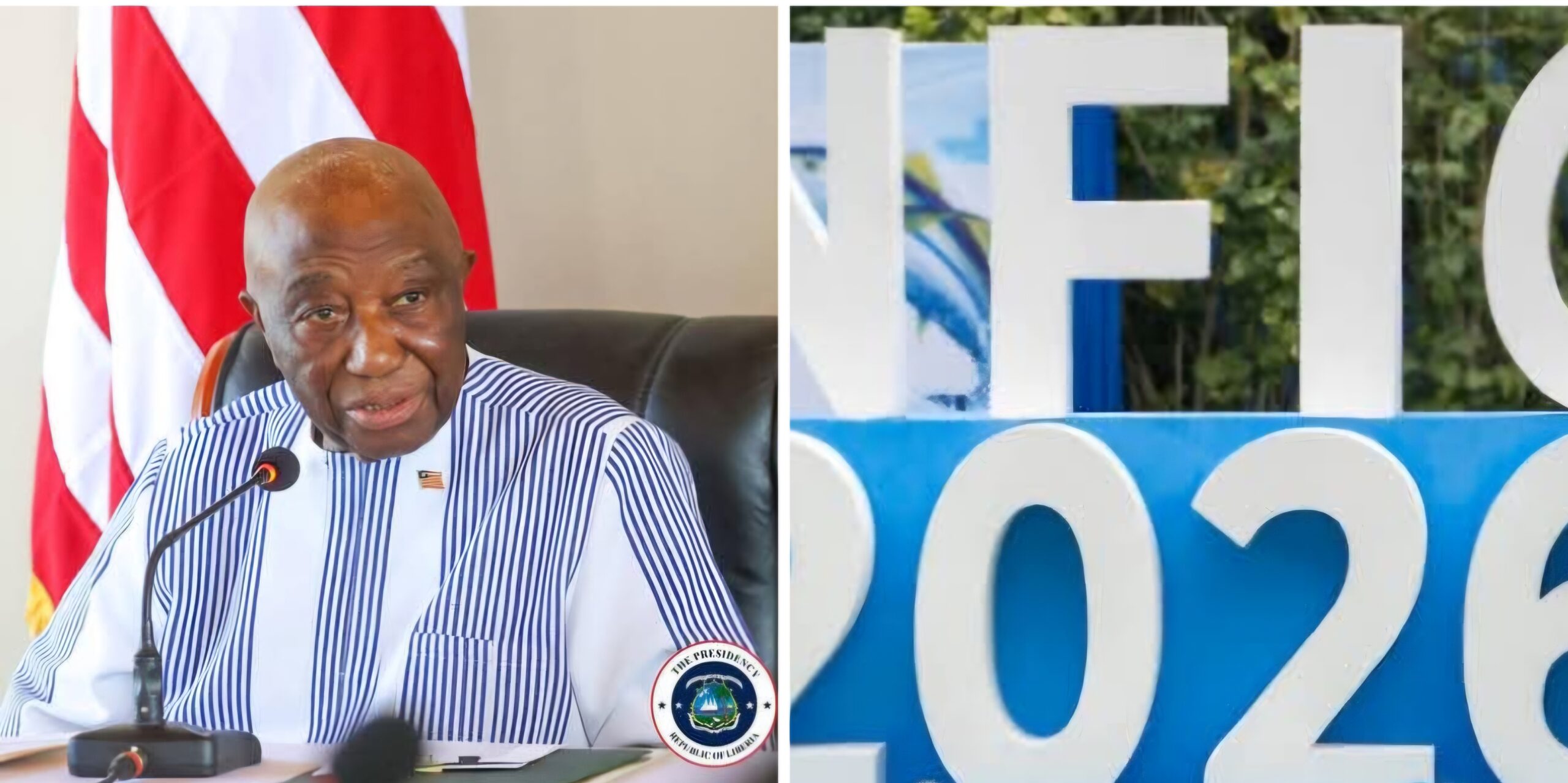
President Joseph Nyuma Boakai has launched an ambitious drive to transform Liberia’s fisheries sector into a cornerstone of economic growth, calling on global investors and regional partners to tap into what he described as the country’s “sleeping giant.”
Speaking at the opening of the National Fisheries Investment Conference, locally known as “Kpongama”—a Kpelle term meaning “The Gathering” the President outlined a sweeping reform agenda aimed at unlocking the vast potential of Liberia’s marine resources while creating jobs, boosting exports, and strengthening food security.
The high-level conference, held at the Farmington Hotel, brought together ministers, international development partners, private investors, and fisheries experts from across West and North Africa, Europe, and beyond.
A RESOURCE-RICH NATION STILL IMPORTING FISH
Despite possessing 579 kilometers of coastline and a 200-nautical-mile Exclusive Economic Zone (EEZ) rich in marine biodiversity, Liberia continues to face a paradox:
The country imports over 33,000 metric tons of fish annually
Approximately 80% of domestic fish production comes from artisanal fishers
High-value catches are often landed in foreign ports due to lack of infrastructure
“This is not a situation we accept, it is a challenge we embrace,” President Boakai declared, emphasizing the urgency of reversing the imbalance.
SHIFTING FROM LICENSE FEES TO VALUE CREATION
The President announced a major policy shift away from dependence on industrial fishing license fees toward a private-sector-driven, value-chain approach.
Key reforms include:
Expansion of public-private partnerships (PPPs)
Development of domestic fish processing and export capacity
Investment in infrastructure to retain value within Liberia
“This is about ensuring that jobs and revenues remain in Liberia,” Boakai noted, adding that the new direction prioritizes inclusive growth for coastal communities.
€25 MILLION EU BOOST AND DIGITAL INNOVATION
Among the headline announcements was a €25 million grant from the European Union, aimed at strengthening Liberia’s artisanal fisheries value chain.
In partnership with Orange Liberia, the government is rolling out:
Mobile-based payment systems
Solar-powered cold storage facilities
Technology solutions to reduce post-harvest losses
These initiatives are expected to significantly improve incomes for small-scale fishers, particularly women who dominate fish processing and marketing.
INFRASTRUCTURE PUSH: HARBOR, LABS, AND AQUACULTURE
Liberia is also investing heavily in long-term infrastructure to modernize the sector:
Design nearing completion for the country’s first dedicated fisheries harbor
Construction of a national fisheries complex set to begin in 2026
Development of a modern fisheries laboratory to meet international export standards
Establishment of a fish processing factory to boost value addition
Launch of Liberia’s first integrated commercial aquaculture farm, targeting tilapia and catfish production.
These projects are being supported by global partners including the World Bank and the OPEC Fund for International Development.
REGIONAL COOPERATION AND THE FIGHT AGAINST ILLEGAL FISHING
President Boakai underscored the importance of regional collaboration, referencing Liberia’s leadership in advancing the Monrovia Declaration on Regional Fisheries Cooperation.
He warned that illegal, unreported, and unregulated (IUU) fishing remains a major threat to sustainability across West Africa.
“The fish do not recognize our borders, but our cooperation must,” he stated, urging stronger enforcement and shared governance among regional states.
NEW POLICIES AIMED AT EMPOWERING LOCAL FISHERS
In a move to support small-scale operators, the government recently reduced artisanal fishing license fees by 34%, easing financial pressure on thousands of fishers.
Additional initiatives include:
Deployment of solar-powered fiberglass canoes
Grants for women fishmongers
Development of dedicated landing sites to improve safety and resilience
INVESTMENT OPPORTUNITIES OPEN TO THE WORLD
The conference also featured the launch of three strategic frameworks to guide the sector over the next decade:
National Fisheries Strategic Plan (10-Year)
Fisheries Investment Plan
Public-Private Partnership Strategy
A “Blue Investment Marketplace” showcased bankable projects aimed at attracting foreign direct investment.
“To investors, Liberia is open for business but not for exploitation,” President Boakai cautioned, emphasizing the need for responsible, sustainable partnerships.
VISION 2030: JOBS, EXPORTS, AND FOOD SECURITY
The President painted a transformative vision for Liberia’s fisheries sector:
Modern fishing ports handling industrial and artisanal vessels
Women-led cooperatives exporting processed seafood to Europe
Youth employment in marine science and aquaculture
Expansion of inland fish farming to reduce pressure on wild stocks
“This is the Liberia we are building. This is why Kpongama matters,” he said.
A TURNING POINT FOR LIBERIA’S BLUE ECONOMY
As Liberia positions itself within the global blue economy, analysts say the success of the initiative will depend on sustained reforms, infrastructure delivery, and investor confidence.
With international partners engaged and policy frameworks in place, the 2026 National Fisheries Investment Conference may mark a decisive turning point in the country’s quest to transform its natural marine wealth into broad-based prosperity.
Declaring the conference officially open, President Boakai concluded with a metaphor rooted in Liberia’s fishing culture:
“When the nets come up heavy, the entire village celebrates.
Today, we cast our net wide , may this gathering yield a harvest that feeds our nation and secures our future.”
