



By: Julius Konton
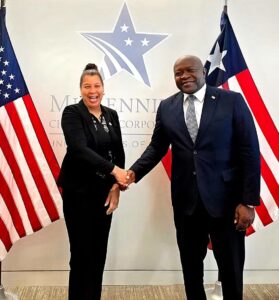
Liberia’s efforts to secure a second development compact with the United States Millennium Challenge Corporation (MCC) have entered a new phase following high-level discussions between Finance and Development Planning Minister Augustine Kpehe Ngafuan and senior MCC officials in Washington, D.C.
The talks focused on progress toward the development of Liberia’s proposed Second Compact, with both sides reviewing the transition into the Joint Design Phase, a stage in which Liberia’s Compact Development Team (LCDT) and MCC are expected to work together to refine investment proposals, establish implementation arrangements and address the policy and institutional reforms required for a potential agreement.
Minister Ngafuan reaffirmed the Government of Liberia’s commitment to accelerating the process and said the administration of President Joseph Nyuma Boakai would support efforts aimed at moving the compact through the remaining development and approval stages.
The meeting brought together MCC Acting Deputy Vice President for Africa Alicia Robinson-Morgan, Acting Managing Director for Africa Carrie Monahan, MCC Country Director for Liberia Kevin George and Liberia Compact Development Team National Coordinator Alieu Fuad Nyei, among other officials.
A major focus of the discussions was Liberia’s electricity sector, particularly the need to create stronger policy and regulatory conditions capable of attracting private investment in power generation and distribution.
The issue remains significant for an economy seeking to expand industrial activity, improve business competitiveness and broaden access to basic services.
World Bank data show that 34.9 percent of Liberia’s population had access to electricity in 2024, compared with 32.5 percent in 2023.
The figure represents progress from previous years but continues to place Liberia among countries with relatively low electricity access.
A World Bank assessment of Liberia’s energy sector has also highlighted the rapid expansion of the customer base of the Liberia Electricity Corporation (LEC).
LEC customers increased from 142,947 in 2021 to 282,505 in 2023, while off-grid programs have also expanded access through solar systems.
The electricity challenge is particularly pronounced outside major urban centers. According to the World Bank, urban electricity access has exceeded 50 percent, while rural access has remained below 10 percent, underscoring the geographical dimension of Liberia’s energy deficit.
Liberia’s pursuit of a second compact comes after the country completed its first MCC Compact, a five-year program valued at approximately $256.7 million.
The first compact, which closed on January 20, 2021, focused primarily on energy, roads and investment-climate interventions.
MCC reported that 92.1 percent of the compact’s budget was disbursed during implementation.
The largest component was the $209 million Energy Project, while approximately $20 million was allocated to the Roads Project.
The energy component was designed to improve the reliability and affordability of electricity, while the roads component addressed infrastructure constraints affecting economic activity.
One of the most significant investments was the rehabilitation of the Mount Coffee Hydropower Plant, Liberia’s principal hydropower facility.
MCC contributed $151.5 million toward the rehabilitation, alongside approximately $212 million from three European development partners.
The plant, which had been destroyed during Liberia’s civil war, was completed in 2018 with an installed capacity of 88 megawatts.
MCC said the rehabilitation helped Liberia Electricity Corporation provide more reliable and affordable electricity to more than 76,000 homes, businesses and other customers, representing a threefold increase compared with 2015.
During the Washington discussions, Minister Ngafuan emphasized that Liberia’s next phase of electricity development would require more than public investment alone.
The Government is seeking to establish policy and regulatory conditions that can encourage greater participation by private investors, particularly in power generation and distribution.
The approach comes as Liberia attempts to expand electricity supply while strengthening the financial and operational sustainability of its power sector.
The World Bank has described reliable and affordable electricity as critical to Liberia’s agriculture, services and mining sectors, as well as to job creation and investment.
For Liberia, the potential economic implications are considerable.
The World Bank estimates that the country’s population reached approximately 5.73 million in 2025, while gross domestic product stood at about $5.25 billion, with GDP growth estimated at 5 percent that year.
Expanding reliable electricity access could therefore have implications extending beyond household consumption, including industrial production, commercial services, digital connectivity and the operating environment for businesses.
According to the Liberian Government’s account of Monday’s meeting, MCC Acting Deputy Vice President for Africa Alicia Robinson-Morgan commended the pace of Liberia’s compact-development process.
Robinson-Morgan expressed optimism that the Joint Design Phase could be completed by May 2027, after which the proposed compact could be presented to the MCC Board for consideration in September 2027.
She further indicated that, subject to completion of the required processes and approvals, MCC would welcome a Liberian delegation to Washington in December 2027 for the signing of the Second Compact.
Those dates remain proposed milestones rather than completed actions.
The compact would still be subject to the applicable development, review and approval procedures before any final agreement could be signed.
Robinson-Morgan also praised the Liberia Compact Development Team, led by National Coordinator Alieu Fuad Nyei, for its role in advancing the development process.
The Second Compact is being developed against a broader national objective of strengthening Liberia’s productive capacity and improving the conditions for sustainable economic growth.
The first MCC Compact was designed around identified constraints to economic growth, particularly inadequate electricity and poor road infrastructure.
Its experience provides an institutional and investment foundation for discussions surrounding a possible second compact.
The new compact-development process is expected to examine potential investments and reforms capable of improving electricity access and reliability, encouraging private-sector participation and supporting inclusive economic development.
For the Government of Liberia, the immediate priority is therefore to maintain momentum through the Joint Design Phase while addressing the technical, regulatory and institutional requirements necessary for MCC consideration.
If the proposed timeline is maintained and all required approvals are secured, 2027 could become a significant year in Liberia’s development partnership with MCC, potentially culminating in the signing of a second compact in December.
For millions of Liberians who continue to experience limited access to electricity, however, the broader significance of the process will ultimately depend on how proposed investments and reforms translate into expanded access, more reliable power, stronger private investment and measurable improvements in economic opportunity.


