
By: Julius Konton
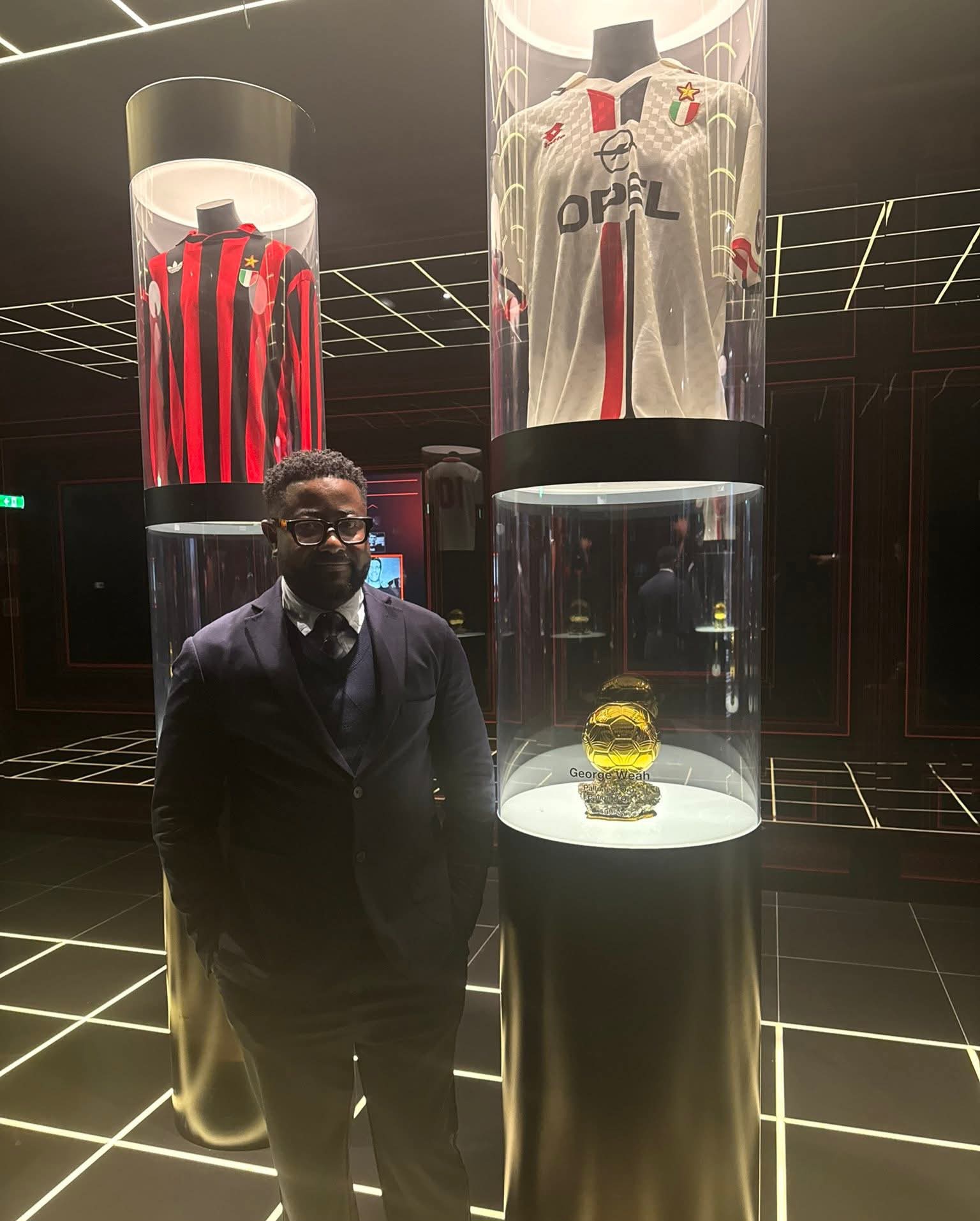
A senior official of the Liberia Football Association (LFA), K. Jlayteh Sayor, has described his recent visit to the headquarters of legendary Italian club AC Milan as both professionally enriching and deeply emotional, particularly after encountering the iconic legacy of Liberia’s football icon George Manneh Weah.
Sayor, who serves as a member of the LFA Executive Committee, is currently enrolled in the prestigious FIFA Master in Management, Law and Humanities of Sport, a globally recognized postgraduate program jointly delivered by several European academic institutions.
As part of the program’s Sports Management module hosted at the SDA Bocconi School of Management in Milan, students were granted a rare educational tour of AC Milan’s corporate headquarters and museum.
According to Sayor, the experience offered an in-depth look into the operational structure of one of football’s most historic institutions while also reconnecting him with a defining moment in Liberian sporting history.
“As part of the FIFA Master Management of Sports Module at SDA Bocconi School of Management in Milan, our class had the privilege of visiting AC Milan’s headquarters,” Sayor explained.
A Moment of National Pride
While the visit provided extensive insights into modern football governance and business strategy, the most powerful moment for the Liberian official came when he stood before a display honoring George Weah.
Inside the AC Milan museum, the iconic number 9 jersey worn by Weah sits proudly beside the 1995 Ballon d’Or trophy, a symbol of one of the most remarkable achievements in world football.
Weah’s historic victory remains a landmark moment in the sport.
In 1995, the Liberian striker became the first and still the only African player to win the Ballon d’Or, the most prestigious individual award in global football.
That same year, he was also named FIFA World Player of the Year, cementing his place among the greatest footballers of his generation.
For Sayor, the encounter carried special significance.
“Walking through the AC Milan museum and corporate headquarters, I encountered a moment that filled me with immense pride as a Liberian standing beside the iconic number 9 jersey of President George Manneh Weah, displayed alongside the historic Ballon d’Or he won in 1995,” he said.
The Global Legacy of George Weah
George Weah’s football journey.from the modest neighborhoods of Clara Town in Monrovia to the summit of world football remains one of the most celebrated stories in African sports history.
During his professional career, Weah played for several major European clubs including AS Monaco, Paris Saint‑Germain, and AC Milan, where he enjoyed some of his most successful years between 1995 and 2000.
With AC Milan, he helped the club win two Italian Serie A titles and became widely admired for his powerful playing style, leadership, and technical brilliance.
His achievements placed Liberia, one of Africa’s smaller footballing nations on the global sporting map. Despite the country’s limited football infrastructure and resources, Weah’s success inspired generations of African players and fans.
Years after his football career, Weah transitioned into politics and was elected President of Liberia in 2017, further cementing his influence both on and off the pitch.
Learning the Business of Modern Football
Beyond the emotional encounter with Weah’s legacy, Sayor emphasized that the educational tour provided valuable lessons in the business and governance of elite football clubs.
AC Milan officials shared insights into how the club manages its global operations, including sporting performance, commercial partnerships, brand development, youth development systems, and international marketing.
Founded in 1899, AC Milan is one of the most successful clubs in world football, with seven UEFA Champions League titles and 19 Italian league championships, making it one of Europe’s most decorated teams.
The club also commands a global fan base estimated at over 500 million supporters worldwide, reflecting the enormous commercial reach of modern football institutions.
For FIFA Master students, such experiences provide a rare behind-the-scenes perspective on how top clubs operate in a highly competitive global sports industry now valued at over $600 billion worldwide, according to international sports market analyses.
Building the Future of Liberian Football
For Sayor, the visit served not only as an academic exercise but also as a reminder of the responsibility facing football administrators in Liberia.
With Liberia still striving to develop competitive domestic leagues, youth academies, and professional governance structures, exposure to world-class football institutions could help shape future reforms and strategic planning within the national football ecosystem.
“For me personally, the most powerful moment remains standing before the display honoring George Weah, a reminder that a young boy from Clara Town once rose to the very pinnacle of world football,” Sayor reflected.
“As someone involved in football governance and development in Liberia, moments like this reinforce the responsibility we carry to continue building pathways for future generations of Liberian footballers.”
A Legacy That Continues to Inspire
More than three decades after his rise to global prominence, George Weah’s story continues to inspire millions across Africa and the world.
For Liberian football officials like Sayor, witnessing that legacy preserved inside one of football’s most historic clubs was not simply a nostalgic moment, it was a call to action.
As Liberia continues its efforts to strengthen football development, Weah’s journey from humble beginnings to global greatness remains proof that talent, discipline, and opportunity can transform not only individual lives but also the global perception of an entire nation.
“George Weah’s story is not just history,” Sayor concluded.
“It is a legacy that continues to inspire the future of Liberian football.”
