
By: Julius Konton
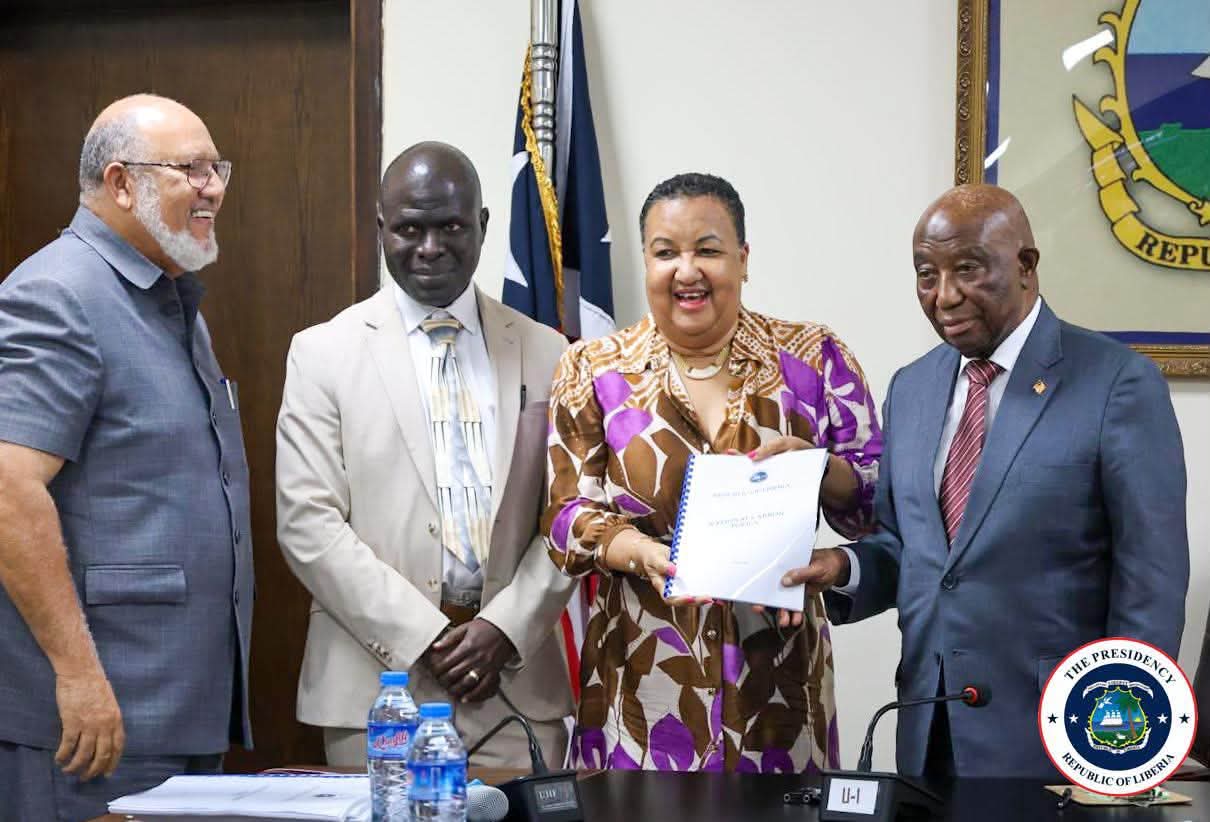
Liberia has taken a significant step toward establishing a more structured presence in the global carbon economy following the presentation of a National Carbon Policy to President Joseph Nyuma Boakai Sr., at the Executive Mansion in Monrovia.
The policy is expected to provide a national framework for Liberia’s participation in carbon markets, carbon trading and climate finance, while establishing clearer roles for government institutions and strengthening safeguards around the country’s forests and other carbon-rich ecosystems.
For Liberia, the move comes at a potentially important moment. The country remains one of West Africa’s most heavily forested nations, with forests covering approximately 78.1 percent of its land area in 2023, according to World Bank data.
Liberia also has among the world’s lowest per-capita carbon dioxide emissions, at approximately 0.2 tonnes per person in 2024, excluding emissions and removals associated with land use, land-use change and forestry.
The figures underscore Liberia’s unusual position in the global climate debate: a country with a relatively small contribution to global greenhouse-gas emissions, but with extensive forests capable of storing and absorbing significant amounts of carbon.
A Forest Powerhouse Seeking Economic Value From Conservation
President Boakai, while receiving the policy, praised the extensive consultations and technical work that produced the document, describing the process as evidence of a shared national commitment to Liberia’s future.
He said the policy could help ensure that Liberia’s forests generate tangible economic and social benefits for the nation and for communities that live in and around forest areas.
“There are amendments we will make, but we have to have something done for now, and that’s what we have to do,” the President said, emphasizing the need to move from prolonged consultations to implementation while leaving room for future improvements.
The President stressed that Liberia must increasingly rely on its own professionals and institutions to address complex national and international challenges.
His remarks reflect a broader challenge facing Liberia’s carbon ambitions: transforming the country’s natural-resource wealth into sustainable revenue while ensuring that communities protecting those resources are not left behind.
Carbon markets generally allow verified reductions or removals of greenhouse-gas emissions to be converted into carbon credits that can potentially be purchased or traded.
For heavily forested developing countries, forest conservation, restoration and sustainable land management can therefore become potential sources of climate finance when projects meet the relevant environmental, accounting and social safeguards.
Liberia has already spent years building the technical foundations for results-based forest financing through REDD+, the international framework for reducing emissions from deforestation and forest degradation.
In 2020, the UN climate process technically assessed Liberia’s forest reference emission levels.
Liberia’s revised figures represented approximately 31.35 million tonnes of CO₂ equivalent per year for its northwestern forest region and about 10.72 million tonnes per year for its southeastern forest region during the relevant reference framework.
These figures demonstrate the substantial climate value attached to Liberia’s forests and explain why forest carbon remains central to the country’s emerging climate-finance strategy.
The National Carbon Policy also comes as Liberia strengthens its broader climate commitments under the Paris Agreement.
Liberia’s latest Nationally Determined Contribution, or NDC 3.0, identifies the country as highly vulnerable to climate change despite its negligible contribution to global greenhouse-gas emissions.
Approximately 60 percent of Liberia’s population lives near the coast, exposing millions of people to risks from sea-level rise, coastal erosion, flooding and other climate-related hazards.
Liberia’s previous NDC targeted a 64 percent reduction in greenhouse-gas emissions below business-as-usual levels by 2030—10 percent through unconditional domestic action and a further 54 percent conditional on international support.
The country reported reducing an estimated 2,545 gigagrams of CO₂ equivalent between 2021 and 2024, with contributions from interventions in the energy, transport and forestry sectors.
It also secured approximately US$573 million in commitments for NDC implementation, although only about US$213 million had been disbursed by December 2024.
One of the most consequential aspects of Liberia’s new policy will be how carbon-market revenues are managed and distributed.
The policy-development process reportedly brought together forest-dependent communities, civil society organizations, government institutions, the Environmental Protection Agency and members of the Legislature.
That broad participation is significant because Liberia’s forests are not simply environmental assets. They are also sources of food, medicine, timber, non-timber forest products and livelihoods for communities across the country.
Liberia’s existing climate commitments call for expanding community forest areas to 1 million hectares by 2030 and reaching approximately 1,500 forest-dependent communities with information on incentives and opportunities to reduce their climate footprint.
The country’s NDC also identifies reforestation, afforestation, agroforestry, forest restoration and stronger protection of high-carbon forests as important components of its climate strategy.
From Natural Resource to National Asset
President Boakai’s intervention places a central question at the heart of Liberia’s carbon-market ambitions: how can the country monetize its climate assets without compromising environmental integrity or the rights of communities?
That question is particularly important as governments and private investors around the world increasingly examine carbon credits as instruments for financing emissions reductions and nature conservation.
For Liberia, the National Carbon Policy could provide a mechanism for coordinating future carbon-market activities, establishing institutional responsibilities and ensuring that transactions are aligned with national development priorities.
The government has indicated that the framework is not intended to be static. Rather, it is expected to evolve as Liberia gains experience and as international carbon-market rules continue to develop.
The policy also places renewed emphasis on transparency, coordination and national ownership.
President Boakai acknowledged that not every stakeholder may agree with every government decision, but argued that leaders must ultimately make decisions in what they consider to be the country’s best interest.
For Liberia, the success of its carbon-market ambitions will therefore depend not only on the volume or value of carbon credits potentially generated, but also on credible measurement, reporting and verification; transparent revenue management; environmental safeguards; community participation; and clear ownership of carbon rights.
The government will also need to ensure that carbon-market projects complement rather than undermine Liberia’s existing forest, land-use and climate policies.
With more than three-quarters of its land still covered by forest, a long history of REDD+ engagement and ambitious climate targets, Liberia possesses many of the natural assets required to become a meaningful participant in the emerging carbon economy.
The presentation of the National Carbon Policy marks the beginning of a new phase.
The challenge now is implementation: converting policy into credible carbon-market institutions, attracting responsible climate finance, protecting Liberia’s forests and ensuring that the economic value created from those forests reaches the Liberian people especially the communities that have long lived alongside and helped protect them.
If effectively implemented, the policy could position Liberia to pursue a model in which forest conservation becomes not only an environmental responsibility, but also a source of sustainable national and community development.
