
By: Akoi M. Baysah, Jr.
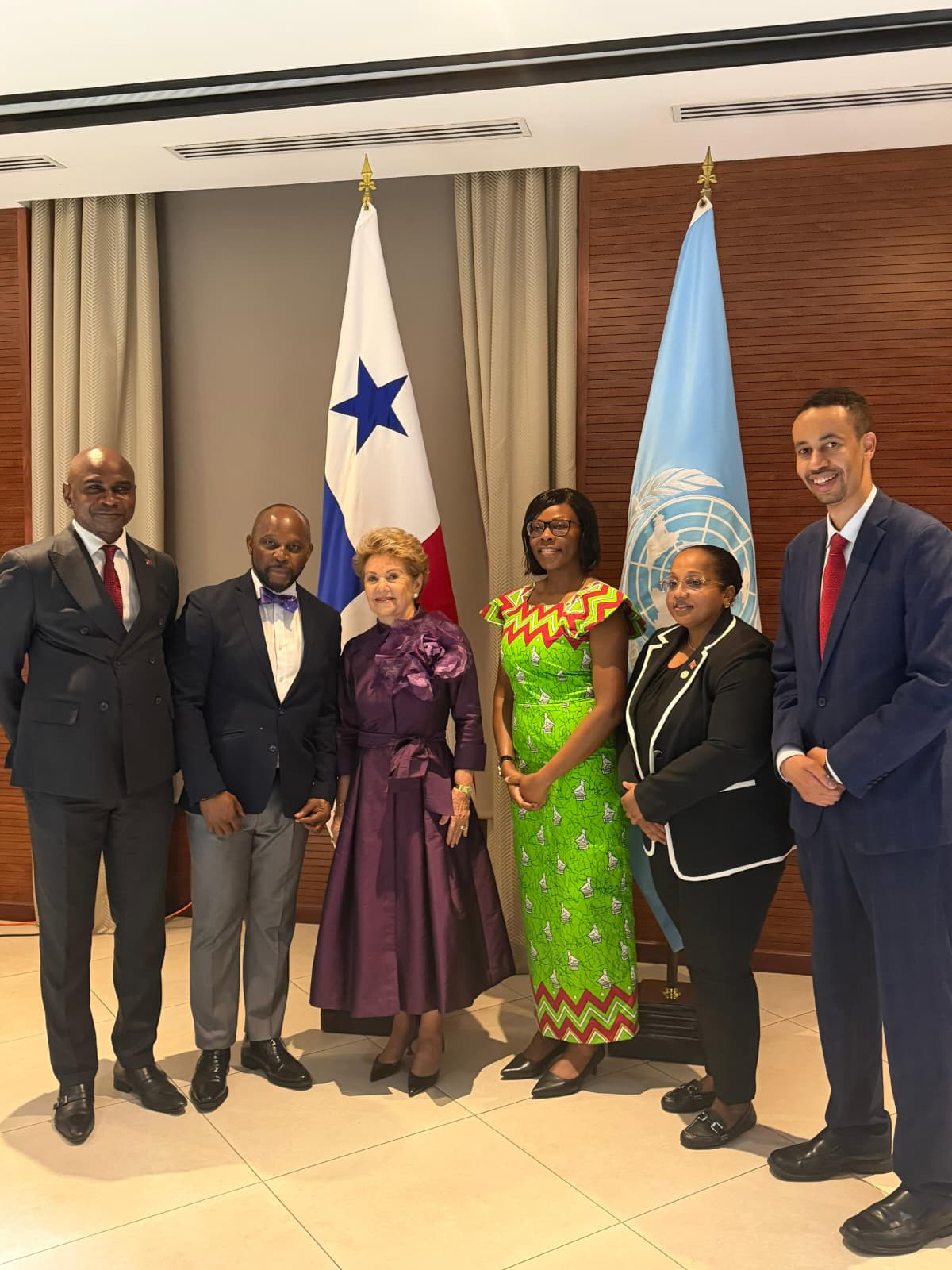
Panama, September 3, 2026: Liberia’s Political Coordinator to the United Nations Security Council, Cllr. Aloysius Jappah assumed an active role in the 9th E10 & I5 Annual Dialogue, hosted by the Republic of Panama in Panama City from 1 to 2 September 2026, delivering substantive interventions on preventive diplomacy, Council effectiveness, and the responsibilities that come with elected membership of the UN Security Council.
Since 2019, the Dialogue has convened annually to unite the ten elected members of the Council (the E10) with the five incoming à priorities, and bolster the Council’s ability to uphold international peace and security.
This year’s event was inaugurated and concluded by Panama’s Minister of Foreign Affairs, H.E. Javier Eduardo Martínez-Acha Vásquez, and honored at its closing by former President H.E. Mireya Moscoso.
The current E10 for 2026 includes Bahrain, Colombia, Democratic Republic of the Congo, Denmark, Greece, Latvia, Liberia, Pakistan, Panama, and Somalia.
Starting on 1 January 2027, the newly elected I5 will consist of Austria, Kyrgyzstan, Portugal, Trinidad and Tobago, and Zimbabwe, replacing Denmark, Greece, Pakistan, Panama, and Somalia as their mandates end on 31 December 2026.
Speaking during the session on “Preventive Diplomacy in Action,” moderated with the support of the Dag Hammarskjöld Foundation and its presenters Sigrid and Henrik, Cllr. Jappah anchored Liberia’s contribution in the letter of the United Nations Charter — Chapter VI (Articles 33–38) on the pacific settlement of disputes, Chapter VIII (Article 52) on regional arrangements, and Article 99 on the Secretary-General’s early-warning authority.
“The best Council intervention is a crisis that diplomacy prevents,” Cllr. Jappah affirmed, adding that “the Charter calls on us to extinguish the spark of conflict before it becomes a blaze. When we subscribed to this organization, we pledged to fulfill that obligation.”
Commenting on the operational challenge of moving from early warning to early action, the Political Coordinator emphasized what he called the prevention paradox — that when preventive diplomacy succeeds, the crisis does not occur, and success is therefore less visible than failure.
He cautioned that sovereignty concerns and geopolitical divisions frequently delay Council action, resulting in inaction until violence erupts.
“Early warning without early action,” he warned, “is only a forecast of failure.”
Drawing on Liberia’s own post-conflict experience, Cllr. Jappah stressed that peace agreements close a chapter but do not, by themselves, remove the grievances, institutional weaknesses, or local tensions that can reignite conflict.
He has requested a sustained deployment of good offices, mediation support, regional engagement, inclusive dialogue, confidence-building measures, early-warning capacity, and local peace infrastructures — with the consent and ownership of the country concerned.
“Peace agreements close a chapter; preventive diplomacy helps keep the next chapter from reopening the war,” he said, noting that sustained international, regional, and national engagement has been decisive in consolidating and protecting Liberia’s hard-won peace.
Contributing to Session V on reinvigorating the Council’s role in preventive diplomacy, Cllr. Jappah observed that the Dialogue offered members a valuable opportunity to internalize how a hasty drawdown of peacekeeping operations can leave a country vulnerable.
He spoke in response to interventions on how transnational organized crime, including transcontinental drug trafficking —can undermine governance in states just emerging from conflict, where institutions remain fragile.
On the question of how the E10 should engage the incoming Secretary-General, Cllr. Jappah urged elected members to first conduct an honest internal assessment and to invest deliberately in strengthening themselves as a caucus.
Cllr. Jappah proposed that the E10 build the discipline and coordination required to create what he described as a collective “veto,” together with the guardrails to use that leverage responsibly.
According to him, he has observed that over a two-year tenure, “before an elected member really gets to understand the Council and its dynamics, it is time to exit,” and he called on the E10 to systematically leverage the institutional memory of what he termed the “Farewell Five” — the five outgoing members concluding their terms each year — so that hard-earned experience is transferred rather than lost.
In addition, Cllr. Jappah urged the Council to frequently hold briefings and open meetings at which statements are made that contain useful antidotes but are followed by no concrete action.
Stating that the traditional E10 luncheons move beyond merely setting the agenda for the Secretary-General’s luncheon with Permanent Representatives, and instead become a forum in which elected members act with one voice on decisive issues before the Council.
Cllr. Jappah welcomed the newly elected members—Austria, Kyrgyzstan, Portugal, Trinidad and Tobago, and Zimbabwe—emphasizing the importance of continuity in preventive practice, disciplined coordination among members, and adherence to the Charter as the Council’s composition changes.
“Prevention is not an abstract ideal,” he concluded. “It is the disciplined practice of acting before choices disappear.”
The E10 & I5 Annual Dialogue, established in 2019, gathers incoming, serving, and outgoing UN Security Council members to enhance institutional memory and align objectives. Panama, holding a non-permanent seat, hosted the 9th edition during its term, ending on December 31, 2026.
