
By: Julius Konton
Liberian President Joseph Nyuma Boakai Sr. has called on Liberians living abroad to move beyond discussions about their country’s future and translate their skills, professional networks, investments and expertise into measurable contributions to Liberia’s national development.
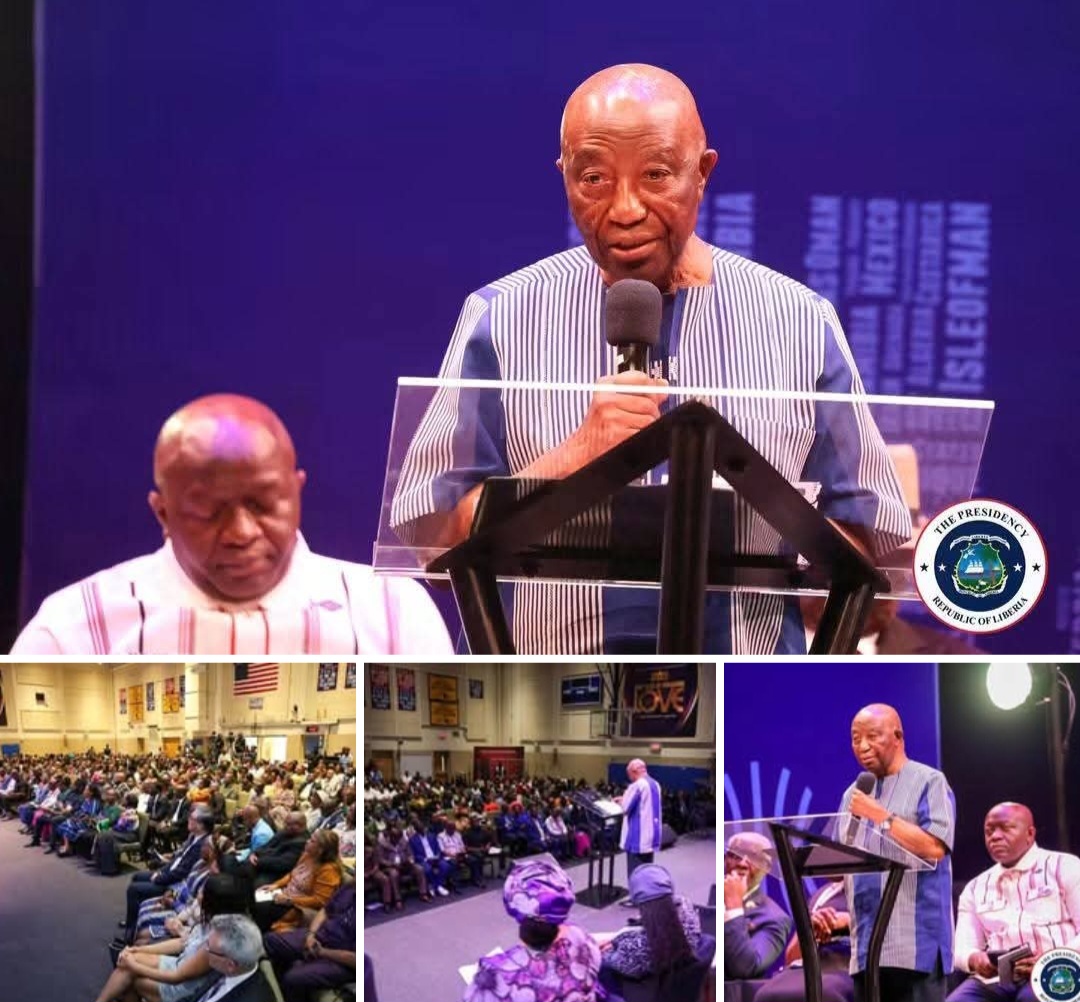
Addressing a Presidential Town Hall with Liberians from the Washington, D.C., Maryland and Virginia metropolitan area at Harvest Intercontinental Church in Olney, Maryland, President Boakai said the Liberian diaspora represents an important pool of human capital and resources that can complement efforts underway at home.
“The Diaspora is not outside Liberia’s development story; it is part of it,” President Boakai told participants.
The Town Hall formed part of the 2026 Liberia Diaspora Conference, held under the theme “From Dialogue to Delivery: Mobilizing the Global Liberian Diaspora for National Transformation.”
The conference brought together Liberian government officials, professionals, entrepreneurs, community leaders and members of the Liberian diaspora to discuss investment, skills transfer, innovation, education, healthcare, agriculture and infrastructure.
President Boakai said the Government wants diaspora engagement to evolve from periodic conferences and consultations into practical partnerships capable of producing identifiable economic and social outcomes.
He said Liberia’s embassies and consulates should play a stronger role in collecting accurate information about Liberians living abroad, including their professions, qualifications, areas of expertise, businesses and professional networks.
Such information, he said, could enable the government and private sector to connect Liberian doctors, engineers, educators, entrepreneurs, researchers, technology specialists and other professionals with specific opportunities in Liberia.
“Accurate diaspora data can help match doctors, engineers, educators, entrepreneurs, researchers and other professionals with opportunities to serve Liberia,” the President said.
The emphasis on diaspora data reflects a broader effort to better understand and mobilize Liberia’s global human capital.
During the 2026 conference, diaspora professionals and organizations also discussed efforts to create networks and registries that could help identify skills available to Liberia from abroad.
The 2026 conference followed the inaugural diaspora conference in 2025, which focused heavily on reconciliation, national healing, healthcare, education, investment and trade.
The second gathering shifted greater attention toward capital, innovation, professional skills and concrete development partnerships.
President Boakai used the Town Hall to outline what he described as progress since his administration took office in January 2024, while acknowledging that Liberia continues to face substantial challenges in employment, infrastructure, education, healthcare and the cost of living.
According to figures presented by the administration, Liberia’s economy expanded by 4.0 percent in 2024 and 5.1 percent in 2025. The government’s 2026 economic outlook said the 2025 expansion exceeded an earlier 4.6 percent forecast and was supported by growth in mining, agriculture, fisheries and services.
The same government assessment reported that mining expanded by 17 percent in 2025, while exports increased by 31.5 percent to approximately US$2.1 billion.
Inflation declined to about 4 percent by December 2025, compared with roughly 10 percent when the administration assumed office in 2024.
The administration has also highlighted a major increase in domestic revenue mobilization.
In September 2026, Liberia surpassed US$1 billion in domestic revenue collection during the first nine months of the year, according to the Executive Mansion.
Government figures show domestic revenue increasing from approximately US$612 million in 2023 to US$699 million in 2024 and US$848 million in 2025, before exceeding the US$1 billion mark in 2026.
President Boakai has framed the milestone not simply as an increase in government income but as a test of whether additional domestic resources can translate into better public services, infrastructure and economic opportunities.
“The priority now is to translate increased domestic resources into better public services, infrastructure, and economic opportunities for Liberians,” he said.
Among the projects highlighted was the 81-kilometer Gbarnga-Salayea Road, formally dedicated in July 2026.
The highway links Gbarnga in Bong County with Salayea in Lofa County and forms part of the broader Gbarnga-Voinjama-Mendikorma corridor.
The project had been under development for nearly a decade before completion.
The government also broke ground for the 50-kilometer Salayea-Konia Road and six-kilometer Zorzor-Yeala Road.
Financing agreements totaling US$73.8 million were signed with the OPEC Fund for International Development, the Arab Bank for Economic Development in Africa and the Kuwait Fund for Arab Economic Development.
The Saudi Fund for Development separately reported a US$20 million concessional loan toward the Gbarnga-Salayea road project.
Government officials say the road investments are intended to improve transportation, facilitate trade, connect agricultural communities to markets and expand access to schools, healthcare and other essential services.
Energy infrastructure has also been presented as a key component of the administration’s development strategy.
In July, the government energized the Buchanan Electricity Distribution Network, restoring grid electricity to parts of Buchanan, Grand Bassa County, after more than three decades without reliable public electricity.
Education and Human Capital
President Boakai also pointed to education as a central pillar of the Administration’s ARREST Agenda for Inclusive Development.
Among the major initiatives is the US$88.7 million Excellence in Learning in Liberia (EXCEL) Project, financed through a US$60 million concessional credit from the World Bank’s International Development Association and a US$28.7 million grant from the Global Partnership for Education.
The project targets foundational literacy and numeracy in public early childhood and primary schools across Liberia.
The President also cited efforts to expand advanced academic programs at the University of Liberia and improve public-school infrastructure, arguing that investment in human capital is essential to creating a workforce capable of sustaining economic growth.
Agriculture and Food Security
Agriculture remains another major component of the government’s development agenda.
Through the National Agriculture Development Plan and the “Liberians Feed Yourselves” initiative, the administration says it intends to strengthen domestic food production, improve market access and reduce Liberia’s dependence on imported food.
For a country whose economy remains heavily dependent on agriculture, mining and natural resources, the government’s strategy places food production alongside infrastructure, education and private-sector development as central components of national transformation.
President Boakai urged Liberians abroad to complement these efforts through investment, technology transfer, technical assistance and business partnerships.
Digital Government and Accountability
The President also highlighted digitalization and public-sector reform.
The government’s Electronic Government Procurement system is being expanded as part of efforts to improve transparency and competition in public procurement.
The administration says the system is intended to strengthen accountability and ensure greater value for public resources.
Boakai further cited asset-declaration compliance, audits conducted by the General Auditing Commission and continuing efforts to establish mechanisms for addressing war and economic crimes as part of his administration’s broader rule-of-law agenda.
The government has simultaneously maintained that the fight against illicit drugs is both a public-health and national-security issue, with its response involving prevention, treatment, law enforcement and accountability.
Liberia’s Expanding International Role
President Boakai also pointed to Liberia’s increased role in international diplomacy.
In June 2025, the United Nations General Assembly elected Liberia to a non-permanent seat on the UN Security Council for the 2026–2027 term, with Liberia receiving 181 of 187 votes cast. It was the country’s first election to the Council since its earlier service beginning in 1961.
The two-year mandate has given Liberia a platform to participate directly in discussions concerning international peace and security, conflicts, humanitarian crises and global governance.
For President Boakai, Liberia’s international engagement and domestic transformation are interconnected, particularly as the country seeks investment, partnerships and technical expertise from around the world.
Despite citing economic and infrastructure gains, President Boakai acknowledged that significant challenges remain.
Unemployment, infrastructure deficits, healthcare access, education quality, sanitation, public services and the cost of living continue to shape the daily experience of many Liberians.
The President said the ARREST Agenda for Inclusive Development provides the government’s framework for addressing these challenges, but stressed that implementation and measurable results should ultimately determine whether policies succeed.
The administration’s development framework focuses on Agriculture, Roads, Rule of Law, Education, Sanitation and Tourism, while also incorporating technology, innovation and broader economic opportunities.
Against this backdrop, Boakai called for a stronger partnership involving government, the private sector, civil society, development partners and Liberians abroad.
He urged Liberians in the diaspora to bring capital, expertise, professional networks, technology and practical ideas into Liberia while encouraging the government to create systems that make investment and professional engagement more predictable.
“The Diaspora has already demonstrated what this partnership can accomplish,” Boakai said in remarks reported during the conference. “You are carrying expertise and resources to communities across the country.”
The message comes as Liberian professionals abroad increasingly discuss not only sending financial support to relatives but also returning, investing, establishing businesses, strengthening healthcare and education, transferring technology and creating institutions that can operate sustainably in Liberia.
The President’s appeal reflects a broader question confronting Liberia: how to convert the country’s extensive global connections into sustained economic and institutional development.
For decades, Liberians living abroad have supported families and communities through remittances, charitable contributions, professional assistance and other forms of support.
The government’s current challenge is to build systems through which those individual contributions can increasingly become structured investments and long-term partnerships.
President Boakai therefore urged Liberians at home and abroad to focus less on political and social divisions and more on practical solutions capable of improving livelihoods.
“Let us keep the conversation focused on what works, what still needs attention, and how Liberians everywhere can contribute to national development,” he said.
The Town Hall concluded with an interactive question-and-answer session involving members of the Liberian community and a number of government ministers accompanying the President.
The exchange provided an opportunity for diaspora participants to raise concerns, propose solutions and engage directly with senior government officials on Liberia’s development priorities.
For an administration seeking to demonstrate that increased revenue, infrastructure investment and international partnerships can produce tangible improvements in the lives of citizens, the President’s message in Maryland was clear: Liberia’s transformation, he argued, requires participation not only from those living at home, but also from the millions of Liberians and people of Liberian heritage connected to the country around the world.
