
By: Julius Konton
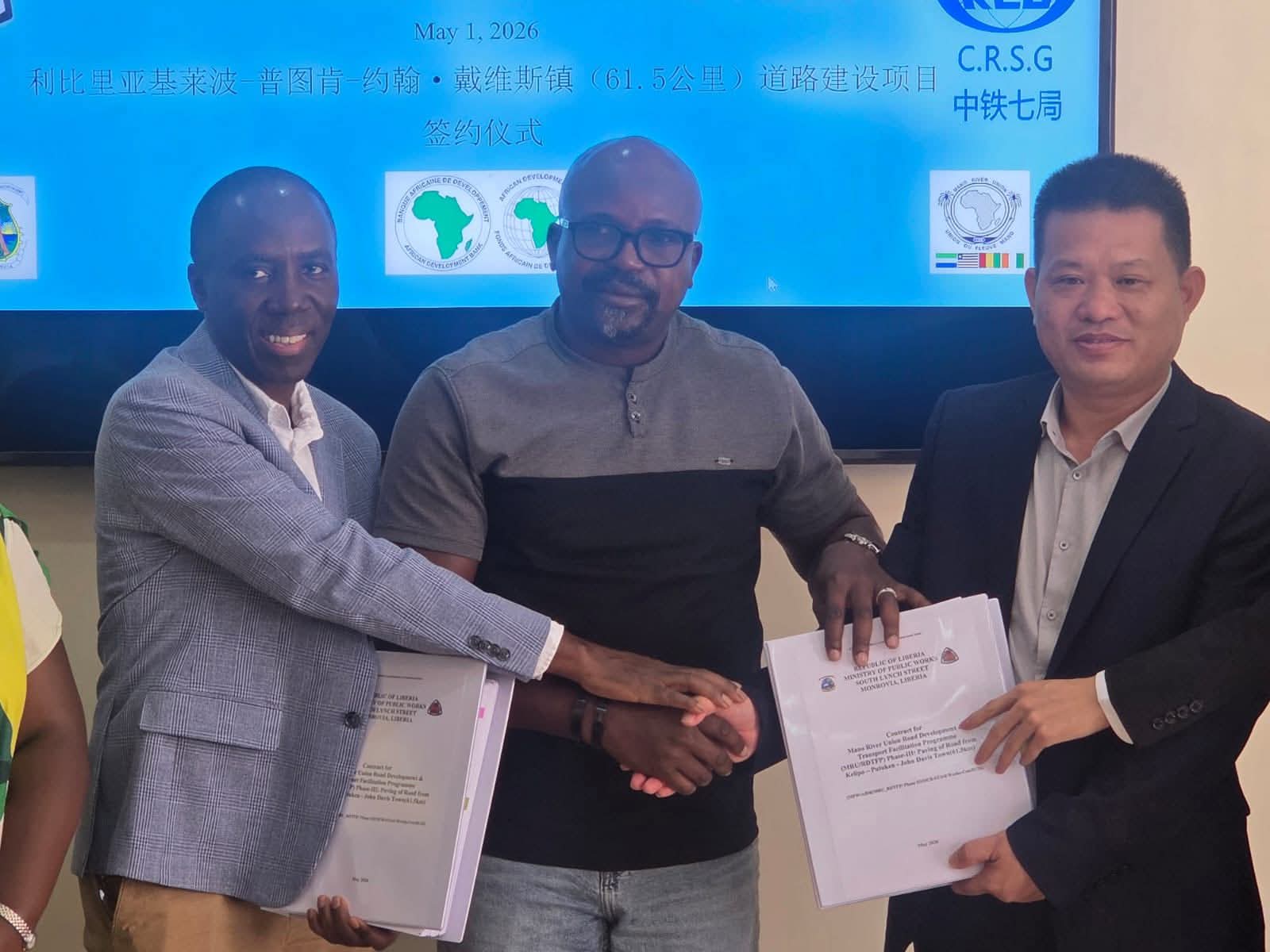
The Government of Liberia has secured a major infrastructure breakthrough with the signing of a US$48.99 million road construction contract, marking a significant step toward transforming connectivity in the country’s historically underserved southeast.
The agreement, signed through the Ministry of Public Works with China Railway Seventh Group (CRSG), activates Phase III of the Mano River Union Road Development and Transport Facilitation Programme (MRU/RDTFP) a flagship regional initiative designed to strengthen transport networks across West Africa.
A Strategic Corridor for Growth
At the heart of the project is the paving of a 61.5-kilometer corridor linking Kelipo, Putuken, and John Davis Town, spanning parts of River Gee and Grand Gedeh Counties.
Once completed by 2029, the road is expected to dramatically reduce travel time, improve access to markets, and unlock economic opportunities in one of Liberia’s least connected regions.
Public Works Minister Roland Layette Giddings described the initiative as a “cornerstone” of the government’s infrastructure agenda.
“This project represents a critical step in unlocking the economic potential of southeastern Liberia.
Strong collaboration with development partners is key to accelerating national construction efforts,” Giddings said during the signing ceremony.
AfDB Expands Its Footprint in Liberia
The African Development Bank (AfDB) Liberia’s leading infrastructure financier continues to scale up its portfolio in the country.
Over the past decade, the Bank has committed hundreds of millions of dollars to transport, energy, and agriculture projects aimed at rebuilding Liberia’s post-conflict economy.
AfDB Country Director Rees Mwasambili reaffirmed the institution’s long-term commitment, stressing the importance of timely delivery.
“We encourage all stakeholders to maintain momentum and ensure this project meets its 2029 completion target,” he noted.
The MRU program itself is a multi-country initiative involving Liberia, Sierra Leone, Guinea, and Côte d’Ivoire, with the goal of facilitating cross-border trade, regional integration, and economic resilience.
Economic Impact: Lower Costs, Faster Trade
According to Liberia’s Project Implementation Unit Coordinator, Rawling Kesselly, the benefits of the road will extend far beyond mobility.
The paved corridor is expected to:
Cut travel time by more than 50% in some areas during the rainy season
Reduce vehicle operating costs by up to 30%, based on regional transport benchmarks
Improve farm-to-market access, benefiting thousands of rural farmers
Lower the cost of essential goods, particularly in remote southeastern communities
Currently, many roads in the region become nearly impassable during heavy rains, isolating communities and disrupting trade flows.
A Region Long Left Behind
Liberia’s southeast has historically lagged in infrastructure development due to decades of civil conflict (1989–2003) and limited post-war investment. Nationally, only about 700–800 kilometers of Liberia’s estimated 10,000 km road network are paved, according to infrastructure sector reports.
This gap has contributed to:
High transportation costs
Limited access to healthcare and education
Weak integration into national and regional markets
The new corridor is expected to reverse some of these trends by serving as a modern economic lifeline.
Contractor Pledges Quality and Timely Delivery
Representing CRSG, Mr. Liu pledged adherence to international construction standards and timelines, emphasizing the importance of cooperation with local communities.
“We are committed to delivering a high-quality project on schedule.
Strong collaboration with the government and local residents will be essential for success,” he said.
China Railway Seventh Group is part of a broader wave of Chinese-backed infrastructure development across Africa, where Chinese firms have played a central role in delivering large-scale transport projects.
Regional Significance
Beyond national impact, the road forms part of a broader effort to strengthen the Mano River Union (MRU) a regional bloc established in 1973 to promote economic cooperation among member states.
Phase III of the MRU transport program aims to:
Enhance regional trade corridors
Improve border connectivity
Support the goals of the African Continental
Free Trade Area (AfCFTA)
By linking remote areas to major transit routes, Liberia is positioning itself to benefit more fully from intra-African trade, which currently accounts for less than 20% of total African exports.
Key Project Facts
Total Investment: US$48,995,608
Road Length: 61.5 kilometers
Location: River Gee & Grand Gedeh Counties
Funding Partner: African Development Bank (AfDB)
Contractor: China Railway Seventh Group (CRSG)
Completion Target: 2029
As Liberia continues its push to modernize infrastructure, projects like the Kelipo–Putuken–John Davis Town corridor highlight a broader national ambition: to bridge regional disparities, stimulate economic growth, and integrate more deeply into West Africa’s trade network.
If successfully delivered, the project could serve as a model for future public-private and multilateral partnerships bringing Liberia closer to its long-term development goals.
