
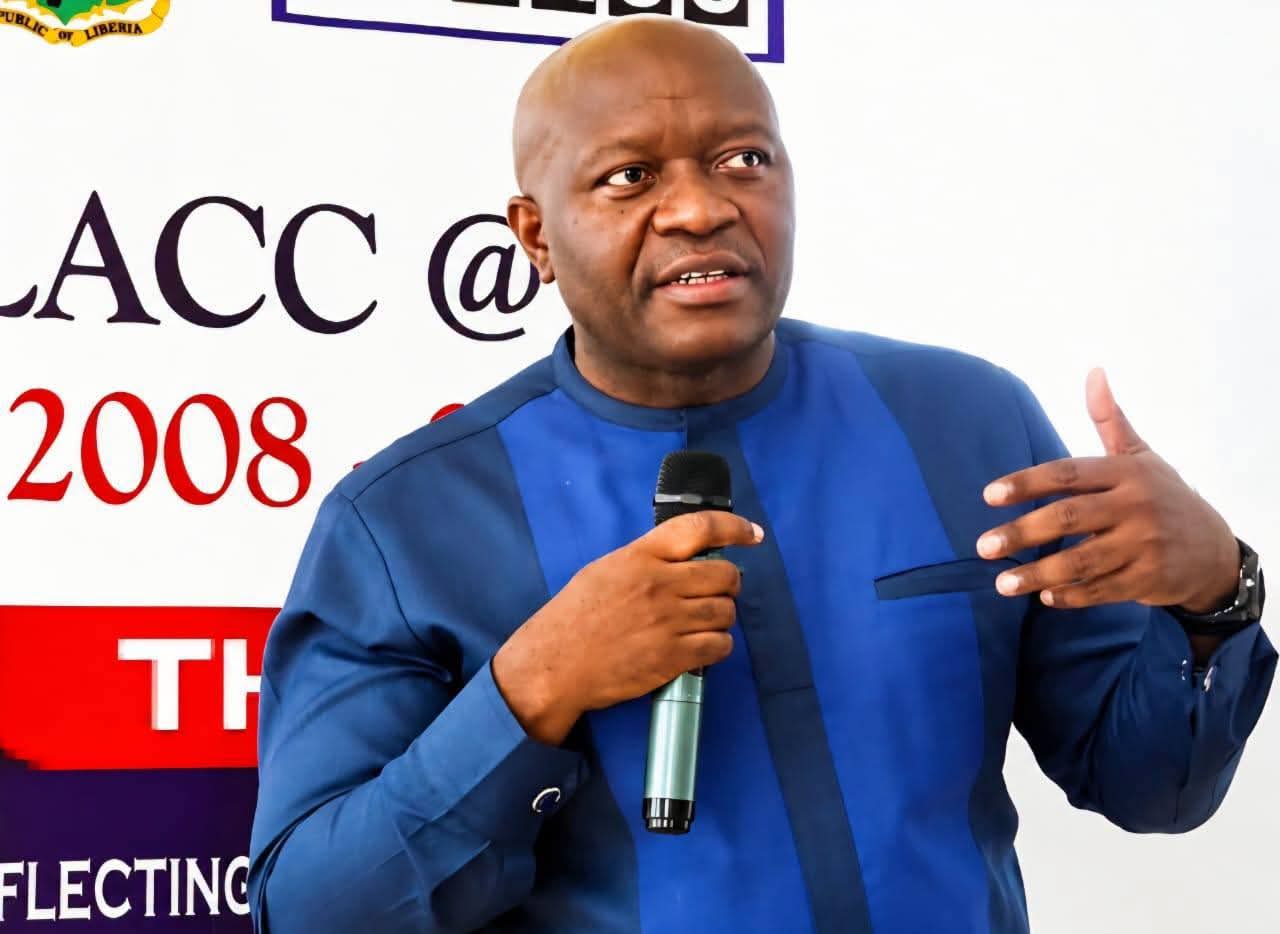
Finance Minister Sounds Alarm on Corruption, Calls for National Change in Values
By : Julius Konton
Finance and Development Planning Minister Augustine Kpehe Ngafuan has issued a forceful call for a broader national campaign against corruption, warning that Liberia’s fight against graft cannot be won by government institutions alone but must begin with individual conscience and societal values.
“Perfection belongs to God, but we should feel bad when we do bad,” Minister Ngafuan declared, arguing that anyone who feels comfortable, normal or indifferent after committing wrongdoing has become part of the problem.
Ngafuan made the remarks while delivering special remarks on behalf of the Government of Liberia at the 18th anniversary celebration of the Liberia Anti-Corruption Commission (LACC), where he praised the Commission for remaining resilient while acknowledging that the corruption it confronts has become increasingly complex.
He said Liberia could not afford to retreat from the fight against corruption, stressing the need to adequately resource the LACC and other integrity institutions so they can prevent corruption, investigate allegations and ensure that those found responsible are held accountable.
“We can’t flee from the fight. We have to resource the LACC and other anti-graft entities to prevent corruption, but when corruption takes place, to ensure that those culpable are brought to book,” Ngafuan said.
The Finance Minister placed the management of public resources at the center of his argument, insisting that government officials are custodians not owners of the nation’s wealth.
According to Ngafuan, Liberia should be viewed as an enterprise in which every citizen is a shareholder, while public officials are entrusted with protecting the interests of those shareholders.
“Every citizen is a shareholder, and public officials have the responsibility to protect those shares,” he said.
He identified the LACC, General Auditing Commission (GAC), Public Procurement and Concessions Commission (PPCC) and the Judiciary as critical pillars of Liberia’s national integrity architecture, stressing that their efforts must be coordinated rather than fragmented.
The Minister warned that corruption has consequences far beyond financial losses to the state.
He argued that when public money is stolen, diverted or misused, the ultimate victims are ordinary Liberians particularly children who may lose access to education, healthcare and other essential services.
“Corruption has a face,” he emphasized, noting that every dollar lost through corruption represents an opportunity that could have been used to improve the lives of citizens.
The scale of the challenge is reflected in the LACC’s own latest published figures.
According to the Commission’s FY2025 Annual Report, investigators handled 44 cases during the year and completed investigations into 27 cases, against an annual target of 16.
The concluded investigations involved potential public-resource exposure of approximately US$19.71 million and LRD$523.37 million.
Liberia Anti-Corruption Commission
The Commission also reported securing 12 indictments, three convictions and one acquittal during 2025.
Liberia Anti-Corruption Commission
Among the major cases cited in the report was the Planned Parenthood Association of Liberia matter, involving approximately US$148,965, in which defendants were convicted on multiple corruption-related charges.
The Commission also secured convictions in the LISGIS case, with two defendants sentenced to five years in prison and ordered to restitute a combined US$97,000.
Liberia Anti-Corruption Commission
In another case involving Bong Mines Hospital, approximately US$43,000 was recovered through restitution following a plea-bargain arrangement.
These figures, Ngafuan’s remarks suggest, demonstrate why Liberia needs stronger institutions, better financing and faster judicial processes.
Liberia’s position in international corruption rankings also underscores the difficulty confronting the country’s anti-graft institutions.
Transparency International’s 2025 Corruption Perceptions Index gave Liberia a score of 28 out of 100, placing the country 136th among 182 countries.
A score closer to 100 indicates stronger perceived public-sector integrity, while a lower score indicates greater perceived corruption.
The latest index places Liberia alongside countries such as Mali, Iraq and Bolivia, illustrating the continued need for stronger preventive and enforcement mechanisms.
For Ngafuan, however, the answer cannot rest solely with government agencies.
The Minister challenged the popular tendency to describe corruption simply as a government problem.
He argued that governments change, ministers change and public officials come and go but corruption can remain because the values that shape public officials originate within society.
“People normally say the government is corrupt,” Ngafuan observed. “Government comes and goes. It means corruption is constant in society.”
He therefore called on families, schools, religious institutions, civil society organizations and communities to take greater responsibility for cultivating ethical values.
Pastors, imams, teachers, parents and community leaders, he suggested, all have roles to play in shaping citizens who reject dishonesty before they enter public service.
The Minister particularly criticized practices within the education system where students may obtain academic honors through dishonest means.
He questioned what kind of society is being created when students are rewarded for achievements they did not legitimately earn.
“You want unmerited merit you bought that award,” he said, warning that such practices teach young people that dishonesty can produce rewards.
His message was clear: anti-corruption education must begin long before an individual becomes a public official.
Ngafuan also challenged the mindset that corruption becomes acceptable when everyone appears to be doing it.
He said the belief that “once it is for everybody, it is for nobody” creates an environment in which individuals feel they can commit wrongdoing without consequences.
He argued that the first prosecution should take place within an individual’s own conscience.
The LACC, he maintained, can investigate, prosecute and enforce the law, but institutions alone cannot transform Liberia unless citizens develop a personal intolerance for corruption.
Ngafuan acknowledged that Liberia’s anti-graft institutions have improved compared with previous years, particularly in terms of compensation and institutional capacity, but said much more remains to be done.
He assured the LACC and other integrity institutions that the Ministry of Finance and Development Planning is working to address compensation and broader resource constraints across government.
He compared under-resourced anti-corruption institutions to soldiers being sent into battle without weapons.
“We must protect you to be less vulnerable; otherwise, it is like sending soldiers to the battlefront without arms,” he said.
The Minister said the government is also mobilizing additional resources to strengthen institutions whose work is central to protecting public funds.
One of the strongest points in Ngafuan’s address was his support for the establishment of a specialized National Anti-Corruption Court, an issue that has increasingly become central to Liberia’s governance reform agenda.
He said he was encouraged that the LACC was advocating for a dedicated court to handle corruption cases, describing judicial delays as one of the major obstacles to effective enforcement.
“The docket is not moving; it is stuck like traffic,” Ngafuan said, arguing that the public often blames anti-corruption investigators when cases fail to move quickly without understanding the structural constraints within the justice system.
Liberia has already taken significant steps toward establishing such a court.
In May 2026, President Joseph Nyuma Boakai submitted legislation to the Legislature seeking the creation of a National Anti-Corruption Court, alongside legislation establishing a War and Economic Crimes Court.
The LACC’s FY2025 report said the proposed specialized court is intended to fast-track corruption cases and ease congestion in Criminal Court “C.”
The Commission indicated that the proposed court could be designated Criminal Court “F.”
The initiative was also the subject of a national policy dialogue in July 2026 focused specifically on strengthening transparency and accountability through the establishment of the specialized court.
Established in 2008, the LACC emerged from Liberia’s broader post-war governance reforms and efforts to create institutions capable of confronting corruption and strengthening accountability.
Over the years, the Commission’s mandate has expanded significantly.
Under the amended LACC Act of 2022, the Commission gained direct prosecutorial authority, allowing it to take corruption cases to court without depending entirely on the Ministry of Justice.
The law also strengthened the national asset-declaration framework and expanded the Commission’s role in receiving declarations from officials across the three branches of government.
The Commission has also strengthened whistleblower and witness-protection mechanisms, while expanding prevention and public-education activities.
During 2025 alone, the LACC reported that 2,430 public officials, 90.1 percent of a baseline of 2,812 declared their assets, while 276 officials did not comply.
The Commission also recorded 2,360 National Integrity Pledges and completed 55 asset-verification exercises involving current and former government officials.
The figures point to both progress and persistent compliance gaps.
Ngafuan’s argument ultimately went beyond prosecution.
He urged Liberia to build a culture in which corruption is rejected before it becomes a criminal case.
That means strengthening schools, families, religious institutions, civil society and public institutions while ensuring that government agencies responsible for fighting corruption have the financial, human and logistical resources necessary to perform their duties.
The LACC’s own 2025 report reflects this broader approach.
The Commission expanded prevention activities across 12 counties, trained 70 Social Accountability Volunteers, trained 30 journalists representing all 15 counties in investigative journalism and installed six whistleblower boxes at selected institutions.
Ngafuan encouraged the Commission to remain firm but fair, emphasizing that accountability must be pursued with professionalism and respect for due process.
He congratulated the LACC on its 18 years of service and urged the Commission, government institutions and citizens to work collectively toward a Liberia where public resources are protected and corruption is no longer tolerated as a normal feature of society.
“We will do our part, and you too have to play your part,” Ngafuan said, stressing that the ultimate objective is to build stronger institutions capable of protecting Liberia’s public resources.
For Liberia, the message from the LACC anniversary was therefore broader than the prosecution of individual corruption cases: the fight against graft is ultimately a battle over national values, institutional strength, public resources and the country’s future.
