
By: Julius Konton
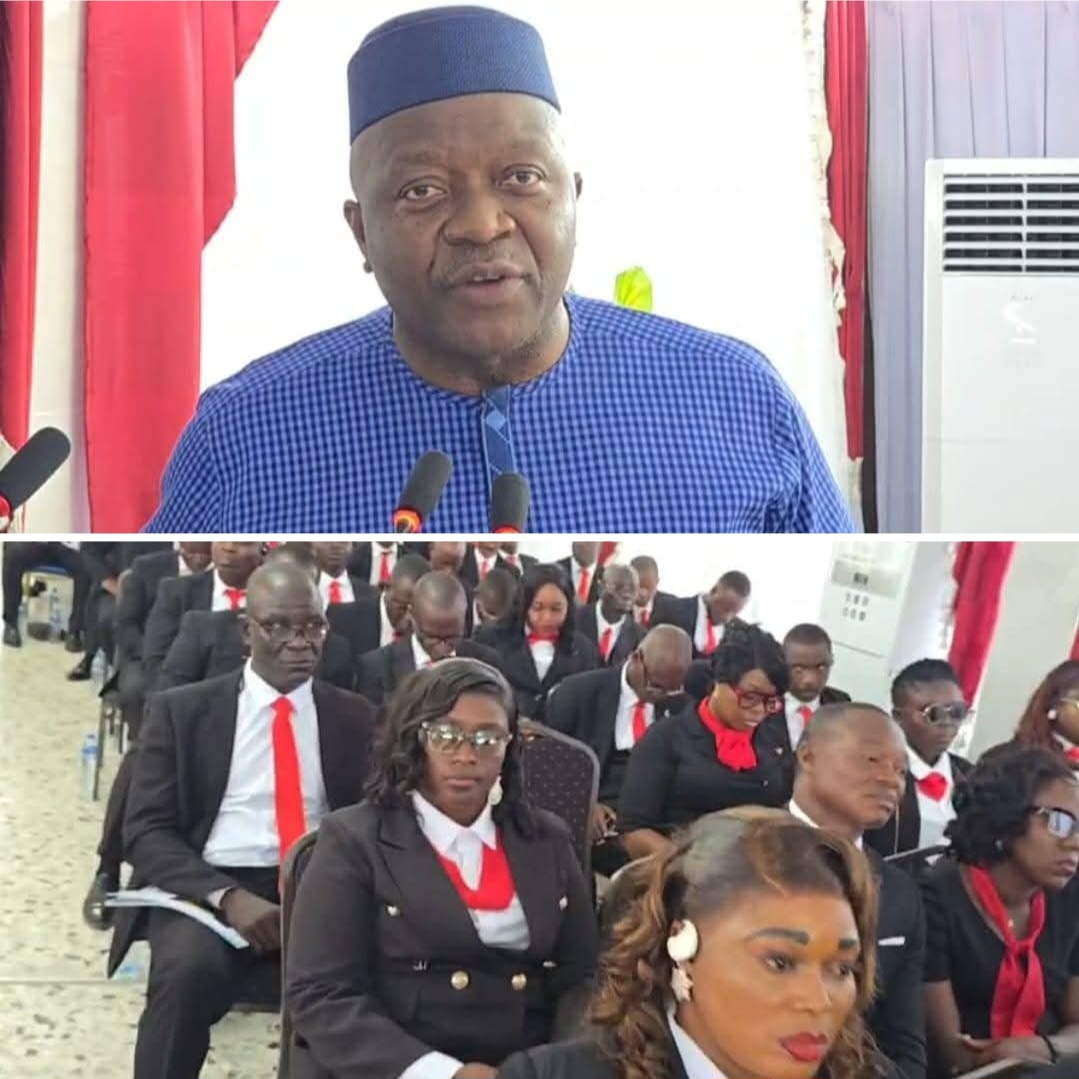
Liberia’s drive to strengthen the rule of law and improve investor confidence reached another milestone as Finance and Development Planning Minister Augustine Kpehe Ngafuan delivered the keynote address at the graduation ceremony of the Professional Magistrate Training Program at the James A. A. Pierre Judicial Institute inside the Temple of Justice.
The ceremony marked the graduation of 64 professionally trained magistrates drawn from Liberia’s 15 counties, concluding a rigorous judicial training program that has become the country’s flagship initiative for strengthening lower courts and expanding access to justice.
Addressing graduates, members of the Supreme Court Bench, diplomats, development partners and senior government officials, Minister Ngafuan described the occasion as “historic,” emphasizing that President Joseph Nyuma Boakai’s administration remains firmly committed to rebuilding Liberia on the unshakable foundation of the rule of law.
“We can design the most brilliant economic policies and attract the world’s leading investors, but if the rule of law is weak, property rights are insecure, and justice is delayed or compromised, our entire economic foundation rests on sinking sand,” Ngafuan declared.
The Finance Minister stressed that a credible judiciary is indispensable for economic growth, private sector investment and sustainable national development.
He noted that domestic and foreign investors alike require confidence that contracts will be enforced, disputes resolved fairly and property rights protected before committing capital.
According to international institutions, countries with stronger judicial systems generally attract higher levels of foreign direct investment (FDI), while efficient courts significantly improve business competitiveness and economic resilience.
Ngafuan described Liberia’s judiciary as “the final anchor of public trust,” adding that justice remains one of the central pillars of the ARREST Agenda for Inclusive Development (AAID) being implemented by the Boakai’s administration.
The Finance Minister praised the Professional Magistrate Training Program, which has operated continuously for 16 years, calling it Liberia’s premier institution for judicial capacity development.
He explained that the program was established to address longstanding shortages of qualified magistrates across rural Liberia, where many communities have historically struggled to access timely justice.
The newly graduated magistrates are expected to serve in magisterial courts nationwide, particularly in underserved counties where judicial personnel remain limited.
According to Ngafuan, the initiative systematically addresses one of Liberia’s longstanding institutional weaknesses by replacing undertrained personnel with professionally qualified judicial officers capable of administering justice fairly and efficiently.
One of the ceremony’s defining moments came when the Finance Minister highlighted Liberia’s growing financial ownership of judicial reform.
For more than a decade, judicial training programs relied heavily on international partners, including the German Government, GTZ (now GIZ), the Government of Sweden through the UNDP Joint Trust Fund, and the United States Government through USAID.
Today, however, more than 90 percent of the Professional Magistrate Training Program is financed directly through the Government of Liberia’s judiciary budget, describing the transition as a landmark achievement.
“This demonstrates that Liberia is prepared to finance its own institutional development, secure its own peace, and invest directly in the capacity of its public servants.”
Highlighting the Boakai administration’s commitment to judicial independence, Ngafuan revealed that government funding for the Judiciary has risen from US$18.5 million in 2023 to US$33.3 million in the 2026 National Budget, an increase of approximately 80 percent over three years.
The expanded budget supports:
Construction and rehabilitation of courts nationwide;
Improved operations of magisterial and circuit courts;
Digitization of court records and proceedings;
Provision of logistics for judges, magistrates and public defenders;
Expansion of access to justice in rural communities.
The Minister said these investments are designed to reduce case backlogs, accelerate adjudication, modernize court infrastructure and restore public confidence in Liberia’s justice system.
Ngafuan also highlighted reforms aimed at improving remuneration for judicial personnel.
He disclosed that under the government’s multi-year public sector salary reform program, remuneration for Supreme Court Justices and subordinate court judges has been restored to pre-harmonization levels, while magistrates and other judicial workers have also received salary adjustments.
He acknowledged, however, that additional work remains.
“Our destination has not yet been reached,” he said, noting that sustained domestic revenue growth and prudent public expenditure management will be essential to financing future salary improvements.
Speaking directly to the graduates, Ngafuan urged them to place integrity above professional brilliance.
“A sharp lawyer or magistrate with integrity is a blessing to society,” he said. “A sharp lawyer without integrity becomes a menace.”
He warned the new magistrates to resist pressure from politicians, business interests, relatives and influential individuals seeking to manipulate judicial decisions.
“The authority you carry is not your personal property,” he cautioned. “It belongs to the Republic of Liberia.”
He reminded them that their real test begins after graduation when they assume responsibility for administering justice in communities across the country.
The Finance Ministry boss emphasized that judicial leadership begins with personal discipline.
He encouraged magistrates to respect the Constitution, observe ethical standards and remain humble despite the authority entrusted to them.
“A magistrate may command a courtroom,” he said, “but every magistrate remains a servant of the Constitution, the laws of Liberia and the ethical standards of the Judiciary.”
He further urged them to listen more than they speak, analyze evidence rather than rumors, and exercise judicial authority with restraint and impartiality.
Ngafuan commended Chief Justice and the Judiciary for developing a comprehensive strategic plan aimed at creating a fair, independent and accountable judicial system.
He reaffirmed the Ministry of Finance and Development Planning’s commitment to mobilizing both domestic and international resources to support implementation of the Judiciary’s strategic priorities, including expanding nationwide access to justice, reducing delays, strengthening judicial independence, modernizing court operations and deepening public trust.
Concluding his address, the Finance Minister acknowledged that while significant progress has been made during the Boakai administration’s first two-and-a-half years, additional reforms remain necessary.
“There are still miles to travel,” he said. “But the Judiciary President Boakai inherited in January 2024 is not the Judiciary we see today.”
He maintained that measurable improvements are already evident across Liberia’s justice sector and expressed confidence that continued investment, integrity and institutional reform would produce an even stronger judiciary in the years ahead.
As Liberia continues implementing the ARREST Agenda for Inclusive Development, government officials say strengthening judicial independence remains essential not only for protecting constitutional democracy but also for fostering economic growth, improving investor confidence and consolidating lasting peace nearly two decades after the end of the country’s civil conflict.
