
By: Julius Konton
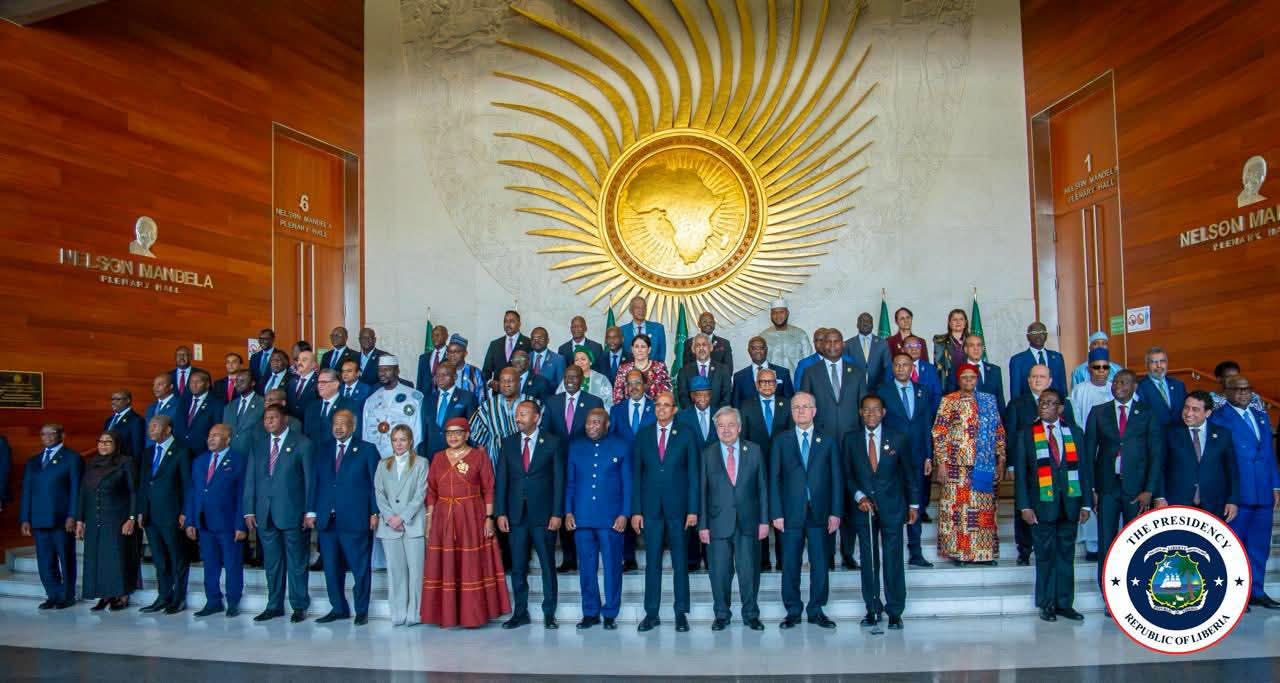
The 39th Ordinary Session of the Assembly of Heads of State and Government of the African Union officially opened Saturday in Addis Ababa, bringing together Africa’s political leadership at a critical juncture for the continent’s development, security, and integration.
Among the leaders actively participating is Joseph Nyuma Boakai, who is leading a high-level Liberian delegation to the Summit, signaling Liberia’s renewed commitment to continental diplomacy and multilateral cooperation following years of post-conflict recovery and domestic reform.
The Assembly convened with a ceremonial opening session, followed by closed-door deliberations involving more than 50 African Heads of State and Government, senior policymakers, and representatives of continental institutions.
The African Union, which comprises 55 Member States and represents over 1.4 billion people, remains Africa’s foremost platform for collective decision-making on shared challenges.
Key Continental Priorities on the Agenda
Over the course of the two-day Assembly, leaders are expected to deliberate on a wide spectrum of strategic priorities shaping Africa’s future.
These include peace and security in conflict-affected regions, democratic governance, climate resilience, public health systems, water and sanitation, energy access, food security, and regional economic integration.
Central to the discussions is the implementation of Agenda 2063, the AU’s long-term development blueprint aimed at transforming Africa into a globally competitive, industrialized, and politically cohesive continent.
According to AU data, Agenda 2063 aligns continental goals with economic growth targets exceeding 7 percent annually and aims to lift hundreds of millions of Africans out of poverty over the next three decades.
Liberia’s Strategic Engagement
On the eve of the Summit’s official opening, President Boakai devoted extensive time to reviewing policy briefs and thematic documents related to the Assembly’s agenda.
His engagement reflects Liberia’s intention to position itself as an active contributor to continental policy conversations, particularly on development financing, peacebuilding, and governance reform.
Liberia’s presence at the Summit comes amid a broader effort by the Boakai administration to re-energize the country’s international partnerships and strengthen its diplomatic footprint across Africa.
Historically, Liberia has played a foundational role in Pan-African diplomacy, having been a signatory to the 1963 Charter of the Organization of African Unity, the AU’s predecessor.
High-Level Bilateral Meetings
Ahead of the Assembly, President Boakai held separate bilateral discussions with Arab Bank for Economic Development in Africa President Abdullah Almusaibeeh, focusing on development financing, infrastructure investment, and support for Liberia’s economic recovery agenda.
BADEA has financed projects worth over US$12 billion across Africa since its establishment in 1975, making it a key partner for emerging economies.
The Liberian leader also met with International Criminal Court Acting Prosecutor Mame Mandiaye Niang, where discussions centered on international justice, accountability, and Liberia’s continued cooperation with global legal institutions.
Delegation-Wide Engagement
Throughout Friday, senior members of the Liberian delegation participated in parallel thematic sessions and ministerial-level consultations in preparation for the Assembly.
These engagements addressed sector-specific issues ranging from health security and energy transition to regional trade and infrastructure connectivity.
A Renewed Continental Posture
With Summit deliberations continuing behind closed doors, President Boakai’s participation underscores Liberia’s renewed resolve to engage constructively within Africa’s multilateral architecture.
Observers note that Liberia’s re-engagement comes at a time when African unity and coordinated action are increasingly seen as essential to addressing global economic uncertainty, geopolitical shifts, and climate-related challenges.
As Africa charts its collective future in Addis Ababa, Liberia’s voice once constrained by years of instability is again emerging as an active contributor to shared continental solutions and regional solidarity.
