
By: Julius Konton
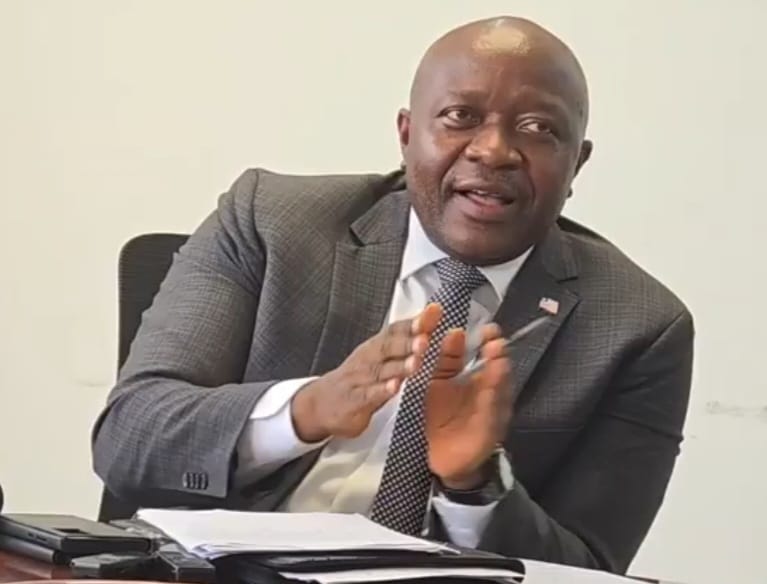
Liberia’s Minister of Finance and Development Planning, Augustine Kpehe Ngafuan, has mounted a robust defense of the government’s economic record following President Joseph Nyuma Boakai’s third State of the Nation Address, insisting that infrastructure-led growth not political rhetoric is already reshaping the country’s economic fundamentals.
Speaking to journalists in Monrovia, Ngafuan acknowledged mounting criticism from opposition figures and economic skeptics but framed the debate as a normal feature of democratic governance.
“The government will continue to do its work, and the critics will continue to do their work which is to criticize,” Ngafuan said.
“Projects are implemented for the Liberian people, not for the ownership of any particular government”, he maintained.
Roads, Not Politics, at the Center of Growth Strategy
At the heart of the government’s economic argument is road connectivity, which Ngafuan described as central to Liberia’s “bread-and-butter” economy linking farmers to markets, reducing transportation costs, and easing inflationary pressure.
He criticized what he called the personalization of public infrastructure projects, particularly claims of “ownership” over roads.
“If someone had already done the road, we wouldn’t be constrained to do it again,” he said, emphasizing continuity of development over political credit-taking.
Liberia’s road network remains among the least developed in West Africa, with fewer than 20 percent of roads paved nationwide, a factor long cited as a constraint to private investment and agricultural commercialization.
Electricity Access: From 30% to 39%, With 75% Target by 2029
Ngafuan highlighted energy access as the single most binding constraint to growth.
When the Boakai administration assumed office, national electricity access stood at just under 30 percent, according to government and development partner data.
That figure has now risen to approximately 39 percent, driven largely by increased generation from the Mount Coffee Hydropower Plant and grid expansion in urban and peri-urban areas.
“We came and met electricity access at around 30 percent. Today it is about 39 percent,” Ngafuan said. “Our ambition under the new MCC Compact between now and 2029 is to push that figure beyond 75 percent.”
Liberia has recently been declared eligible for a second Millennium Challenge Corporation (MCC) Compact, with energy once again selected as the priority sector, a signal of international confidence in the government’s reform agenda.
Lower Inflation Linked to Domestic Agriculture
Addressing skepticism around inflation figures, Ngafuan argued that increased domestic agricultural production has helped stabilize prices.
“One of the things that impacted inflation was the reduction in prices of domestically produced agricultural goods,” he explained.
“Some of these goods were previously imported, but now more products are coming from Liberian farmers.”
According to Central Bank estimates, food inflation traditionally Liberia’s most volatile component has eased as local rice, cassava, vegetables, and palm oil supply improved in key counties.
Jobs Debate: Government Stands by 70,000 Figure
Ngafuan also weighed in on the controversial claim of 70,000 jobs created within two years, a figure that has drawn skepticism from opposition leaders and some economists.
While conceding weaknesses in Liberia’s job-tracking systems, he rejected claims that the number is implausible.
“To doubt 70,000 short-term jobs in two years in this country, we are better than that,” he said.
He acknowledged that data systems at the Ministry of Labor, LISGIS, and related institutions remain underdeveloped but said investments are underway to create more robust tracking mechanisms.
Notably, Ngafuan aligned himself with comments by former Finance Minister Samuel Tweah, who previously argued that job creation figures should focus not only on quantity but also on capacity and sustainability.
“I agree with my predecessor that we must do better in tracking jobs and we are working on it,” Ngafuan admitted.
Cutting Costs to Drive Hiring
The Finance Minister explained that government reforms aimed at reducing operating costs particularly electricity expenses are already easing pressure on businesses.
“When expenditure reduces, profit increases.
When profit increases, businesses expand.
And expansion leads to hiring,” he said, linking macroeconomic reform directly to household incomes.
Long-Term Vision Amid Short-Term Criticism
Ngafuan urged journalists and analysts to distinguish between short-term political debates and long-term structural reform.
“There will always be arguments about short-term versus long-term outcomes,” he said. “But if we don’t address the structural constraints to growth power, roads, everything else will remain superficial.”
As Liberia continues to navigate fiscal pressure, rising public expectations, and intense political scrutiny, the government’s bet on infrastructure-first economics is increasingly becoming the defining test of the Boakai administration’s credibility both at home and abroad.
